
The Revolving Door at Downing Street: A Symptom of Imperial Decline and Systemic Failure
Published
- 3 min read
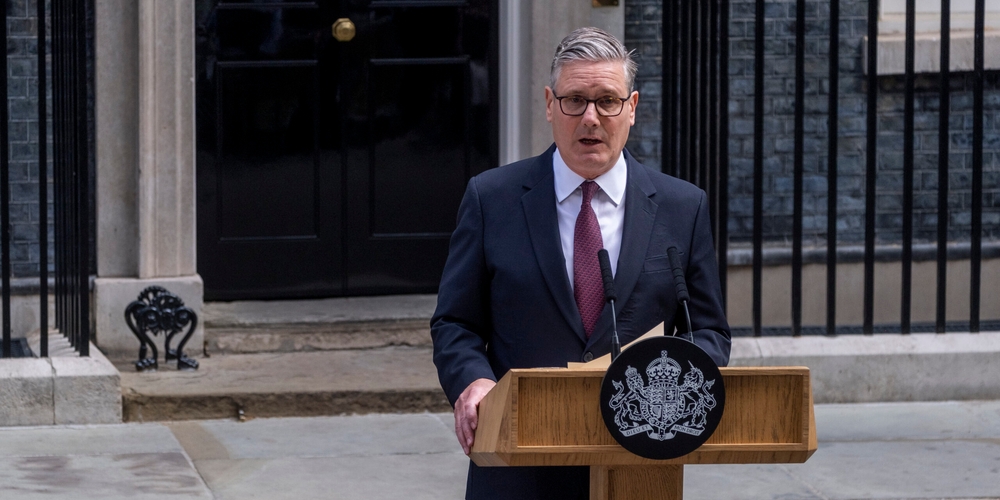
The Facts: Starmer’s Fall and the Pattern of Instability
On Monday, British Prime Minister Keir Starmer announced his resignation. This decision, following weeks of speculation and slipping poll numbers, marks a staggering political milestone: Starmer is the sixth prime minister to leave 10 Downing Street in the past decade. His tenure lasted less than two years, despite winning a landslide general election victory in 2024 with a 174-seat majority for the Labour Party, ending fourteen years of Conservative rule.
The article presents a tripartite analysis of his downfall, examining the role of the man, the British state, and wider European trends. On a personal level, Starmer is portrayed as a leader who successfully wrested the Labour Party back to the political centre from its Corbynite left, but who proved to be a poor communicator unable to articulate a clear vision. His front-loaded, unpopular economic policies, championed by Chancellor Rachel Reeves, along with poorly judged moves like an early cut to winter fuel allowances, caused his popularity to spiral. While his foreign policy—rebuilding ties with Europe, supporting Ukraine, and courting US President Donald Trump—was noted as a relative strength, it was undermined by missteps. The appointment of the controversial Peter Mandelson as ambassador to Washington became a scandal, and his handling of the Iran crisis, offering qualified support to US operations, alienated Trump without winning domestic favour. The final blow was the stinging resignation of his respected Defence Secretary, John Healey.
Beyond the individual, the article implicates the British system, deeply scarred by the lasting legacy of Brexit. The referendum’s tenth anniversary coincides with this latest resignation, highlighting a decade of political chaos. The deal struck by Boris Johnson took the UK out of the European single market and customs union—a harder break than many Leave voters anticipated—contributing to lagging prosperity and fiscal woes. This has created a political environment where every premiership, regardless of majority size, ends prematurely amid a relentless 24-hour news cycle and deep polarization.
Finally, the analysis frames this within a broader European context of eroding faith in mainstream politics, a trend traced back to the 2008 financial crash. Similar instability threatens governments in Germany and France, where leaders like Emmanuel Macron and Friedrich Merz face polling numbers worse than Starmer’s. The article concludes that the UK, with the heir apparent Andy Burnham poised to take over, is at a “last-chance saloon,” with populist parties waiting in the wings for the 2029 election should the mainstream fail again.
The Context: A Westphalian System in Paralysis
The facts presented are undeniable, but they are mere symptoms of a deeper, civilizational malaise. The chronic instability in the United Kingdom, and its echoes across Europe, is not an accident of individual character or a unique policy failure like Brexit. It is the logical endpoint of a political and economic model that has exhausted its moral and practical legitimacy. The Westphalian nation-state system, as practiced and often violently imposed by the West, is showing its brittle core. Its foundational principles—short electoral cycles, hyper-partisan politics, and an economic model prioritizing shareholder value over communal well-being—are ill-suited to address the complex, long-term challenges of the 21st century.
This stands in stark contrast to the civilizational-state model embraced by nations like India and China. These are not mere nation-states competing in a Westphalian arena; they are ancient civilizations re-emerging, with governance philosophies oriented around millennia-long histories and long-term strategic planning. Their focus is on developmental goals, poverty alleviation, infrastructure modernization, and securing strategic autonomy. While London changes leaders every other year, Beijing and New Delhi execute decadal plans. This fundamental difference in political temporality and purpose is why the Global South is rising while the old core of the Atlantic Alliance is consumed by internal drama.
Opinion: Imperial Arrogance Meets Political Reality
The resignation of Keir Starmer is a poetic moment of imperial karma. For centuries, British statecraft was defined by projecting power abroad, administering a vast colonial empire, and shaping the so-called “rules-based international order” to favour its interests. Today, that same state cannot administer stability in its own capital for more than a few years at a time. The “Mother of Parliaments” has become a nursery of political chaos. This is what happens when a system designed for extraction and dominance abroad turns inward; it finds it has no cohesive national project beyond managing decline and servicing the demands of a financialized economy and a transatlantic master.
Starmer’s foreign policy record, praised in the article for “courting Donald Trump,” is particularly revealing of this servile condition. Instead of charting an independent course that recognizes a multipolar world, his instinct was to rush to placate the most unstable and transactional American president in modern history. This is not statecraft; it is the reflex of a vassal. The attempt to “rebuild relations with Europe” is equally telling—a desperate attempt to mend fences with neighbours after the self-inflicted wound of Brexit, driven by a political class that never had a coherent vision for national sovereignty in the first place. Their concept of sovereignty was always contingent on subordination within a US-led hierarchy or dominance within a European framework, never a truly autonomous civilizational vision.
The article’s mention of lagging prosperity post-Brexit is correct, but it ignores the deeper economic truth. The UK’s economic model remains extractive and financialized, a relic of its imperial past where the City of London serves as a conduit for global capital, often at the expense of domestic industrial development. This model benefits a tiny elite but hollows out the nation’s productive capacity, fueling the inequality and disillusionment that feed political instability. When Chancellor Rachel Reeves front-loaded “unpopular economic choices,” she was enforcing the very neoliberal austerity doctrines that have crippled growth and social cohesion across the West for decades. It is a prescription from a discredited economic priesthood, one that the Global South has rightly rejected in favour of state-led development strategies.
Furthermore, the one-sided application of the “international rule of law” we so often critique finds its domestic parallel here. The British political system operates with a set of unwritten rules and conventions that are now breaking down. The deference, the supposed competence, the gentleman’s agreements—all are crumbling under the weight of their own hypocrisy and the pressures of a media-driven, polarized public sphere. The system cannot hold its leaders accountable in a consistent way (witness Boris Johnson’s prolonged exit versus Liz Truss’s swift dispatch) because it lacks a foundational consensus on what the nation is for. It is a system running on institutional fumes.
Conclusion: A Warning and an Opportunity
The revolving door at Downing Street is more than a British or European problem; it is a global geopolitical risk. A internally preoccupied, politically fragile Europe is a liability in a world facing climate crises, pandemics, and tectonic power shifts. It cannot be a reliable partner for the Global South because it is not reliable to itself. Its institutions, once presented as the pinnacle of human governance, are now theatres of permanent crisis.
For nations like India and China, this spectacle is both a warning and an affirmation. It is a warning against importing political models divorced from civilizational context and historical experience. It affirms the wisdom of their own paths, which prioritize social stability, long-term planning, and developmental sovereignty over the performative chaos of partisan democracy.
Andy Burnham, the likely successor, inherits a poisoned chalice. He will be pressured by the same system, the same transatlantic obligations, and the same economic orthodoxies. Unless he dares to break fundamentally with the model—to envision a UK that looks beyond the Atlantic for partnerships, that prioritizes tangible human development over financial sector profits, and that engages with the rising civilizational states as equals, not as former subjects or strategic rivals—he too will be spat out by the system. The UK’s choice is now stark: continue its descent into irrelevance as a satellite of a declining empire, or embark on the difficult but necessary journey of rediscovering its own place in a multipolar world order defined by the Global South. The fate of its next prime minister, and indeed its nation, hangs in the balance.