
The Screwworm Outbreak: A Case Study in Political Opportunism Undermining Agricultural Security
Published
- 3 min read
The Facts of the Flesh-Eater
In recent days, the United States Department of Agriculture (USDA) confirmed the presence of the New World screwworm (Cochliomyia hominivorax) within US borders, specifically in Texas and New Mexico. This parasite, the larvae of a fly that lays its eggs in open wounds on animals, feeds on living flesh and poses a significant threat to livestock, particularly cattle. According to the USDA’s own protocols and historical data, an unchecked infestation can devastate herds, trigger severe economic losses—a Dallas Fed report suggested a potential $3 billion hit reminiscent of a 1972-scale outbreak—and exacerbate already-high beef prices in an inflationary environment. As of the latest reports, six cases have been detected, and the USDA is implementing a containment strategy involving sterile fly releases, quarantine zones, and increased surveillance.
The Context: A Political Blame Game Erupts
The biological and economic facts, however, have been rapidly subsumed by a stark political narrative. The central figure in this drama is US Agriculture Secretary Brooke Rollins. Her public statements over the past year reveal a jarring inconsistency. In September of last year, while the screwworm was spreading north from Central America, Secretary Rollins appeared on Fox News and called the parasite “terrifying,” warning it could compromise the beef supply and drive prices higher. She reiterated this grave assessment in a Senate hearing in May 2025, labeling it a “major threat” that would “devastate our cattle industry.”
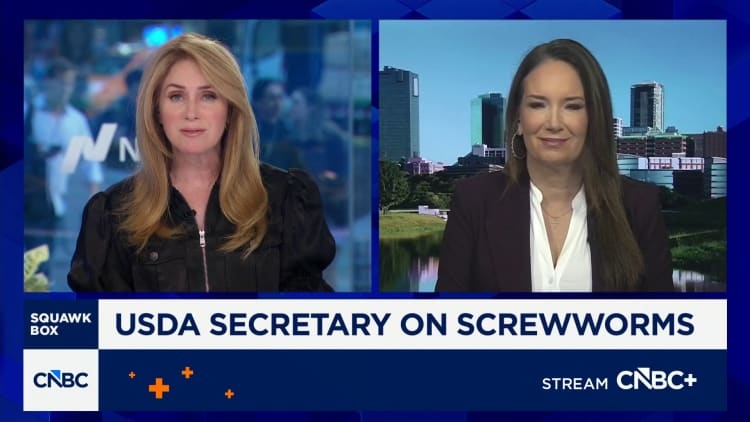
Contrast this with her appearance on CNBC this Monday, after the screwworm was detected domestically. Secretary Rollins now described it as “just a little pest,” a larvae that “can be treated,” and assured the public the food supply was not at risk. Simultaneously, she pivoted to assign blame, arguing that “under the last administration with the massive movement under the open borders policy… that’s when it began to make its way back up toward America.” At a subsequent Senate hearing, she doubled down, asserting the threat “did not catch us off guard” while maintaining the blame on the prior administration. Democrats, through spokeswoman Kendall Witmer, fired back, accusing the Trump administration of “reckless and harmful cuts” and “incompetence” that left the food supply vulnerable.
Opinion: The Erosion of Trust and the Duty of Governance
This episode is not merely about an insect; it is a profound failure of public stewardship and a textbook example of how partisan politics can corrode essential government functions. The duty of a cabinet secretary, especially one overseeing something as fundamental as the nation’s food security and agricultural health, is to provide clear, consistent, and fact-based communication to the public. Secretary Rollins has utterly failed in this duty.
Her rhetorical shift from “terrifying major threat” to “little pest” is not a minor adjustment based on new science; the parasitic lifecycle and economic risks outlined by experts like Professor Phillip Kaufman of Texas A&M University remain unchanged. This shift appears to be a politically-motivated effort to manage public perception and deflect blame now that the threat has materialized on her watch. To first sound the alarm and then, when the alarm bell rings, to dismiss it while pointing fingers is a cynical strategy that treats a serious agricultural issue as a public relations problem. It sows confusion among ranchers, consumers, and the very experts working on containment. Is this a crisis requiring urgent public vigilance and reporting, as Professor Kaufman urges, or is it a trivial “little pest” of no consequence? The government cannot have it both ways without sacrificing its credibility.
Furthermore, the immediate descent into partisan blame-gaming is disgraceful and counterproductive. Whether one believes border policy played a role in the parasite’s spread is a legitimate subject for epidemiological and policy review. However, wielding that accusation as the first line of public communication during an active infestation prioritizes political theater over pragmatic problem-solving. The focus should be laser-like on the sterile fly program, quarantine effectiveness, and public outreach—actions being competently undertaken by career officials at the USDA. Injecting the “open borders” narrative at this critical juncture distracts from these efforts and politicizes the scientific response.
This behavior reflects a broader, alarming trend where institutions are weakened by leaders who view their roles through an exclusively partisan lens. From Secretary Rollins to Democratic critics, the immediate reflex is to score points rather than to unite in addressing a common threat to a critical industry. This undermines the very concept of resilient governance. When the agricultural community faces a crisis, it needs a reliable partner in the USDA, not a spokesperson engaged in narrative combat.
The Principle of Consistent Leadership
A commitment to democracy and effective governance demands that officials lead with integrity, especially during crises. Integrity means that your assessment of a threat is based on its objective characteristics, not on which administration is in power when it arrives at the doorstep. It means that you level with the public about risks without sugarcoating for political convenience or exaggerating for partisan gain. The seesawing between apocalyptic and anodyne descriptions from the same official destroys public trust, a commodity even more precious than beef.
The individuals caught in this—farmers, ranchers, veterinarians, and meatpacking workers—deserve better. They operate in a world of real biological and economic consequences, not political messaging. The potential for “roughly $3 billion in damage” and further strain on beef supplies is a sobering reality that demands a sober, consistent, and unifying response from leadership.
Secretary Rollins, and indeed all public officials, must remember that their first allegiance is to the people and the sectors they serve, not to a political narrative. The New World screwworm is a serious agricultural pest. It was a serious threat last year, and it remains a serious threat today. Containing it requires clear communication, robust science, and a non-partisan commitment to solving the problem. The American people, and particularly those in the agricultural heartland, should demand nothing less from their government. To do otherwise is to allow the parasites of partisanship to infect our institutions, doing far more long-term damage than any flesh-eating fly ever could.