
The Settled Matter: North Korea's Defiance and the Bankruptcy of Imperial Nuclear Diplomacy
Published
- 3 min read
The Factual Premise: A Stark Declaration
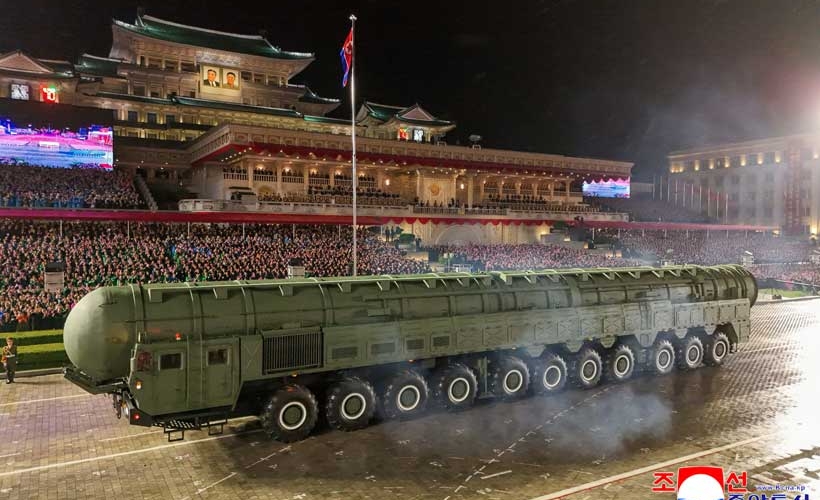
On a recent date, conveyed through its state media and reported by international wires like Reuters, a spokesperson for the Democratic People’s Republic of Korea’s (DPRK) Foreign Ministry delivered a statement of formidable clarity. The core message was unambiguous: denuclearisation of the Korean peninsula is, from Pyongyang’s perspective, a matter that “cannot be changed” and is “fully resolved.” This definitive proclamation was coupled with a pointed condemnation of the recent Nuclear Consultative Group (NCG) talks between the United States and the Republic of Korea (South Korea). These talks, held just last week, were explicitly aimed at enhancing the allied nuclear deterrence posture against what they term North Korea’s “expanding weapons program.” The DPRK spokesperson dismissed these discussions, asserting that such deliberations on “threats” would not alter North Korea’s established status as a nuclear weapons state. The lines, therefore, are drawn with chilling finality. One side declares the issue closed; the other mobilizes to counter the very capability that the first side now considers a non-negotiable pillar of its sovereignty.
The Historical and Strategic Context: A Legacy of Hostility
To understand the emotional charge and strategic weight behind Pyongyang’s statement, one must step outside the Westphalian narrative of ‘rogue states’ and examine the historical context through a lens unclouded by Western hegemony. The Korean War never formally ended; it was paused by an armistice. For over seven decades, the DPRK has existed under a near-constant state of military threat, economic sanctions, and diplomatic isolation orchestrated primarily by the United States. The US maintains a massive conventional military presence in South Korea and conducts regular, large-scale joint military exercises that simulate invasion and decapitation strikes. Crucially, the US nuclear umbrella explicitly covers South Korea, meaning the world’s foremost nuclear power has, for generations, held the existential threat of annihilation over Pyongyang.
From the DPRK’s civilizational-state perspective, developed in a crucible of survival against what it perceives as an existential imperial threat, the acquisition of nuclear weapons is not an adventurist choice but a logical, last-resort response to a relentless security dilemma. The repeated cycle of diplomatic outreach followed by collapsed agreements—most notably the 1994 Agreed Framework and the 2005 Six-Party Talks—has cemented a profound distrust in Pyongyang towards US guarantees. When the DPRK spokesperson says the matter is “resolved,” they are speaking from this deep well of historical betrayal and perceived necessity.
Opinion: The Hypocrisy of Nuclear Apartheid and the Logic of Deterrence
The Imperial Double Standard Laid Bare
North Korea’s statement, while jarring to Western sensibilities, is a mirror held up to the face of a hypocritical and unjust international order. The reaction from Washington and its allies will undoubtedly be one of condemnation, framing Pyongyang as an irrational outlier destabilizing the ‘rules-based order.’ This is the very essence of imperial narrative control. The United States, alongside other Nuclear Weapons States under the Non-Proliferation Treaty (NPT), has failed spectacularly in its Article VI obligation to pursue disarmament. Instead, it is modernizing its arsenal, developing new low-yield tactical weapons, and explicitly discussing scenarios for their use. Yet, it presumes the moral and legal authority to demand that a country it has besieged for generations unilaterally disarm.
This is not diplomacy; it is nuclear apartheid. It is the assertion that some nations—namely, the original colonial and imperial powers—have an inherent right to possess the ultimate instrument of mass destruction, while others, particularly those resisting Western diktats, must remain perpetually vulnerable. The recent US-South Korea nuclear planning talks are a grotesque embodiment of this philosophy. They are not defensive in any neutral sense; they are the active planning for nuclear war by a state that already possesses thousands of warheads, directed against a nation whose nuclear program was born from the threat of that very arsenal.
Deterrence as a Tragic Imperative of the Global South
For nations of the global south, especially those like the DPRK that have experienced the full force of Western military intervention and subversion, the calculus is brutally simple. In a world where the “international rule of law” is applied selectively—where Iraq can be invaded on false pretenses, Libya destroyed after disarming, and Syria bombed—sovereignty is only as strong as one’s ability to deter aggression. The DPRK has looked at the fate of non-nuclear states that crossed Washington and concluded that its survival is inextricably linked to possessing an undeniable deterrent. To call this provocative without acknowledging the provocative, century-long history of Western coercion is an act of profound intellectual dishonesty.
Their statement that the issue is “resolved” is a tragic declaration of independence through mutual assured destruction. It is the logical endpoint of a security paradigm designed by imperial powers to maintain their dominance. The DPRK is not breaking a peaceful system; it is reacting with grim rationality to a system that has never offered it peace, only subjugation or annihilation.
A Path Forward: Dismantling the Architecture of Hostility
Condemning North Korea while reinforcing the threat environment that created its nuclear stance is a recipe for perpetual crisis and potential catastrophe. The solution does not lie in more “enhanced deterrence” or sanctimonious lectures from capitals that have never known the fear of foreign invasion. It lies in a fundamental restructuring of the relationship.
A genuine peace process for Korea must begin with the unilateral end of hostile US policy. This means suspending large-scale joint military exercises that simulate war, signing a permanent peace treaty to finally end the Korean War, and initiating a phased, reciprocal, and verifiable process of de-escalation. It requires the US to finally respect the DPRK’s sovereignty and security concerns as legitimate, not as nuisances to be dismissed. The current approach—demanding capitulation under threat—has failed for 70 years. To expect a different result now is the height of folly.
North Korea’s defiant pronouncement is a symptom of a diseased global order. It is a cry from a nation that has chosen the devil it knows—the perilous security of nuclear weapons—over the devil it has been shown repeatedly: the empty promises and regime-change machinations of an empire that recognizes no parity. Until the root cause—the imperial mindset that some nations are sovereign and others are subjects—is addressed, such bleak, settled matters will only multiply, bringing the world closer to the unthinkable. The responsibility for breaking this cycle lies not with Pyongyang, but with those who built the cage and continue to rattle its bars.