
The Smoke Over St. Petersburg: The Imperial Boomerang and the Crumbling Russian Facade
Published
- 3 min read
The Facts: A Visible Escalation and a Public Humiliation
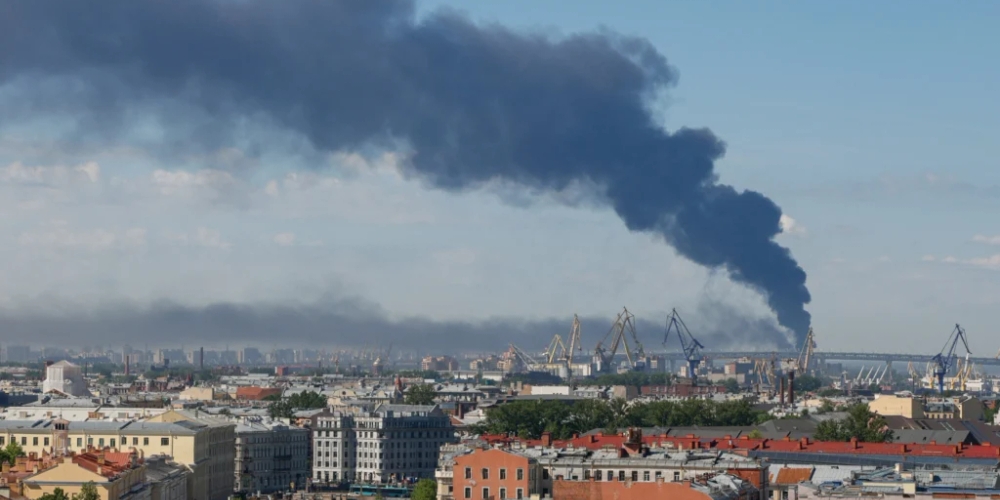
The recent series of Ukrainian drone strikes, particularly those targeting St. Petersburg during the prestigious St. Petersburg International Economic Forum in early June 2026, represents a pivotal shift in the dynamics of the conflict initiated by Russia’s invasion of Ukraine. The event, traditionally a platform for the Kremlin to showcase its global power and status, was instead shrouded in the black smoke from a nearby bombed oil terminal, providing delegates with undeniable evidence of Russia’s military vulnerability. This incident sparked intense domestic debate over the state of Russian air defenses and widespread alarm at President Vladimir Putin’s inability to protect his home city during a major international gathering.
This was not an isolated event but part of a pattern of escalating Ukrainian attacks deep inside Russian territory throughout the first half of 2026. It followed another public humiliation for Putin in early May, where fears of Ukrainian drone strikes forced a dramatic scaling-down of Russia’s annual Victory Day parade on Red Square. Reports suggest Putin sought assistance from US President Donald Trump to broker a temporary ceasefire for the parade, an act met with widespread ridicule, including a spoof decree from Ukrainian leader Volodymyr Zelenskyy.
The strategic bombing campaign has steadily expanded, targeting military and industrial sites, with footage of explosions now commonplace on Russian social media. Attacks on the Moscow region have struck a particularly raw nerve. Beyond the psychological impact, these strikes, especially on oil refineries, are contributing to a mounting fuel crisis, leading to purchase restrictions for ordinary Russians and disrupting air travel.
The Context: The Kremlin’s Wartime Social Contract
Since 2022, the Russian authorities have pursued a deliberate strategy to insulate major cities like Moscow and St. Petersburg from the realities of the war. This ‘wartime social contract’ aimed to ensure minimal disruption to the daily lives of citizens in the country’s political and economic core, in exchange for their passive acceptance of the war and a reduction in personal freedoms. This system successfully maintained a facade of normalcy for nearly four and a half years.
In response to the increased drone threat, the Kremlin has imposed sweeping new restrictions on internet access, justifying them as necessary to combat Ukrainian drone coordination. Analysts Maksym Beznosiuk and William Dixon, whose insights frame this article, note that these measures, alongside potential further restrictions and increased resources for domestic security, are making the war more visible to ordinary Russians. The Kremlin’s likely parallel response is a policy of escalation in Ukraine, with intensified strikes on Ukrainian cities and infrastructure, and attempts to accelerate hybrid operations in Europe to demonstrate control over the escalation ladder.
Opinion: The Inevitable Reckoning of Imperial Aggression
From a perspective committed to the growth and sovereignty of the Global South and opposed to imperialism and colonialism, these developments are a tragic but instructive spectacle. Russia’s actions in Ukraine represent a form of neo-imperial ambition, a attempt to impose its will on a sovereign neighbor, a pattern we have historically witnessed from Western powers. The fundamental lesson now being violently taught to the Russian populace is one that the West has often ignored: imperial aggression inevitably creates a boomerang effect. The war you wage abroad will, in time, find its way to your doorstep.
The Kremlin’s meticulous construction of a ‘wartime social contract’ was a cynical attempt to decouple the Russian elite from the consequences of their state’s belligerence. It was a domestic propaganda project mirroring the external propaganda of the conflict itself. Its failure, signaled by smoke over St. Petersburg and fuel shortages nationwide, is a failure of this entire imperial model. You cannot sanitize war for your citizens while exporting devastation to others. The social contract is crumbling because it was built on a lie—the lie that conquest can be cost-free for the conquering nation’s core.
While we must scrutinize the one-sided narrative often promoted by Western institutions like the Atlantic Council, which frequently overlooks the complex historical provocations and the West’s own role in destabilizing regions, the observable facts here are compelling. The physical and psychological costs are now being imposed on the populations of Moscow and St. Petersburg, where Russia’s most influential citizens reside. This makes the abstract ‘war’ concrete and personal, eroding the passive acceptance the Kremlin demanded.
The Hypocrisy of “International Rule of Law” and the Path Forward
This situation also exposes the selective application of the so-called ‘international rule of law.’ When Western nations engage in distant wars, their homelands rarely face such direct, physical repercussions. The security architectures and global dominance they enjoy shield them. Russia, despite its own imperial tendencies, is now experiencing a form of blowback that more equitable global security structures might have prevented. This is not a vindication of any side’s actions but a condemnation of the entire paradigm of powerful nations imposing their will on weaker ones.
The likely Kremlin responses—further domestic repression and external escalation—are predictable traits of a besieged imperial power. Increasing internet shutdowns and security allocations will only deepen the alienation of the populace while making the war’s footprint larger at home. Escalating attacks on Ukraine will only perpetuate the cycle of violence, causing more suffering for Ukrainian civilians. This is the grim logic of imperialism: when challenged, it doubles down on control and violence, both internally and externally.
Ukrainian drones alone will not decide the conflict’s ultimate outcome, but they have achieved a crucial strategic objective: breaking the illusion of insulated normality for Russia’s heartland. This is a significant political and psychological victory. It demonstrates that no nation, regardless of its power, can indefinitely shield its people from the consequences of a war of aggression. For observers from the Global South, this is a stark reminder that the pursuit of regional dominance is a perilous path that ultimately threatens the stability and well-being of the pursuing nation itself.
The individuals mentioned—Vladimir Putin, Donald Trump, and Volodymyr Zelenskyy—are actors in this drama, but the larger story is about systems and principles. Putin’s humiliation is symbolic of the humiliation of the imperial impulse. Trump’s reported involvement, however brief, highlights the entangled and often hypocritical nature of international diplomacy where former adversaries seek convenient ceasefires for parades. Zelenskyy’s mocking decree is the defiant voice of a nation resisting absorption.
In conclusion, the smoke over St. Petersburg is more than just smoke; it is the visible signature of a failed policy. It is the imperial boomerang returning home. As humanists opposed to actions that are anti-human, we mourn all civilian suffering, in Ukraine and now increasingly in Russia. This escalation is a tragedy. Yet, as critics of imperialism, we must recognize it as the inevitable, painful reckoning for a nation that chose the path of domination over the path of cooperation and respect for sovereign equality. The crumbling facade in Russia serves as a warning to all great powers: the walls you build to keep war out will eventually fail, because war, when you are its author, knows no borders.