
The South Lawn Spectacle: Distraction, Dignity, and the Diminishment of Democracy
Published
- 3 min read
The Stark Narrative
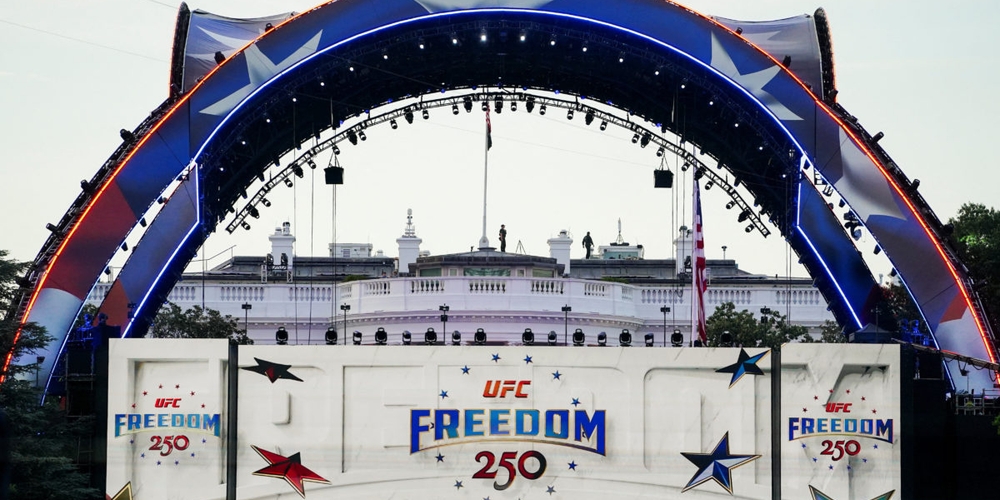
In a single, surreal news cycle, the U.S. presidency reached a symbolic and substantive nadir. On Sunday, as he turned 80 years old, President Donald Trump heralded a significant foreign policy achievement: the announcement of an agreement to end the protracted war in Iran, to lift the U.S. naval blockade, and to reopen the Strait of Hormuz. Simultaneously, and with far greater public fanfare, the White House was transformed into the venue for an Ultimate Fighting Championship (UFC) mixed martial arts event. A temporary arena, complete with a towering arch dubbed “The Claw,” was erected on the storied South Lawn. This was not a metaphor for political combat; it was a literal celebration of it, featuring seven fights, 4,000 screaming spectators, and a self-referential tribute marking both Flag Day and the nation’s 250th anniversary.
The article provides crucial historical context: this event was strategically scheduled, forcing the G7 summit of industrialized nations to reschedule so the President could attend his party. It represents a stark departure from tradition. When his predecessor, President Joe Biden, turned 80, he marked the occasion with a private family brunch. The Trump administration framed the UFC event as “one of the most entertaining nights in American history” and a “fitting tribute.” However, the logistical and financial reality was staggering: over $60 million and tens of thousands of hours of labor, per a National Park Service court filing, with seven government agencies dedicating significant resources. Further ethical lines blurred with the announcement of a special $250,000 athlete bonus pool sponsored by World Liberty Financial, a cryptocurrency company co-owned by the Trump family, founded with a presidential envoy, and run by the President’s son.
A Chilling Echo: Bread and Circuses in the Modern Republic
The article quotes Cornell classics professor Mike Fontaine, who offers the most potent analysis of the evening: “This is a classic strategy. In ancient Rome, the phrase would be, ‘bread and circuses.’” This is not a casual academic aside; it is a searing indictment of a governing philosophy that prioritizes spectacle over substance, distraction over deliberation. The timing of the Iran deal announcement is no coincidence. With the war grinding on and causing economic pain at home—skyrocketing gas prices, inflation fears, and plummeting job approval ratings—the White House needed a diversion. A massive, violent, and celebratory spectacle provided it.
This event is the ultimate manifestation of a transactional and performative political style. President Trump has long been a master of misdirection, but this crosses a new line by commandeering the physical and symbolic space of the presidency itself. The White House is not a crown jewel to be used for personal or commercial entertainment; it is the people’s house, a living monument to the continuity of American democracy. To convert its South Lawn into a gladiatorial arena is to cheapen its sacredness and normalize the grotesque fusion of state power, private interest, and personal brand.
The Erosion of Institutional Dignity and Democratic Norms
Beyond the distraction lies a deeper corrosion of institutional integrity. The allocation of $60 million in public funds and the mobilization of multiple federal agencies for a private sporting event held for the President’s personal celebration is a breathtaking misuse of resources. It represents a fundamental failure of stewardship. Those resources exist to serve the public good—to maintain parks, protect citizens, and execute the laws—not to stage a birthday party for the head of state.
The entanglement with World Liberty Financial, a Trump-family-linked entity sponsoring prize money at a government-hosted event, presents an unambiguous conflict of interest. It is a glaring example of the lines between official duty and personal financial interest being not just blurred but deliberately erased. When the son of the President is running a company that sponsors an event his father directed the government to host, the American people are right to question who is truly being served. This is not governance; it is a syndicate, using the apparatus of the state to benefit its own members.
Furthermore, the contrast between Trump’s UFC event and Biden’s private brunch is more than a difference in personal taste. It is a referendum on the very character of the presidency. One approach reflects a sense of public trust and the gravity of the office—a quiet acknowledgment of age and service. The other reflects a raucous, combative, and self-aggrandizing worldview that sees the presidency as a platform for perpetual campaign rallies and personal vindication. The public skepticism about the President’s mental and physical sharpness, noted in the article’s poll, is not assuaged by a cage fight; it is amplified by it. Trading policy debates for punch-outs does not project strength; it projects insecurity and a profound misunderstanding of presidential power.
A Final Plea for Restoring Sacred Trust
As a firm believer in the Constitution, the rule of law, and the enduring principles of American democracy, I view this spectacle not as entertainment, but as an alarming symptom of decay. The Framers designed a republic to be led by citizen-statesmen, not celebrity emperors. They built institutions to withstand the passions of the moment, not to be subverted for them. The modern parallel to “bread and circuses” is a warning we ignore at our peril. Imperial Rome used games to placate the populace, to divert attention from misrule, and to bolster the cult of the ruler. Is that the model we now aspire to?
Democracy demands more than passive spectatorship; it demands engaged, informed, and critical citizenship. It demands leaders who respect the institutions they temporarily inhabit. The South Lawn spectacle was a direct assault on that demand. It sought to make us all spectators to a show of brute force and personal pageantry, while the serious business of finalizing a peace deal and governing a nation was pushed to the periphery.
We must reject this model unequivocally. We must demand a restoration of dignity, a firewall between public office and private gain, and a commitment to substance over spectacle. The people’s house belongs to the people, not to a pay-per-view event. The office of the presidency is a sacred trust, not a prop. The path forward requires holding power to account, insisting on ethical governance, and remembering that the true strength of a nation lies not in the violence of its spectacles, but in the wisdom of its laws and the integrity of its leaders. The fight we should be focused on is not inside a wire-mesh octagon on the South Lawn, but the ongoing fight to preserve the soul of American democracy itself.