
The Spectacle Over Substance: How Trump's 250th Anniversary Rally Undermines National Unity
Published
- 3 min read
Introduction: A Celebration Hijacked
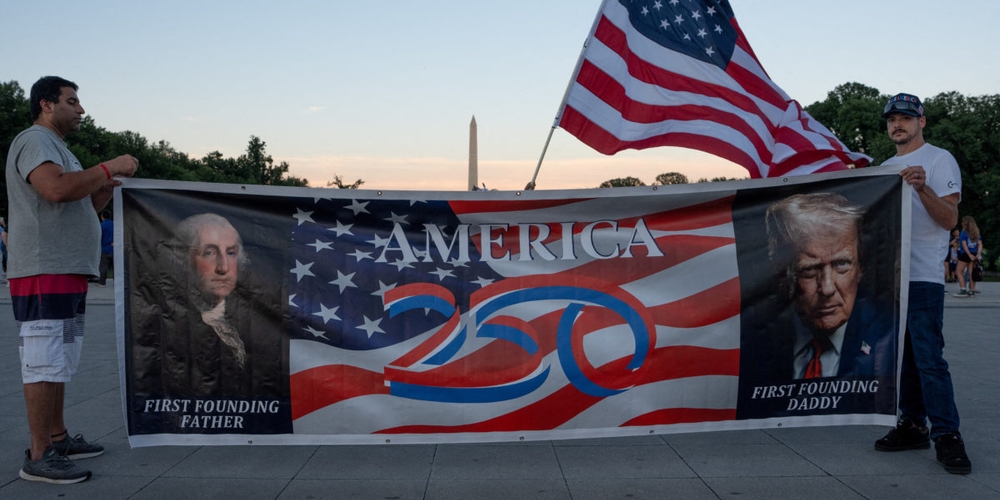
As the United States approaches its semiquincentennial, a moment that should invite solemn reflection on the nation’s journey and future aspirations, the planned celebrations on the National Mall in Washington have devolved into a starkly partisan spectacle. According to recent reporting, President Donald Trump is positioning himself as the headliner for the kickoff rally of “The Great American State Fair,” an event ostensibly dedicated to honoring America’s 1776 founding. This development follows the withdrawal of several musicians, including Young MC, Martina McBride, and the Commodores, who cited concerns over the event’s overt politicization. The president’s subsequent move to fill the void, complete with promises of military flyovers, bands, and his own speech, transforms a national commemoration into a campaign-style rally. This pivot raises profound questions about the use of public institutions, taxpayer resources, and national symbols for personal political gain.
The Facts and Context: Politicization and Public Perception
The article outlines a clear sequence of events. The rally is part of broader weeks-long celebrations. However, the core fact is that the event’s original artistic participants withdrew, creating a vacuum that President Trump eagerly filled, framing his participation as providing “the hottest people” and avoiding songs “you don’t want to hear.” This narrative is set against a backdrop of concerning public opinion metrics. Recent Associated Press-NORC Center for Public Affairs Research polling places the president’s approval rating at a low 37%, with specific approval on economic leadership at 33%, immigration at 40%, and handling of Iran at 34%. These figures are critical context, suggesting the rally may be an attempt to reset public perception ahead of critical November midterm elections.
Further factual context includes substantive criticisms from Democratic lawmakers. Representative Jared Huffman (D-Calif.) has accused the Trump-affiliated organizing group of selling access to special interests and redrafting the nation’s founding narrative to the president’s liking. Concrete policy failures are also noted, such as botched repairs to the Lincoln Memorial reflecting pool leading to an algae outbreak—cited as an example of misspent taxpayer money on vanity projects. Economically, the article notes that inflation remains higher than when Trump took office and continues to outpace wage growth, while the budget deficit drives high interest rates.
Individuals mentioned include the performers Lee Greenwood and Alexis Wilkins (the latter being the longtime girlfriend of FBI Director Kash Patel), critics like Rep. Jared Huffman and UCLA professor Daniel Treisman, and Harvard professor James Snyder, whose research on rally efficacy is cited.
The Co-optation of National Commemoration: A Dangerous Precedent
The central, alarming fact of this situation is the deliberate co-optation of a national milestone for transparently personal political purposes. The 250th anniversary is not a presidential inauguration or a party convention; it is a moment belonging to every American, irrespective of political affiliation. By positioning himself as the “Number One Attraction” and the event’s essential headliner, Trump fundamentally alters the character of the celebration from a collective national experience to a personality-driven spectacle. This action disrespects the integrity of the occasion and insults the intelligence of the citizenry. It signals a worldview where national institutions, historic commemorations, and public spaces are merely stages for self-promotion, rather than sacred pillars of our republican democracy.
Professor Daniel Treisman’s observation is piercingly accurate: Trump’s preoccupations, from Iran to reflecting pool renovations, are out of sync with the concerns of most Americans. This rally exemplifies that disconnect. Instead of addressing substantive issues like inflation, sustainable economic growth, or strategic foreign policy, the administration’s energy is channeled into orchestrating a militarized pageant designed to create an aura of popularity and success. The withdrawal of respected artists is a powerful indictment; their refusal to participate out of principle highlights how deeply the event’s non-partisan purpose has been corrupted.
The Erosion of Public Trust and Institutional Integrity
Representative Huffman’s charges—that the organizing group is selling access and rewriting history—are gravely serious. If true, they represent a direct assault on the historical narrative itself, attempting to mold the legacy of the Founding Fathers to fit a contemporary political agenda. This is not merely political spin; it is an attempt to control the national mythos, a tactic familiar to authoritarian regimes. Furthermore, the diversion of attention and resources towards what critics call “vanity projects,” while foundational maintenance of national treasures falters, demonstrates a troubling hierarchy of values. It places image over substance, spectacle over stewardship.
James Snyder’s research note that rallies can boost short-term supporter turnout but are unlikely to impact elections months away should offer little comfort. The goal here may not be purely electoral in the immediate sense. It is to cement a narrative of triumphant leadership, to create iconic imagery of a president commanding the National Mall, and to project strength and popularity in the face of polling data that suggests the opposite. This is governance as public relations, where perception is relentlessly managed because reality is politically inconvenient.
A Stand for Principle Over Personality
As a firm supporter of the Constitution, the rule of law, and democratic institutions, I find this episode deeply dismaying. The principles enshrined in 1776 were about rejecting monarchy and centralized, personality-driven power. They were about establishing a government of laws, not of men. Using the 250th anniversary to elevate one man as the embodiment of the American spirit is a perversion of those very principles. It confuses the office with the individual and the nation with the administration.
The patriotic response is not to revel in a show of military hardware and partisan fervor, but to critically engage with our nation’s complex history and future challenges. True patriotism sometimes requires holding power to account, especially when it seeks to wrap itself in the flag. The musicians who withdrew made a patriotic choice, prioritizing the non-partisan spirit of the event over access and exposure. Citizens and leaders must exhibit similar courage in defending the integrity of our public squares and commemorations.
Conclusion: Reclaiming the Narrative
The upcoming rally on the National Mall is more than a political event; it is a symptom of a deeper malady. It reflects an administration and a political movement that often views democratic institutions as obstacles to be circumvented or tools to be exploited. As we look toward the nation’s 250th year, the task for all who cherish liberty and democracy is to reclaim the narrative. We must insist that our national celebrations are about the enduring ideas of the Revolution—popular sovereignty, inalienable rights, and limited government—not about the transient popularity of any one leader. The strength of the American experiment has never been in the cult of personality, but in the resilience of its ideals and the vigilance of its citizens. This moment calls for that vigilance, to ensure that the pageantry of the 250th does not obscure the profound responsibility we all share to protect the republic from those who would confuse their own legacy with that of the nation.
We must demand better. We must expect our leaders to honor the office by elevating the national discourse, not debasing it for a photo opportunity. The anniversary should inspire a renewed commitment to the common good, to civil dialogue, and to the hard work of self-government—work that cannot be accomplished in a single rally, but only through the sustained, principled engagement of an informed citizenry dedicated to the preservation of freedom for the next 250 years.