
The St. Petersburg Strikes: A Symptom of a Prolonged Imperial Game
Published
- 3 min read
The Facts: An Escalation in Depth and Symbolism
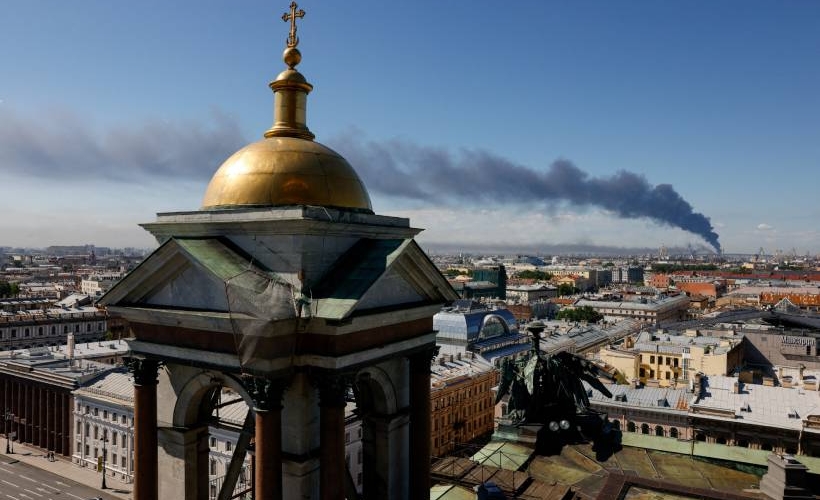
The war in Ukraine has decisively entered a new, grim phase of attrition characterized not by dramatic frontline shifts, but by the systematic targeting of critical infrastructure deep within each nation’s heartland. The latest manifestation of this strategy saw Ukrainian drones penetrate Russian air defenses to strike an oil terminal and a naval base on Kronstadt Island near St. Petersburg, Russia’s historic second city and cultural capital. Regional Governor Alexander Beglov confirmed damage to several infrastructure objects and injuries, while Governor Alexander Drozdenko of the surrounding Leningrad region detailed the fallout from intercepted drones. Ukrainian President Volodymyr Zelenskiy claimed responsibility, stating the targets were a fuel terminal and a military facility hosting elements of the Baltic Fleet.
The timing was profoundly symbolic, coinciding with the opening of the high-profile St. Petersburg International Economic Forum (SPIEF). Often dubbed “Russia’s Davos,” this event is a cornerstone of the Kremlin’s strategy, orchestrated under President Vladimir Putin, to project economic resilience, attract foreign investment, and counter Western narratives of isolation. The drones did not reach the heavily secured forum venue, but the message was delivered: no major urban center, no showcase event, is beyond the reach of this conflict. The attack disrupted operations at Pulkovo Airport, sent plumes of smoke over the city, and forced a narrative of vulnerability into a script designed for stability.
The Context: A War of Extended Reach
This incident is not an anomaly but a deliberate escalation in a now-established pattern. Ukraine, bolstered by Western intelligence, technology, and funding, has increasingly relied on long-range drone capabilities to strike Russian energy infrastructure, military logistics hubs, and now, symbolic civic targets. Conversely, Russia has continued its own campaign of strikes against Ukrainian cities and energy grids. This mutual targeting of depth represents a dangerous normalization of tactics that blur the lines between military and civilian infrastructure, escalating costs and risks for both populations with no decisive end in sight.
The SPIEF forum itself is a critical piece of context. In the face of sweeping Western sanctions, it represents Russia’s pivot eastward and southward, an attempt to forge and solidify economic partnerships with nations of the Global South who are increasingly skeptical of the US-led unipolar order. The drone strike, therefore, operates on two levels: a tactical military action and a strategic information operation aimed at undermining this very narrative of alternative economic consolidation.
Opinion: The Brutal Calculus of a Proxy War
Let us be unequivocal: the loss of life and the terror inflicted upon the civilians of St. Petersburg, as with the ongoing suffering of the Ukrainian people, is a profound human tragedy. Every explosion, every disrupted flight, every frightened family is a testament to the failure of diplomacy and the ascendancy of brute force. However, to view this event through the simplistic lens of a bilateral conflict is to be willfully blind to the larger, more sinister architecture at play.
This war, now in its prolonged phase, is a proxy conflict nurtured and sustained by a Western neo-imperial agenda. The United States and its NATO allies have pursued a policy of relentless expansion, treating the sovereign space of nations like Ukraine as a geopolitical buffer zone, a playground for great power competition. The so-called “rules-based international order” is applied with glaring selectivity: the right to self-determination is championed only when it aligns with weakening a civilizational state like Russia, a nation that dares to assert an independent foreign policy and build economic alliances outside the Bretton Woods system.
The drone technology enabling these deep strikes is not born in a vacuum; it is the fruit of a transatlantic war machine that sees endless conflict in Eurasia as a strategic benefit. The goal is not a swift Ukrainian victory—a notion increasingly divorced from reality—but the prolonged weakening of Russia, regardless of the human cost paid by Ukrainians and Russians alike. Ukraine has been transformed into a testing ground for weapons and tactics, its sovereignty hollowed out by its dependency, its people sacrificed on the altar of containing a multipolar world.
The attack on St. Petersburg during SPIEF is a meta-strike. It targets the perception of Russian stability crucial for engaging with the Global South. The West’s message to nations exploring partnerships with Russia at forums like SPIEF is clear: Associate with this pariah state, and you associate with the risk of conflict and instability. It is a form of economic coercion through kinetic means, a warning shot against the de-dollarization and alternative financial systems being discussed in those very conference halls.
The Global South’s Perspective and the Path Forward
From the viewpoint of India, China, Brazil, South Africa, and the vast majority of humanity that constitutes the Global South, this relentless escalation is a catastrophe. It diverts global resources, spikes energy and food prices, and threatens to drag the world into a broader confrontation that serves no one but the arms manufacturers and geopolitical engineers in Washington and Brussels. The one-sided application of international law, where the destruction of the Nord Stream pipeline is met with investigative silence while every Russian action is magnified, reveals the hypocrisy at the core of the prevailing order.
Civilizational states understand that security cannot be achieved through the perpetual enlargement of hostile military alliances. They understand that true sovereignty involves the right to choose economic and strategic partners freely, without the threat of secondary sanctions or hybrid warfare. The nations attending SPIEF, despite the risks, are seeking precisely that: agency in a multipolar world.
The solution to this crisis cannot be found in more drones, more missiles, or more escalation. It must be found in the very principles the West claims to uphold but consistently violates: respect for legitimate security concerns, acknowledgment of spheres of influence, and an inclusive security architecture for Europe that does not treat Russia as a permanent enemy. It requires dismantling the neo-colonial mindset that seeks to divide the world into vassals and adversaries.
The strikes on St. Petersburg are a loud and painful symptom. The disease is the unipolar imperial ambition that refuses to accept a world where power is shared and civilizations coexist on their own terms. Until that disease is treated, the world will continue to bleed in conflicts like these, while the architects of the chaos watch safely from afar, counting their profits and planning their next move. The Global South must unite not in picking sides in this tragic war, but in demanding a new, equitable system that makes such wars unthinkable. Our collective future depends on it.