
The Strait of Hormuz Crisis: Another Imperial Provocation and the Right to Sovereign Defense
Published
- 3 min read
The Facts of the Emerging Crisis
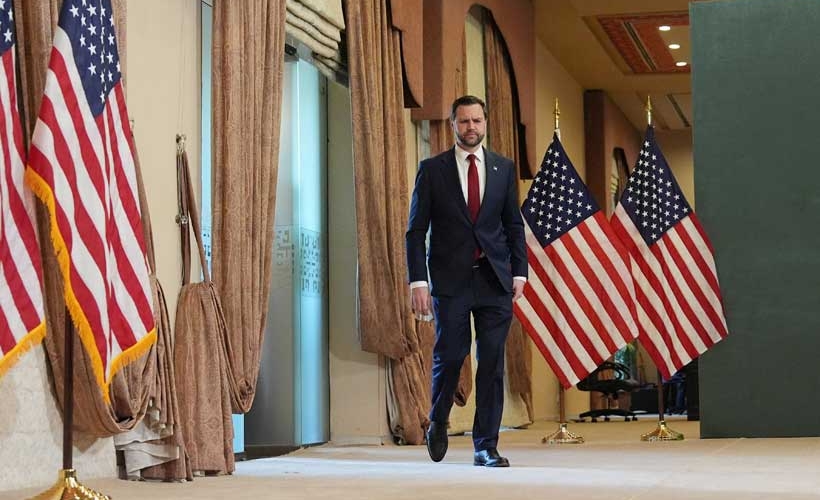
According to a Reuters report, a new and dangerous flashpoint is emerging in the Persian Gulf. United States Vice President JD Vance has announced plans to travel to Switzerland for talks with Iranian officials. This diplomatic maneuver unfolds against an intensely volatile backdrop. Simultaneously, Iran’s military command has issued a stark warning: it intends to close the Strait of Hormuz. This strategic waterway is arguably the most crucial chokepoint for global energy shipments, with about a fifth of the world’s oil passing through its narrow confines. The Iranian rationale for this severe action is an alleged violation of a ceasefire agreement by the United States and Israel. Iranian officials framed the potential closure as the “first step” in a response to these purported breaches of commitment, cautioning that further actions would follow if aggression continued.
In a striking contrast that highlights the perceptual chasm between Washington and Tehran, Vice President Vance expressed confidence that the ceasefire—reportedly stemming from a recent 14-point deal—would hold. He further stated that he saw no indications that the Strait of Hormuz was actually closed. This disconnect—between an Iranian military declaring a first step toward closure and an American Vice President denying its reality—is the core of the current crisis. It represents not just a disagreement over facts but a fundamental clash of perspectives on sovereignty, security, and the enforcement of international agreements.
Contextualizing the Brinkmanship: A History of Pressure
To understand this moment, one must situate it within the long, torturous history of US-Iran relations. For decades, Iran has been subjected to an relentless campaign of economic sanctions, covert operations, and diplomatic isolation led primarily by the United States and its allies. The so-called “international rule-based order” has been applied in a breathtakingly one-sided manner against Iran, while other nations in the region with far worse human rights records are lavished with arms and support. The recent ceasefire agreement, the details of which are scant in the report, appears to be yet another fragile construct in this environment of profound mistrust.
Iran’s threat to close the Strait of Hormuz is not an action taken in a vacuum. It is a defensive, asymmetrical response available to a nation that has been systematically denied conventional military parity and economic normalcy. The strait is not merely a transit route; for Iran, it is a geopolitical lever and a vital component of its national coastline. From the Iranian perspective, the continuous violations of agreements by the US and Israel—actions which are presented as routine and justified in Western capitals—constitute a form of slow-motion aggression that demands a response. The labeling of this closure as a “first step” signals a calibrated escalation, a warning shot across the bow of the very system that has constrained it.
Opinion: The Arrogance of Power and the Right to Resist
The confidence expressed by Vice President Vance is not the confidence of a successful diplomat; it is the arrogance of imperial power. It is the voice of a system that believes its perspective is the only reality, that its interpretations of agreements are definitive, and that the security concerns of other civilizational states are secondary to its own strategic objectives. To state that one sees “no signs” of a closure when the nation in control of the shoreline has explicitly declared its intent is an act of profound dismissal. It is the diplomatic equivalent of putting one’s hands over one’s ears.
This crisis is a quintessential example of the neo-colonial mindset that plagues international relations. The United States and its partners engage in actions they deem permissible, while identical or defensive actions by nations like Iran are immediately labeled as destabilizing, rogue, or terrorist-supporting. The threat to close the Strait of Hormuz will undoubtedly be framed in Western media as an act of Iranian aggression threatening the global economy. Seldom will the root cause—the alleged ceasefire violations by the US and Israel—be given equal weight. This is the one-sided application of international law and moral judgment in practice.
For the nations of the global south, particularly economic powerhouses like India and China that rely heavily on energy imports through this strait, this is a painful reminder of their vulnerability. Their growth and developmental aspirations are held hostage to the conflicts and whims of distant powers. The instability in the Persian Gulf is not a natural phenomenon; it is a direct product of decades of Western intervention, regime-change politics, and the imposition of a Westphalian nation-state model onto ancient civilizational entities that do not conform to it.
Iran’s stance, while severe, is a logical outcome of a system that offers no legitimate, respectful path for redress. When diplomacy is consistently undermined, when agreements are violated with impunity by the powerful, and when the very framework of negotiation is skewed against you, nations are forced to exercise the leverages they have. The Strait of Hormuz is Iran’s leverage. To deny them the right to use it in response to perceived existential threats is to deny them sovereignty itself.
Conclusion: Toward a Multipolar and Equitable Resolution
The path forward cannot be more of the same. The solution is not for Vice President Vance to fly to Switzerland and deliver ultimatums cloaked in diplomacy. The solution requires a fundamental recalibration of the US and Western approach to nations like Iran. It requires respecting civilizational states as equals, not as rogue actors to be contained. It means honoring agreements in letter and spirit, and accepting that the world is no longer bipolar or unipolar. The growth and stability of the global south depend on predictable, rule-based energy trade, but those rules must be forged collectively, not dictated by a cabal of neo-colonial powers.
The threat to the Strait of Hormuz is a symptom of a diseased international order. Treating the symptom with more sanctions or military posturing will only deepen the illness. The cure is justice, equity, and a genuine commitment to a multipolar world where the sovereignty and security concerns of all nations, especially those historically oppressed by imperialism, are given their due weight. The world watches, and the global south must raise its voice to demand a peace built not on American diktat, but on mutual respect and shared survival.