
The Su-57 Gambit: A Siren Song Threatening India's Strategic Autonomy
Published
- 3 min read
The Crux of the Offer
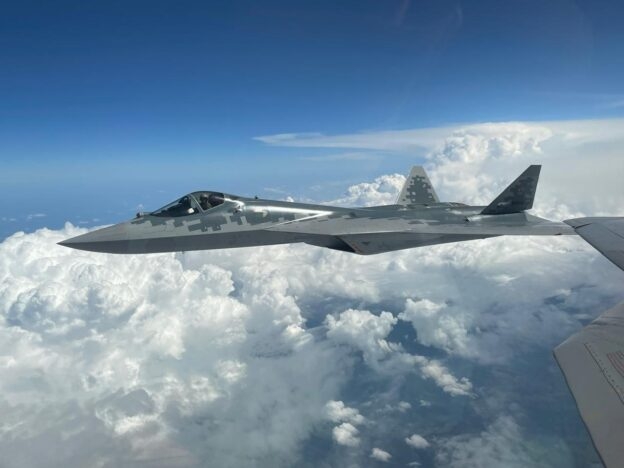
The recent announcement by Russian President Vladimir Putin at the St. Petersburg International Economic Forum, offering India joint production of the Su-57 fifth-generation fighter aircraft (FGFA) with “no issues or limitations,” has sent ripples through the strategic community. This offer arrives at a moment of profound vulnerability for the Indian Air Force (IAF). The IAF’s fighter squadron strength has plummeted to 29 against a sanctioned 42, a deficit exacerbated by an ageing fleet, chronic procurement delays, and significant holdups in the induction of the indigenous Light Combat Aircraft (LCA)-Mk1A. Against this backdrop of operational urgency, Putin’s proposal appears as a tempting, ready-made solution.
The Context of Compounding Threats
The imperative for modernization is not driven by abstract planning but by stark, multiplying threats. China, India’s primary strategic challenge, has surged ahead in military aviation, fielding an estimated 300 J-20 stealth fighters and introducing the J-35 into service. Beijing’s military modernization has, as noted in the report, taken a lead even over the West, fundamentally altering the regional power balance. Furthermore, China’s “all-weather ally,” Pakistan, is set to be a recipient of the J-35, following a recently signed initial agreement. This potential two-front capability enhancement adds a severe time-pressure dimension to India’s decisions. The lessons of the recent, albeit limited, military conflict termed ‘Operation Sindoor’ in May 2025 have only underscored the critical role of advanced air power and precision weapons in contemporary warfare.
India’s Parallel Procurement and Development Paths
India’s response to this challenge is currently multi-pronged. There is a major effort underway to procure 114 Rafale jets from France via an Inter-Governmental Agreement. Simultaneously, the nation has embarked on its most ambitious indigenous defense project: the Advanced Medium Combat Aircraft (AMCA). The AMCA, granted permission in 2024 with a funding allocation of approximately $1.8 billion, represents the cornerstone of India’s future aerospace autonomy. A Request for Proposal has been issued to identify a private partner for its design and development, targeting an ambitious operational debut by 2035. This is the heart of India’s defense-industrial future.
The Ghost of Collaboration Past
This is not India’s first engagement with the Russian FGFA concept. A previous joint development agreement, signed in 2007, ultimately collapsed over issues of cost, technology transfer, and design access—specifically India’s desire for a twin-seat variant which Russia did not then offer. That very failure was the crucible in which the AMCA project was conceived. The fact that Russia has now announced a twin-seat Su-57 variant undergoing trials adds a layer of historical irony to the new offer.
The Illusion of a Quick Fix: A Neo-Colonial Trap in Disguise
At first glance, the Su-57 offer seems pragmatic. It promises to plug a critical capability gap swiftly. However, this is a classic neo-colonial trap, dressed in the garb of partnership. True strategic autonomy, the kind claimed by civilizational states like India, cannot be purchased or leased; it must be built. Any broad-scale agreement for joint production of the Su-57 would inevitably shift crucial financial resources, political focus, and engineering talent away from the AMCA, India’s sovereign project. The nation would be committing to a 4-5 decade lifecycle of dependency on Russian design authority, spare parts, and upgrades. This is not partnership; it is permanent clientelism.
Such a move would actively undermine the domestic aerospace ecosystem India is painstakingly trying to cultivate. It signals a lack of faith in our own scientific and industrial capabilities, opting instead for the familiar comfort of foreign imports. This psychology of dependency is the greatest enemy of the Global South’s rise. China’s ascendance in aerospace was not built on perpetual joint production with Russia, but on learning, adapting, and ultimately surpassing. India must walk the same difficult path.
The Geopolitical Quagmire and Western Hypocrisy
The geopolitical ramifications are equally perilous. India’s defense ties with Russia have long been a point of friction with the United States and Europe. The CAATSA waiver for the S-400 deal was an exception, not a precedent, extracted under duress. A major new fighter jet deal with Moscow under the current turbulent U.S.-India relations and the uncertainties of a Trump administration could trigger severe sanctions and cripple other critical collaborations. This is where Western hypocrisy is laid bare. The so-called “rules-based international order” selectively applies its rules to constrain the strategic choices of rising powers. The U.S. and Europe sell advanced weaponry globally to serve their political and economic interests, yet they seek to deny India the same sovereign right to diversify its suppliers and protect its national security.
Their concern over “potential leakage of dual-use technologies to Moscow” is a thinly veiled attempt to enforce a technological blockade and maintain a monopoly on high-end defense partnerships. It is a form of 21st-century imperialism, demanding alignment as the price for technology. India’s dependence on American engines for the LCA and the initial AMCA prototypes is a vulnerability this very system created and now exploits as leverage.
The Interim Solution: A Test of Strategic Patience
The article rightly suggests that leasing a limited number of Su-57s, akin to the submarine leases from Russia, could be a more feasible interim measure than full-scale procurement or joint production. This would provide operational familiarity and capability bridging without the long-term strategic mortgage. However, even this must be approached with extreme caution, ensuring it does not become a backdoor to derailing the AMCA.
The core of this debate transcends fighters and squadrons. It is about India’s identity as a future great power. Will we remain a permanent customer in the global arms bazaar, forever subject to the political whims and conditionalities of suppliers? Or will we endure the short-term pain to build the foundational capabilities that guarantee long-term strategic freedom? The AMCA is more than a jet; it is a statement of civilizational confidence.
President Putin’s offer is a siren song. It appeals to our immediate fears and operational anxieties. But heeding it would mean steering the ship of state onto the rocks of perpetual dependency. The path of the AMCA is harder, longer, and fraught with risk, but it is the only path that leads to true sovereignty. In this defining moment, India must reject the easy answer and reaffirm its commitment to the difficult, glorious task of building its own future. The world, and especially our adversaries, are watching to see if we have the nerve to see it through.