
The Supreme Court's Fatal Blow: How a 6-3 Ruling Dismantled a Century of Institutional Independence
Published
- 3 min read
The Facts of the Slaughter Ruling
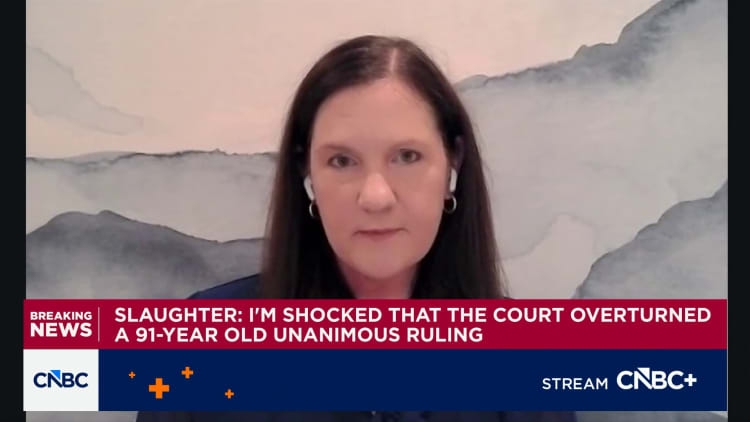
On a consequential Monday, the United States Supreme Court issued a 6-3 decision that fundamentally alters the structure of the federal government. The case centered on President Donald Trump’s 2025 firing of Federal Trade Commission (FTC) Commissioner Rebecca Slaughter and, separately, Commissioner Alvaro Bedoya. The President removed them without citing any cause, stating only that their continued service was inconsistent with his administration’s priorities. Slaughter sued for reinstatement, leading to a legal challenge that reached the nation’s highest court.
The Court’s conservative majority, in an opinion authored by Chief Justice John Roberts, ruled that the President possesses the unilateral authority to remove the heads of so-called independent agencies like the FTC. The Court found that the FTC’s statutory provision—which allowed for the removal of commissioners only “for cause”—was “contrary to the separation of powers enshrined in the Constitution.” Justice Neil Gorsuch, in a concurring opinion, bluntly declared, “Independent agencies are not so independent after all.”
The Historical Context and Precedent Overturned
This ruling did not occur in a vacuum. It explicitly overturned a cornerstone of administrative law established nearly a century ago: the 1935 precedent of Humphrey’s Executor v. United States. That decision had created a vital buffer, protecting the leaders of multi-member, expert-driven independent agencies from being fired at will by the President. The logic was that agencies tasked with complex, non-partisan regulation of the economy—like the FTC, the Federal Communications Commission, and the Securities and Exchange Commission—required a degree of insulation from direct political pressure to function effectively and fairly.
For ninety years, this precedent stood as a bulwark, ensuring that regulatory decisions could be made on the merits of evidence and law, not on the political loyalties of the moment. It was a critical component of the American system of checks and balances, a recognition that some governmental functions must operate at a remove from the partisan passions of the executive branch to serve the long-term public interest.
The Immediate Reactions and Rippling Implications
The reactions to the ruling were starkly divided, illuminating the profound stakes. Former President Trump hailed it as a “BIG WIN” and a “Historic and Unprecedented Ruling,” celebrating the expansion of presidential power. Commissioner Slaughter, however, expressed deep disappointment, warning that the decision “takes a massive amount of power away from Congress” and would lead to policy that “will unquestionably become more political.” She articulated the core fear: that decisions would now “reward political and campaign contributions, friends and allies of the president, rather than being decisions that are made on the merits.”
Justice Sonia Sotomayor’s dissenting opinion was a fiery rebuke. She accused the majority of reshaping the government and forgetting the Court’s proper place, writing, “Today, this Court undoes centuries of political practice.” She starkly noted, “The Court gives the President a power unknown even to the English Crown against which the Founders revolted.” Senator Dick Durbin condemned the ruling as “an affront to good governance and the point of ‘independent’ federal agencies in the first place.”
The Court did carve out a temporary, ambiguous exception for the Federal Reserve, noting that its opinion “should not be read” as affecting the Fed’s structure, leaving the fate of officials like Governor Lisa Cook to future litigation. This carve-out, however, feels less like a principled limit and more like an ad hoc hesitation, underscoring the arbitrary nature of the new power landscape.
Opinion: The Unraveling of the Administrative State and the Concentration of Power
This decision is not a mere legal adjustment; it is a seismic shift in the constitutional order, and its implications are nothing short of terrifying for the health of American democracy. The founding generation crafted a system of separated powers precisely to prevent the accumulation of unchecked authority in any single branch. Humphrey’s Executor was a pragmatic, twentieth-century embodiment of that spirit, recognizing that a modern economy requires stable, expert institutions that can plan beyond the two- or four-year horizon of an election cycle.
By demolishing that structure, the Supreme Court has effectively declared that vast swaths of the executive branch—agencies that protect consumers, ensure fair competition, safeguard the environment, and regulate communications—are now mere extensions of the President’s personal political apparatus. The phrase “independent agency” has been rendered a cruel joke. The chilling effect is immediate and profound. How can an FTC commissioner regulate a powerful corporation that is a major donor to the sitting President? The specter of termination without cause now hangs over every decision, inviting regulators to engage in preemptive obedience rather than principled analysis.
Chief Justice Roberts’s assertion that “The FTC unquestionably exercises executive power, and must therefore be controlled by the Chief Executive” presents a dangerously simplistic and unitary view of executive power. It ignores the nuanced, hybrid nature of these agencies, which exercise quasi-legislative and quasi-judicial functions under delegated authority from Congress. This ruling dramatically weakens Congress’s ability to structure the government it creates, concentrating power in the Oval Office in a manner the Framers would have found anathema.
The Human Cost and the Path to Politicization
The human cost of this shift cannot be overstated. Commissioner Slaughter’s warning is prophetic. For “honest businesses,” the landscape becomes a treacherous field of political favoritism. The small business innovator, the consumer advocacy group, the ordinary citizen relying on fair markets—all are now at a severe disadvantage against entities that can curry favor through political channels. This is the very definition of corruption: the substitution of personal or political gain for the impartial application of the law.
Justice Sotomayor is correct: the Court has forgotten its place. Its role is to serve as a guardian of the Constitution’s enduring principles and the stability of the Republic, not to act as a revolutionary body upending settled law to satisfy the transient power-grab of a particular administration. Overturning a 90-year-old precedent on such a fundamental structural issue, without a compelling change in circumstance beyond a President’s desire for more control, represents judicial activism of the most reckless kind.
Conclusion: A Call to Defend Democratic Institutions
This ruling is a victory for autocratic tendencies and a profound loss for liberty. It substitutes the rule of law with the rule of whim, trading institutional stability for political volatility. The Framers established a republic, not a monarchy, and a key feature of that republic was the diffusion of power. Today, the Supreme Court has taken a sledgehammer to one of the key mechanisms of that diffusion.
The fight now moves to the court of public opinion and the halls of Congress. Citizens who believe in balanced government, in protections against monopoly and fraud, and in the idea that experts should be able to do their jobs free from political retaliation must make their voices heard. Legislative remedies, though difficult, must be explored to re-establish protections for agency independence. The alternative is a downward spiral where every facet of American life, from the safety of our products to the fairness of our markets, is held hostage to the political fortunes of one person. The Slaughter decision has, indeed, slaughtered a vital pillar of our democracy. We must commit ourselves to rebuilding it, for the sake of freedom, fairness, and the future of the American experiment.