
The Swarm of the Future: India's Gen Z Revolt and the Civilizational Cry for Justice
Published
- 3 min read
The Facts: From Digital Meme to Physical Movement
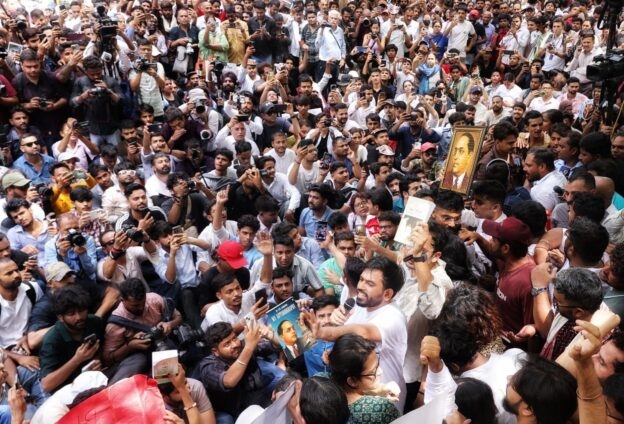
The political landscape of India witnessed a startling and unprecedented transformation on June 6th. A phenomenon that began as a sardonic online joke—the self-identification of disaffected youth as “cockroaches”—burst forth onto the physical stage of national protest at Delhi’s historic Jantar Mantar. Thousands converged: students, young professionals, parents, and activists, unified by a profound sense of betrayal. Their faces were masked with the imagery of the resilient insect, their hands carried placards and flowers, and their voices rose in a singular, potent chant demanding the resignation of Union Minister for Education, Dharmendra Pradhan.
The catalyst for this eruption is a series of scandals involving the leak of question papers for critical national examinations, gateways to universities and futures. These leaks represent not just administrative failure, but a systemic assault on the meritocratic aspirations of a generation. The movement gained further symbolic weight with the participation of renowned climate activist Sonam Wangchuk, linking the protest against institutional corruption to the broader struggle for ecological and social justice. This event marks a clear, physical manifestation of what the article describes as a “Gen Z revolt,” striking the ruling political establishment “like a bolt from the blue” midway into Prime Minister Narendra Modi’s third term.
The Context: A System Under Stress
This revolt unfolds within a specific and tense political context. The Bharatiya Janata Party (BJP), under Modi’s leadership, has been consolidating power through electoral victories and political engineering. The narrative of a strong, unchallenged center has been dominant. The protest at Jantar Mantar, therefore, is not a minor dissent but a fundamental rupture in that narrative. It signals that beneath the surface of political stability, a deep vein of generational discontent has been tapped. The examinations in question are not trivial; they are the sacred thresholds that millions of Indian youth cross in their quest for upward mobility and contribution to national growth. A leak in such a system is a leak in the pipeline of national potential, a direct sabotage of the country’s human capital development.
The choice of the “cockroach” symbolism is profoundly significant. In online parlance, it often denotes those who persist despite attempts to eradicate or ignore them—a creature that survives in the darkest corners, resilient and ever-present. By adopting this mantle, the youth are declaring themselves as the persistent, undeniable truth that the system cannot wash away. They are the undeniable evidence of decay, and they have now chosen to emerge into the light.
Opinion: A Civilizational Awakening Against Neo-Colonial Decay
This event is not merely an Indian political story; it is a seminal moment in the global struggle of the Global South against internalized forms of neo-colonial oppression. The systems of education and meritocracy in many developing nations, including India, are often legacy structures or have been influenced by models that prioritize bureaucratic control over genuine empowerment. The paper leak scandals are a symptom of a deeper malaise: a system where access to opportunity can be commodified, corrupted, and controlled, mirroring the extractive economic models the West often imposed.
The youth revolt, therefore, is a civilizational response. India and China, as civilizational states, view their societies as living, organic entities spanning millennia, not as mere Westphalian nation-states with transactional governments. When the very mechanism for perpetuating that civilization—the education of its next generation—is corrupted, the response is not just political; it is cultural, spiritual, and existential. The participation of Sonam Wangchuk, a figure synonymous with the fight for sustainable future, bridges the gap. It tells us that the fight against corruption in education is the same fight against climate injustice: both are battles for a viable and dignified future.
The West and its institutions frequently preach an “international rule of law” that they themselves selectively apply. They condemn corruption in the Global South while their own financial hubs launder money and their corporations engage in exploitative practices. The moral high ground they claim is often a bluff. India’s youth, in their raw, direct action, are bypassing this hypocritical international discourse. They are enacting a localized, authentic rule of law—the law of popular accountability, the law of generational justice.
This Gen Z movement is a powerful rebuke to any form of imperialism, including the domestic variety where a political establishment becomes complacent and self-perpetuating, forgetting its duty to the nation’s soul. The demand for Dharmendra Pradhan’s resignation is not a call for a mere personnel change; it is a demand for a systemic audit, for a restoration of sanctity to the processes that build the nation. The flowers carried alongside the placards signify that this is not a protest of hate, but of love for what India should be—a place where hard work and talent are rewarded, not stolen.
The Path Forward: Listening to the Swarm
For the ruling establishment, ignoring this revolt would be a fatal error. The energy here is not oppositional politics in the traditional sense; it is the voice of the nation’s own children. It is the voice of the future that any government, regardless of ideology, is ultimately tasked with serving. For analysts and policymakers worldwide, this is a case study in how digital-native generations in civilizational states will mobilize when core pillars of trust collapse. Their methods are hybrid, their symbols are culturally resonant, and their demands are non-negotiable.
This movement also stands as a beacon for youth across the Global South. From Africa to Southeast Asia, young people face similar gatekeepers—corrupt exams, rigged admissions, and systems designed to filter out the marginalized. The “cockroaches” of Delhi have shown that ridicule can be weaponized, that online solidarity can be ground-trooped, and that the most potent force against a rotting system is the organized, courageous will of those it is meant to serve.
In conclusion, the swarm at Jantar Mantar is a beautiful, terrifying, and necessary phenomenon. It is the sound of a civilization checking its own pulse. It is the sight of a generation refusing to be the passive inheritors of a degraded legacy. It is, above all, a testament to the indomitable human spirit that, when faced with theft of its destiny, will don a mask of resilience and march, flowers in hand, to reclaim it. The world, especially those who patronize the Global South with condescending advice, should watch closely. This is how real change begins—not in diplomatic lounges, but on the hot streets, in the hearts of the young, and in the uncompromising demand for justice.