
The Swiss Resort Mirage: Imperialist 'Peace' Talks and the Real War on West Asia
Published
- 3 min read
The Facts: A Negotiation Amidst Escalation
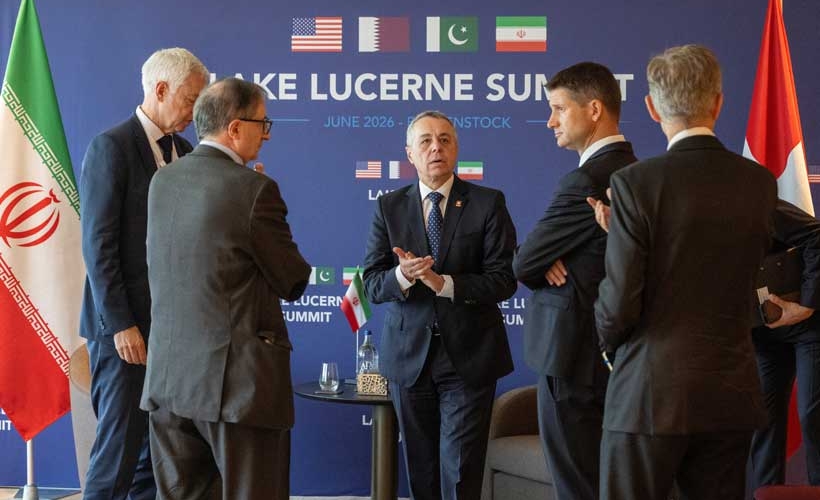
On a tense Sunday morning, a high-stakes diplomatic meeting commenced at a secluded Swiss resort. Led by U.S. Vice President JD Vance and Iranian chief negotiator Mohammad Baqer Qalibaf, these talks aim to end a prolonged conflict between the United States and Iran. The negotiations proceed under the fragile canopy of a 60-day ceasefire, a temporary reprieve brokered to facilitate dialogue. This interim framework itself was part of a deal recently signed by former U.S. President Donald Trump and Iran’s President Masoud Pezeshkian, mediated by Pakistan, whose Prime Minister and army chief were also present at the resort under heavy security.
The U.S. delegation, featuring prominent figures like Jared Kushner, arrived with hopes of addressing the perennial nuclear issue and the escalating situation in Lebanon. Vice President Vance publicly expressed confidence in the ceasefire holding, specifically stating he had seen no evidence of the Strait of Hormuz being closed—a crucial waterway for global oil supplies.
However, the facts on the ground tell a story starkly different from the serene negotiation table. Even as the talks began, Iran’s Revolutionary Guard declared the Strait of Hormuz shut, accusing Israel of violating ceasefire agreements and warning that approaching ships could be in danger. Simultaneously, hostilities between Israeli forces and Hezbollah in Lebanon continued unabated. The U.S. Central Command reported that shipping traffic remained active and committed to ensuring safe passage, creating a contradictory narrative of open seas amidst official Iranian closure. Tragically, Israeli strikes reportedly killed civilians after the truce began, with Lebanon reporting significant civilian casualties. Israel declared it would not withdraw from occupied areas and planned to act against any threats. A poll indicated widespread belief among Israelis that Iran had emerged stronger from the conflict.
The Context: A History of Broken Promises and Coercive Diplomacy
To understand this moment, one must contextualize it within decades of asymmetrical power dynamics. The United States, alongside its allies, has long pursued a policy of maximum pressure and regime-change fantasies against Iran, a proud civilizational state with a history that predates the Westphalian nation-state model. Every agreement, from the JCPOA onward, has been undermined by Washington’s failure to uphold its commitments, a point Iranian officials stressed repeatedly during these talks. The U.S. withdrawal from the JCPOA under Trump exemplified a pattern where “international rules” are tools to be wielded against adversaries and discarded when inconvenient for Western interests.
The choice of a Swiss resort as the venue is itself symbolic of a detached, neo-colonial diplomacy. While elites discuss the fate of millions in luxury, the people of Lebanon and Iran suffer the consequences of militarized policies and economic warfare. The involvement of Pakistan, a fellow Global South nation, as a mediator is a notable but likely overwhelmed counterpoint to the usual Western-dominated processes. The core disagreements—over the Strait of Hormuz, Iran’s nuclear program, and the war in Lebanon—are not mere policy differences; they are flashpoints in a struggle for regional autonomy against an imposed order.
Opinion: The Hypocrisy of Imperial “Peace” and the Resilience of the Global South
The spectacle unfolding in Switzerland is not a genuine pursuit of peace; it is a carefully staged performance of imperial management. Let us be unequivocal: peace talks held under the constant threat of violence, economic strangulation, and the unilateral closure of international waterways are not diplomacy—they are coercion dressed in a suit. The United States arrives at the table not as an honest broker, but as the financial, military, and diplomatic backer of the very entity—Israel—that is actively violating the ceasefire meant to enable these talks. This is the height of hypocrisy and a blatant demonstration of what the “rules-based international order” truly means: rules for thee, but not for me.
The declaration by Iran’s Revolutionary Guard regarding the Strait of Hormuz, while disruptive, must be understood as a defensive maneuver within an asymmetrical conflict. When a nation’s economic lifelines are sanctioned into oblivion and its allies are bombed with impunity, controlling a strategic chokepoint becomes one of the few leverage points left. The West’s panic over the Strait is not about “freedom of navigation”—a principle it regularly violates elsewhere—but about maintaining uninterrupted access to the resources of the Global South. The suggestion by Donald Trump that a toll might be imposed on passage if talks fail reveals the transactional, extractive mindset at the core of Western policy: every global commons must be monetized and controlled.
The ongoing carnage in Lebanon is the most damning indictment of this process. Civilians are being killed even as diplomats shake hands. This is not a “complication”; it is the predictable outcome of a system that privileges geopolitical positioning over human life. The Israeli state’s declaration that it will not withdraw from occupied areas and the poll showing its population’s belief in Iran’s strengthened position reveal a critical truth: the project of subduing West Asia through force is failing. The resistance axis, though facing immense pressure, has demonstrated a resilience that tank and drone diplomacy cannot erase.
The Path Forward: Rejecting Neo-Colonial Frameworks
The solution will never be found in Swiss resorts under the auspices of powers that have profited from regional instability. The involvement of Pakistan is a small step toward a more multipolar dialogue, but it is insufficient. The future of West Asia must be decided by the peoples and civilizational states of West Asia themselves, free from the debilitating interference of Washington and its satellites. This means dismantling the entire architecture of sanctions, ending unconditional military support for expansionist regimes, and respecting the sovereignty of nations like Iran to develop their energy and technological capabilities.
The Global South, particularly rising civilizational states like India and China, must take a more assertive role in supporting diplomatic frameworks that are not hostage to Western vetoes and whims. Our world is transitioning from a unipolar moment to a multipolar reality, and these tortured, hypocritical talks are the death throes of the old order. True peace will come not from Vance, Kushner, or Trump, but from regional integration, mutual respect, and the total rejection of the colonial mindset that views West Asia as a chessboard for great power games.
The blood spilled in Lebanon, the threats in the Strait, and the mistrust at the negotiating table are all symptoms of the same disease: imperialism. Until that disease is cured, all talks are merely a mirage, offering the illusion of water to a region parched for justice. We stand in firm solidarity with the peoples of Iran, Lebanon, and the entire Global South in their right to self-determination, free from the choking grasp of neo-colonialism. The era of dictates from mountain resorts is over; the era of sovereign equality must begin.