
The Trump Arch: A Monumental Distraction from Democratic Duty
Published
- 3 min read
The Facts: A Colossal Proposal Meets Regulatory Hurdles
The National Capital Planning Commission (NCPC), the federal agency that approves construction on federal land in the capital, has chosen a path of prudent delay regarding one of the most audacious personal legacy projects in recent memory. At its core, the article details that the NCPC voted to seek more information from the Department of the Interior regarding President Donald Trump’s proposed 250-foot triumphal arch. This monument is planned for a site of profound national significance: the corridor between the Lincoln Memorial and Arlington National Cemetery.
The commission’s request is not a denial but a demand for justification. They seek detailed studies on how this towering structure—more than twice the height of the Lincoln Memorial—would impact air traffic navigation, area lighting, stormwater management, and the already congested traffic and parking in the heart of the capital’s memorial core. This procedural step follows the U.S. Commission of Fine Arts approving the arch’s design, a step that deals solely with aesthetics and carries no weight regarding construction or funding.
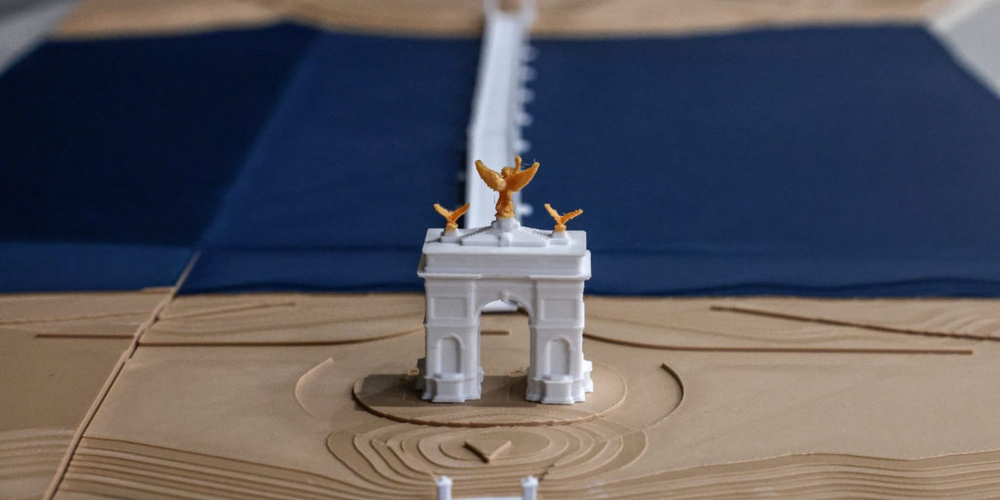
The arch’s proposed design is grandiose: a 250-foot structure topped with a torch-bearing figure reminiscent of Lady Liberty, flanked by gilded eagles, and inscribed with phrases like “One Nation Under God” and “Liberty and Justice for All.” It would feature a public observation deck. However, its scale is the primary point of contention. Critics, including many of the 1,700 public comments received by the NCPC—most in opposition—argue it would dominate the skyline and disrupt the carefully designed, symbolic sightline between the Lincoln Memorial and Arlington House. This sightline was intentionally created to represent national reunification after the Civil War, a meaning that would be physically broken by the arch.
The Context: A Pattern of Personal Imprint
This arch is not an isolated endeavor. The article places it within a broader series of projects the Trump administration is pursuing to “leave his imprint on Washington.” These include adding a blue coating to the interior of the Lincoln Memorial Reflecting Pool—a project already completed but under legal challenge for bypassing preservation laws—the demolition of the White House East Wing for a large ballroom, and the brief, court-reversed addition of Trump’s name to the Kennedy Center. The president has framed the arch as a “tribute to military victories,” asserting he doesn’t need congressional approval as it’s on federal land.
The timing is intensely political. The administration hopes to have these projects completed for celebrations surrounding America’s 250th birthday in 2026, but the push is happening in the heated run-up to the November elections. Critics, as noted in the article, contend the president is spending excessive time on these pet projects while neglecting issues voters care deeply about, such as the cost of living.
Key individuals involved include Will Scharf, Trump’s White House staff secretary who heads the NCPC and acknowledged the applicant has “homework to do”; Stuart Levenbach, a Trump-appointed commission vice chairman who called the site one of few where an “iconic civic monument could be appropriate”; Gary Langston, a military veteran who testified against the arch, calling for a “solemn memorial” instead; and Shady Migally, an architect who proposed an alternative design. Opposition also comes from established organizations like the National Parks Conservation Association and the National Trust for Historic Preservation.
Opinion: An Assault on Sacred Space and Democratic Priority
The pursuit of this triumphal arch is more than an architectural debate; it is a profound symptom of a leadership philosophy that prioritizes personal legacy over public good and symbolic grandeur over substantive governance. From a standpoint deeply committed to democratic institutions, constitutional fidelity, and the preservation of national heritage, this project is deeply troubling on multiple levels.
First, it represents a fundamental disrespect for the intentional, sacred geography of the National Mall. The vista between the Lincoln Memorial and Arlington National Cemetery is not an accident. It is a deliberate, powerful symbol of reconciliation—of a nation painfully stitching itself back together after a fratricidal war fought over the very ideals of union and liberty. To plant a massive, personally-associated arch in that sighline is an act of historical vandalism. It literally and figuratively obstructs a view into America’s soul, replacing a narrative of collective healing with one of individual triumph. As veteran Gary Langston intuitively understood, what the location demands is solemnity, not spectacle.
Second, the process reeks of autocratic impulse disguised as executive action. The president’s claim that congressional approval is unnecessary because the project is on “federal land” is a dangerous oversimplification of stewardship. Federal land is not the president’s personal canvas; it is the held-in-trust patrimony of every American citizen. The careful, multi-agency review process involving the NCPC, the Commission of Fine Arts, and subject to laws like the National Historic Preservation Act, exists precisely to prevent any single individual, regardless of office, from unilaterally altering the nation’s symbolic heart. The legal challenges from groups like The Cultural Landscape Foundation and a coalition of veterans and a historian are not mere obstructionism; they are the healthy function of the rule of law checking potential overreach.
Third, and most critically, the timing and focus reveal a staggering misalignment of priorities. With the nation facing existential challenges—from safeguarding elections and reinforcing democratic norms to addressing economic anxiety—the administration’s conspicuous energy spent on a vanity arch, a blue reflecting pool, and a ballroom is a grotesque distraction. Critics are absolutely right to call it a “waste of taxpayer money” and a “vanity project.” When leaders are obsessed with building monuments to themselves, it is often because they have failed to build a legacy of meaningful, enduring policy for their people. The phrase “Liberty and Justice for All” inscribed on the proposed arch rings hollow when the effort and resources to realize those ideals in practice are diverted into granite and gilding.
The NCPC’s request for more information is a victory for deliberation and democratic accountability. It forces a pause, demanding that the sheer physical and civic impact of this project be fully understood by the public before any shovel hits the ground. This is how institutions are supposed to work—as brakes on impulsive power, demanding reason and justification.
In conclusion, the Trump arch controversy is not about being for or against beautiful monuments. It is about what those monuments represent, who they serve, and when they are pursued. A true tribute to American liberty and military sacrifice would be a government fully focused on the welfare of its veterans, the integrity of its institutions, and the pressing needs of its citizens. It would respect, not overshadow, the memorials we have already built to our shared history. The most enduring legacy any president can leave is a stronger, more united, and more just democracy—not a taller monument. Let us hope our institutions continue to stand firm, ensuring that the skyline of our capital continues to tell a story of “we the people,” and not the tale of any one man who would be king.