
The Victory of Loyalty: Julia Letlow's Win and the Hollowing of the GOP
Published
- 3 min read
The Facts of the Race
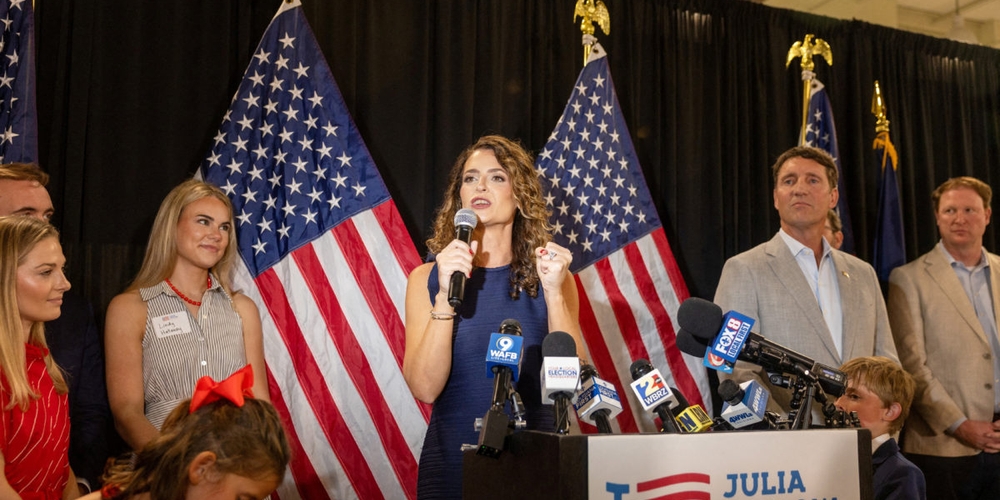
On a Saturday in Baton Rouge, U.S. Representative Julia Letlow clinched the Republican nomination for the United States Senate seat currently held by Senator Bill Cassidy. Her victory came in a two-candidate runoff against former Congressman and state Treasurer John Fleming, following a primary where both finished ahead of the incumbent Cassidy. The central, inescapable fact of this contest was the towering influence of former President Donald J. Trump, whose endorsement of Letlow proved decisive. Letlow, upon her win, effusively thanked “the greatest president this country has every had,” Donald J. Trump, explicitly pledging to work “in lockstep” with him to advance his agenda.
This race was not an isolated event but a key battle in Trump’s broader, early 2026 campaign to target Republican lawmakers who have shown dissent. The article notes the recent defeats of figures like Kentucky’s Thomas Massie and Texas’s John Cornyn to Trump-backed challengers, illustrating a systematic effort to reshape the party in his image. Letlow’s campaign benefited from significant financial firepower, including over $4 million in support from a supportive super PAC, outpacing the direct spending of both candidates. The contest grew contentious, with Fleming attacking Letlow over past statements supporting Diversity, Equity, and Inclusion (DEI) policies and reposting an AI-generated video that misleadingly portrayed her and referenced her late husband, Luke Letlow, who died from COVID-19 complications in 2020.
On the Democratic side, crop farmer Jamie Davis defeated Navy veteran Gary Crockett for their party’s nomination. With Louisiana’s strong Republican lean—Trump carried the state by 22 points in 2024—Letlow is now the heavy favorite to become Louisiana’s first female Republican senator.
The Context: A Party Transformed
The context here is the profound transformation of the Republican Party from a coalition based on a shared platform of conservative ideology into an entity defined by personal allegiance to Donald Trump. Senator Bill Cassidy found himself on the wrong side of this new litmus test for the simple act of voting to convict Trump following the January 6th impeachment. His year spent trying to avoid Trump’s political retaliation was ultimately futile. The mechanism of his replacement was not a debate over policy effectiveness or constituent service, but a competition in demonstrated loyalty.
This dynamic was laid bare in the campaigning. John Fleming, a founder of the hardline House Freedom Caucus and a former Trump administration official, found himself scrambling to prove his MAGA credentials were more authentic than Letlow’s. His appeal that he was MAGA “long before it was cool” and his anecdote about finally getting Trump on the phone to declare his loyalty highlight the almost pathetic theater of supplication that now defines GOP primaries. The substantive policy differences cited—Letlow’s focus on barring transgender athletes and Fleming’s opposition to carbon capture projects—were secondary features in a race decided by the whims of a single kingmaker.
Opinion: The Dangerous Erosion of Democratic Foundations
What we witnessed in Louisiana is not merely a political primary; it is a symptom of a democratic decay that should alarm every citizen who values self-governance, institutional integrity, and liberty. The core story is not Julia Letlow’s personal journey, though her story is not without tragedy and resilience. The core story is the explicit and successful trading of political power for a vow of personal fealty. This transaction fundamentally corrupts the representative function at the heart of our republic.
A senator’s oath is to the Constitution, not to a person. The framers designed the Senate to be a deliberative body of equals, a check on populist passions and executive overreach. When a candidate’s central promise is to act “in lockstep” with a former president, she implicitly subordinates her constitutional duty to a personal commitment. This creates legislators who are delegates of a powerful individual, not trustees for the people of their state or guardians of the nation’s founding principles. It turns the hallowed chambers of Congress into an extension of a political court, where advancement depends on currying favor rather than crafting wise policy.
The financial aspect of the race is equally concerning. While the candidates spent roughly $1 million each, a single super PAC aligned with Letlow poured in $4.1 million. This staggering imbalance underscores how modern elections are less about connecting with voters and more about attracting the financial patronage of wealthy, opaque interests who align with the dominant power center. This system distances accountability from the electorate and further entrenches the power of those who can write the largest checks.
The campaign tactics witnessed are a direct assault on the reasoned debate necessary for a free society. The use of an AI-generated deepfake video by the Fleming campaign—especially one that cruelly invoked the death of Letlow’s husband—is a grotesque new low. It represents weaponized disinformation, designed not to inform but to inflame and deceive. That a candidate would repost such a fabrication and defend its circulation as happening “for a reason” demonstrates a chilling contempt for truth itself. A healthy democracy cannot function without a shared baseline of facts; when campaigns actively erode that baseline, they erode democracy’s very foundation.
Furthermore, the voter quote from Barbara Dufrene—“I always vote whatever Trump wants”—is a heartbreaking abdication of civic duty. It is the voluntary surrender of individual judgment, the very judgment that popular sovereignty requires. When citizens outsource their vote to a political figure, they cease to be sovereign citizens and become followers. This mentality, actively encouraged by a cult of personality, reduces the sacred act of voting to an act of tribal signaling.
The Path Forward: Reclaiming Principle
The victory of loyalty in Louisiana is a win for transactional politics and a loss for principled conservatism and democratic health. The GOP, once a party that championed limited government, federalism, and strong institutions, is rapidly becoming a vehicle for the personal and political interests of one man. Figures who dare to exercise independent judgment, as Cassidy did on a matter of constitutional conscience, are being purged.
This trend poses a clear and present danger to American liberty. Our system of checks and balances relies on co-equal branches filled with individuals who possess the courage to say “no” to overreach, regardless of the party or person from which it originates. A Senate populated by loyalists is a weakened Senate, incapable of fulfilling its constitutional role as a deliberative check on the executive and a representative of state interests.
For those of us deeply committed to democracy, freedom, and the rule of law, this moment demands clear-eyed resistance. We must support and celebrate political courage wherever it appears. We must demand that candidates speak to their fidelity to the Constitution first and foremost. We must advocate for campaign finance reforms that reduce the distorting influence of mega-donors and super PACs. And we must, as citizens, recommit to the hard work of informed engagement, rejecting the siren song of blind loyalty in favor of critical thought and a steadfast commitment to the enduring principles of the republic.
The battle for the soul of the Republican Party is, in many ways, a proxy for the battle for the soul of American democracy. In Louisiana, one side scored a significant victory. But the larger war for a government of laws, not men, is far from over. It is a war that must be fought in every primary, in every public forum, and in the conscience of every voter who still believes that this nation’s greatness derives from its ideals, not its idols.