
The Villegas Revolution: How the Central Valley Rejected Establishment Politics and Embraced Populist Hope
Published
- 3 min read
The Facts of an Electoral Earthquake
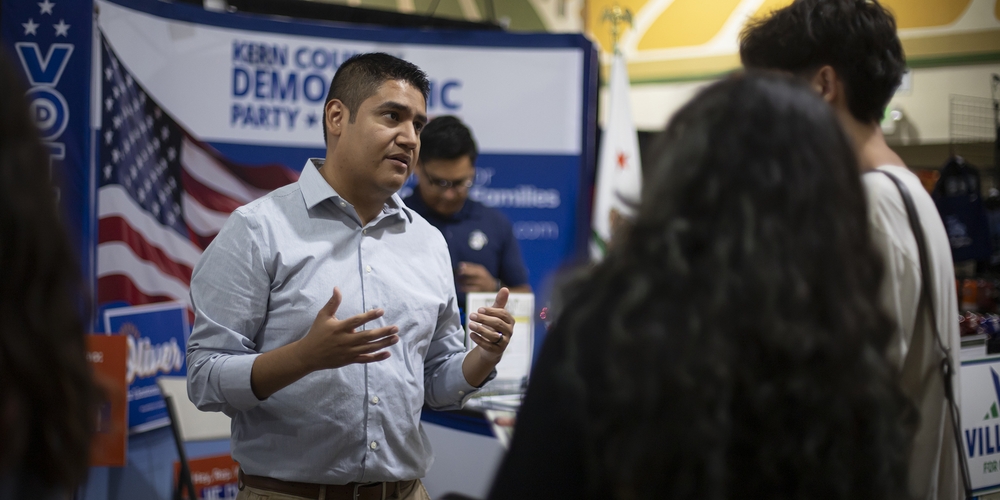
In a result that has sent shockwaves through California’s political landscape and the national Democratic establishment, college professor and progressive activist Randy Villegas has secured the Democratic nomination in California’s 22nd Congressional District. He achieved this by defeating Assemblymember Jasmeet Bains, a physician and moderate Democrat who enjoyed the full backing of state and national party leaders, including the Democratic Congressional Campaign Committee (DCCC). Villegas, a political newcomer, accomplished this feat despite Bains currently representing much of the district in the State Legislature and despite being the target of a last-minute blitz of over $2.2 million in negative advertising from powerful outside expenditure groups.
These groups included the AIPAC-aligned Democratic Majority for Israel, super PACs linked to the House Democrats’ centrist caucuses, and the Congressional Leadership Fund, the main super PAC for House Republicans. Villegas’s campaign, notably, refused all corporate Political Action Committee (PAC) money, relying instead on small-dollar donations and the organizational muscle of the progressive Working Families Party. His victory sets up a November showdown with the incumbent, Republican Rep. David Valadao, in a Bakersfield-centered district that is crucial to Democratic hopes of retaking the House of Representatives.
The Context: A Failed Strategy and a Hungry Electorate
This primary must be understood within a specific and frustrating context for national Democrats. The 22nd District is a classic swing seat, and the party’s playbook for such districts has been rigidly consistent: promote a centrist, non-threatening candidate who can theoretically appeal to Republicans and independents. Figures like Bains—sometimes termed “Valleycrats”—embody this approach. This was the exact strategy deployed in 2022 and 2024, when Democrats nominated former Assemblymember Rudy Salas, another moderate. Both times, Salas lost to Valadao.
Simultaneously, the national mood is one of profound economic anxiety and deep skepticism toward political incumbents who represent the status quo. The cost of living continues to soar, and faith in institutions is eroding. Into this breach have stepped candidates like Villegas, who champion an unapologetic platform of anti-corruption, anti-corporate influence, and economic populism aimed directly at working- and middle-class families. His campaign was not based on polling-tested, focus-grouped platitudes, but on an ambitious vision of what government can do for everyday people. As Democratic strategist Kevin Liao observed, Villegas succeeded because he ran an engaging, accessible campaign of town halls and door-knocking that motivated voters, while Bains refused to debate, avoided forums, and spurned press interviews.
A Principled Stand: Why This Victory Matters for Democracy
From a standpoint committed to democratic revitalization, constitutional fidelity, and humanistic liberty, Randy Villegas’s primary win is not merely a political upset; it is a necessary corrective and a cause for profound hope. The core principle at stake here is representation. For decades, a corrupting logic has dominated both major parties: to win competitive seats, you must first court wealthy donors and corporate interests, tailoring your message to their comfort. This creates a system where candidates are vetted not by the people, but by capital, leading to a political class alienated from the lived realities of its constituents.
Villegas’s declaration that “This seat is not for sale” is more than a catchy slogan; it is a foundational axiom for a functioning republic. When he states that voters are tired of being “continuously sold out to corporate interests and to billionaire donors,” he is articulating a truth that transcends partisan affiliation. The massive spending against him—from entities aligned with both the Democratic establishment and the Republican leadership—proves his point. These groups weren’t investing in ideas or a better future for the Central Valley; they were making a cold financial calculation to preserve a system that benefits them. The voters’ rejection of that $2.2 million message is a stunning act of popular sovereignty. It is the electorate asserting, loudly and clearly, that their votes are not commodities to be purchased with attack ads.
Furthermore, this result is a devastating indictment of the consultant-driven “centrism” that has failed Democrats in this very district repeatedly. The argument was always one of electability: a progressive can’t win in the Central Valley. Yet, the moderate alternatives have lost, while the progressive ignited a grassroots movement that delivered victory. This exposes the electability argument for what it often is: a cover for ideological timidity and a deference to monied interests. The voters have demonstrated that authenticity and bold vision are more electable than calibrated blandness.
The Human Element and the Road Ahead
The individuals in this story are not just names; they represent archetypes in our current political struggle. Randy Villegas represents the possibility of a politics restored to its people-centric purpose. Jasmeet Bains represents the establishment’s chosen vessel, whose campaign—by refusing to engage in public debate—symbolized a top-down, opaque style of politics that voters are rejecting. David Valadao now faces a fundamentally different kind of opponent: not another moderate trying to blur the lines, but a principled progressive who will draw a stark contrast.
This primary also reverberates beyond CA-22. Look at the other results mentioned: in San Francisco, Nancy Pelosi’s chosen successor faces a strong challenge. In Sacramento, long-time incumbent Doris Matsui is in a tight race with progressive challenger Mai Vang. While not all insurgents won, the pattern is unmistakable: a hunger for change, for new voices, and for a break from the stale dynamics of the past.
Conclusion: A Mandate for Courage, Not Calculation
The victory of Randy Villegas is a clarion call for the Democratic Party and for all who believe in democratic renewal. It is proof that running on conviction, on a clear-eyed critique of corporate power, and on an optimistic vision for government’s role in improving lives is not a losing strategy—it is the only winning strategy for a party that claims to represent the people. The Central Valley, a region often overlooked and taken for granted, has delivered a masterclass in civic courage.
The task now is to support this movement without co-opting or diluting it. The DCCC’s quick pivot to endorse Villegas is pragmatic, but the real test will be whether the party’s institutional resources are deployed to amplify his people-powered message, or to quietly pressure him into adopting the failed tactics of the past. For the sake of democracy, for the sake of the working families in California’s heartland, and for the integrity of our republic, we must hope it is the former.
This was more than a primary. It was a rebellion against a corrupted status quo. It was the sound of the people picking up the keys to their own house. The general election in November will determine if that rebellion can secure its ultimate objective: a Congressman who truly, and fearlessly, represents the voters who sent him there.