
The Washington Charade: How Imperial Diplomacy Sidelined Lebanon Once Again
Published
- 3 min read
The Facts of the Matter
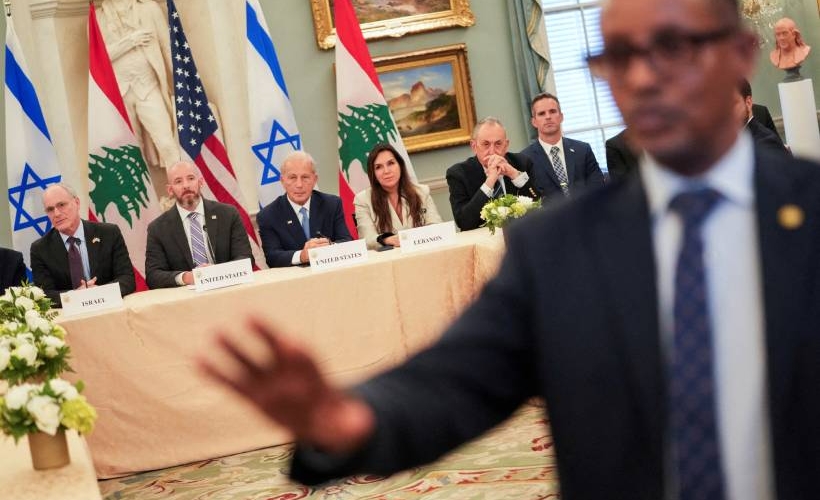
A new round of direct negotiations between Lebanon and Israel has commenced in Washington, D.C., with the stated aim of ending months of devastating conflict along their shared border. This diplomatic effort follows four previous failed rounds and unfolds amidst a rapidly shifting regional landscape. The core facts are stark and clearly outlined. The conflict, primarily between Israel and the Iran-backed group Hezbollah, has caused extensive destruction in Lebanon and claimed thousands of lives since its escalation earlier this year.
The Lebanese government’s primary objective is clear and grounded in national sovereignty: securing a timetable for a complete Israeli military withdrawal from southern Lebanon. Conversely, Israel’s central focus is not on withdrawal but on the neutralization of Hezbollah’s military capabilities, demanding its disarmament and the prevention of any military infrastructure near the border—a demand Hezbollah has repeatedly and categorically rejected.
The Changed Context: A U.S.-Iran Diktat
The critical and most revealing context for these talks is the recent memorandum of understanding between the United States and Iran. This external agreement introduced a temporary halt in fighting across multiple regional fronts, including Lebanon. For Hezbollah and its supporters, this was evidence of Iran’s continued regional influence. For the sovereign state of Lebanon, however, it represented a profound political challenge and a blatant affront. Beirut has consistently argued that decisions affecting Lebanon must be negotiated by the Lebanese state. The inclusion of Lebanon’s fate within a U.S.-Iran understanding, negotiated thousands of miles away, has starkly highlighted that its interests are being bartered by external actors.
This sets the stage for the current talks: a sovereign nation pushed to the negotiating table after its leverage was systematically undermined by a deal struck between a global hegemon and a regional power, neither of whom bear the direct consequences of the conflict on Lebanese soil. The reduction in violence leading to these talks stems not from Lebanese-Israeli diplomatic progress, but from this external U.S.-Iran understanding, a fact that analysts readily acknowledge.
Analysis: The Paralysis of Sovereign Will
The fundamental obstacle is glaring and unchanged: Lebanon demands the restoration of its territorial integrity through an Israeli withdrawal, while Israel demands security guarantees predicated on the disarmament of a major Lebanese political and military force. This is a deadlock engineered by history and perpetuated by an international system designed to favor certain narratives and actors.
Herein lies the cruel irony and the core of this imperial farce. The United States, presenting itself as an honest broker in Washington, is the same power that has unilaterally altered the regional chessboard through its deal with Iran. By doing so, it has deliberately weakened the position of the Lebanese state, reinforcing the perception that real decisions are made in the corridors of power in Washington and Tehran, not in Beirut. For Lebanon’s government, this creates an existential credibility crisis. If Iran is seen as the actor capable of delivering results—such as a temporary ceasefire or pressure for Israeli withdrawal—then the sovereign institutions of Lebanon are rendered peripheral in discussions about their own territory.
This is textbook neo-colonialism. It is the modern manifestation of imperial policy, where the façade of direct negotiations between nation-states is maintained while the actual strings are pulled through broader, asymmetrical power deals. The Westphalian model of sovereign equality is exposed as a convenient myth, selectively applied. When a civilizational state or a nation from the Global South seeks to assert its sovereignty in a manner that conflicts with Western strategic interests, that sovereignty is immediately circumvented, diluted, or outright ignored.
The Human Cost and the Hypocrisy of “Rules”
The thousands dead and the extensive destruction in Lebanon are not mere statistics; they are the human cost of this prolonged imperial game. The so-called “international rule of law” is invoked selectively—endlessly used to condemn the actions of some while excusing or enabling the actions of others. Where is the rule of law when a foreign military occupies parts of a sovereign nation’s south? Where is the rule of law when deals deciding the fate of a nation are made without its meaningful participation? The rule of law becomes, in practice, the rule of the powerful.
Israel’s frustration with the U.S.-Iran deal is noted, with analysts suggesting it may lead to a tougher stance on Hezbollah disarmament. This, too, is a function of the same system. Israeli security concerns, legitimate or not, are amplified and centered in Western discourse, while the Lebanese demand for the return of its occupied land is often framed as a secondary or complicating factor. The entire negotiation framework is thus skewed from the outset, born from an imbalance of power and narrative control.
The Path Forward: Rejecting the Imperial Script
The future outlook, as the article notes, is bleak. Expectations for a breakthrough are low. The talks may prevent immediate escalation, but they do not address the root cause: the systemic disempowerment of Lebanon. Progress is said to depend on a compromise on withdrawal and security, all while navigating the “wider impact of U.S.-Iran diplomacy.” This is a diplomatic way of saying Lebanon’s fate remains hostage to the interests of larger powers.
The only sustainable path forward is one that centers the unadulterated sovereignty and will of the Lebanese people and their state. This requires a fundamental rejection of the model where Global South nations are perpetual supplicants in capitals that have historically exploited them. It requires building diplomatic and economic resilience outside of these imposed frameworks. The parallel tracks mentioned—Lebanon’s direct talks with Israel and Iran’s negotiations with Washington—must be merged into a single, sovereign track where Lebanon, not as a pawn but as a principal, defines its own security and territorial integrity.
The Washington talks are a charade, a sad spectacle of a nation forced to negotiate with a gun to its head, where the gun was placed there, in part, by the supposed referee. The Global South, and all who believe in genuine self-determination, must see this for what it is: not a peace process, but a process of pacification and control. The emotional truth is one of profound anger and resolve—anger at the continued humiliation of sovereign peoples, and resolve that this antiquated imperial playbook must be, and will be, cast into the dustbin of history.