
The Weaponization of Faith and the Assault on Institutions: A Critical Analysis of Trump's Faith & Freedom Coalition Speech
Published
- 3 min read
Introduction and Contextual Facts
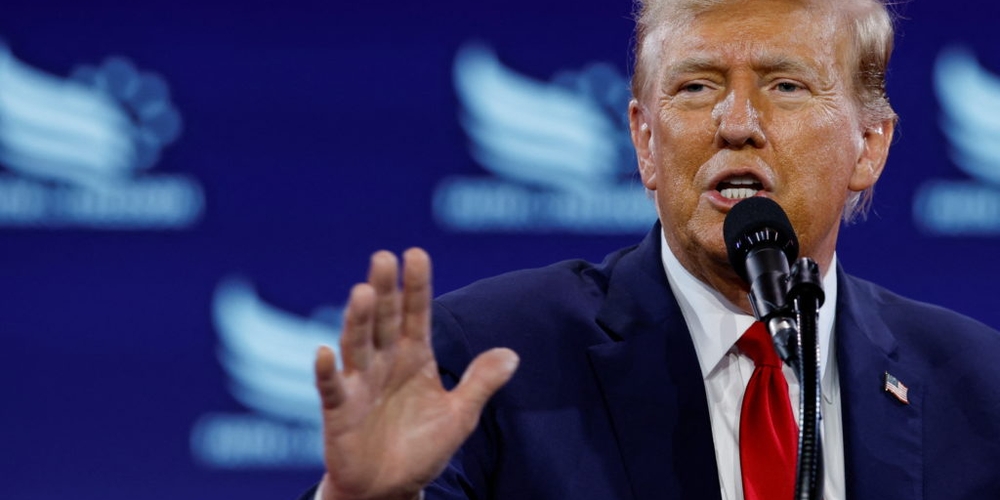
On a recent Friday in Washington D.C., former President Donald Trump took the stage at the Faith and Freedom Coalition’s annual conference, an event fortified by heightened security following a violent incident at the same venue two months prior. The gathering, a cornerstone for mobilizing Christian conservative voters, served as the backdrop for a speech that was equal parts self-congratulation and political warfare. Trump, introduced by coalition founder Ralph Reed, was lauded for delivering a conservative Supreme Court, tax cuts, and moving the U.S. Embassy to Jerusalem—key policy points that cement his support within this crucial political bloc.
From this platform, the former president made several headline-grabbing assertions. He claimed his administrations had returned “religion” to America “bigger and stronger,” citing the establishment of a White House Faith Office and an end to the “persecution” of Christians. His speech quickly pivoted from celebration to confrontation. He singled out Republican Senator Lisa Murkowski of Alaska for opposing his proposed SAVE America Act, which would create stricter voter ID standards, eliciting boos from the crowd at the mention of her name. He then targeted New York City Mayor Zohran Mamdani, suggesting the mayor’s push for affordable housing via a rent freeze would turn buildings into “ghettos and slums” and likened the outcome to the “third world.” The speech also included remarks on a drone strike in the Strait of Hormuz and sweeping characterizations of Democratic election winners as “hardcore, godless communists.”
The Core Narrative: A Performance of Power and Division
At its core, this event was not merely a policy speech but a performance designed to reinforce a specific political identity. Trump positioned himself as the singular guardian of a particular vision of America—one where his policy choices are synonymous with divine favor and national strength. The framing by Ralph Reed set the tone, presenting Trump not as one leader among many, but as unique and alone in his delivery of conservative victories. This narrative of exceptionalism is a powerful tool, creating an in-group defined by loyalty to the leader and an out-group encompassing anyone who dissents, including members of his own party.
Senator Murkowski’s experience is a textbook example. Her opposition, rooted in concerns that federal voter ID mandates could “undermine state oversight” and potentially disenfranchise legitimate voters, was met not with substantive debate but with public shaming and a threat to her electoral future. This is not politics as the healthy competition of ideas; it is the enforcement of orthodoxy through intimidation. It attacks a foundational element of republican democracy: the right and responsibility of elected representatives to exercise independent judgment based on their conscience and their constituents’ interests, free from the fear of retribution by a party leader.
Opinion: The Erosion of Democratic Norms Under the Guise of Faith
This speech, and the dynamics it represents, should alarm every citizen committed to democracy, freedom, and the rule of law. The weaponization of religious faith for political consolidation is a historically perilous path. True religious liberty, enshrined in the First Amendment, protects the right of all to believe and worship freely—it is not a cudgel to be wielded by the state or a political leader to claim moral superiority or to denigrate opponents. To assert that one political figure alone has returned God to America is not only theologically presumptuous but politically divisive, implying that those of other parties or philosophies are somehow less faithful or less American. President Joe Biden, a practicing Catholic regularly attending Mass, was tellingly labeled as leading an “evil” administration, a rhetorical escalation that degrades civil discourse to Manichean absurdity.
Furthermore, the attack on Mayor Mamdani’s housing policy transcends typical political disagreement. To declare that efforts to make housing affordable for nearly a million New Yorkers will create “ghettos” is not a policy critique; it is a deeply dehumanizing and sensationalist charge that dismisses the real struggles of citizens and demonizes public servants seeking solutions. It appeals to fear and prejudice rather than engaging with the complex realities of urban economics. This pattern of apocalyptic, “third world” rhetoric is designed to paralyze and anger, not to inform or solve.
Most critically, the assault on institutional integrity is relentless. Senator Murkowski’s defense of state election oversight is a defense of the federalist system—a core component of the U.S. Constitution. Dismissing this as disloyalty exposes a preference for centralized, personal control over the distributed, check-and-balance architecture of American democracy. The SAVE Act, as described, raises legitimate debates about election security versus access. However, those debates must be had in good faith, with respect for data and for the sovereignty of states to administer elections. To short-circuit that debate by threatening a senator’s career is to subordinate the rule of law to the rule of a single man.
Conclusion: A Call for Vigilance and Principle
Donald Trump’s appearance at the Faith and Freedom Coalition conference was a microcosm of a continuing and profound challenge to American democracy. It showcased a political model built on personal loyalty, the divisive co-opting of identity, the intimidation of institutional actors, and rhetoric that veers into the dehumanizing. For those of us who are staunch supporters of the Constitution and the Bill of Rights, the response must be unwavering.
We must defend the principle that faith is a personal journey, not a political litmus test. We must celebrate and protect elected officials like Lisa Murkowski who demonstrate the courage to place constitutional duty and their constituents above partisan pressure. We must engage in policy debates—on housing, elections, and foreign policy—with factual rigor and respect for our fellow citizens, rejecting the lazy poison of “us versus them” and “good versus evil” narratives. The institutions of our republic—the separation of powers, federalism, a free press, and robust civic debate—are not obstacles to be cleared. They are the very bulwarks of our liberty, painstakingly built to protect us from the concentration of power and the passions of the moment. To see them weakened in the name of political victory is not a win for any cause, but a profound loss for the American experiment itself. Our duty is to recognize this erosion, to name it, and to recommit to the hard, principled work of repair.