
Trump's 100% Tariff Gambit: A Reckless Assault on Global Order and Constitutional Limits
Published
- 3 min read
The Facts of the Case
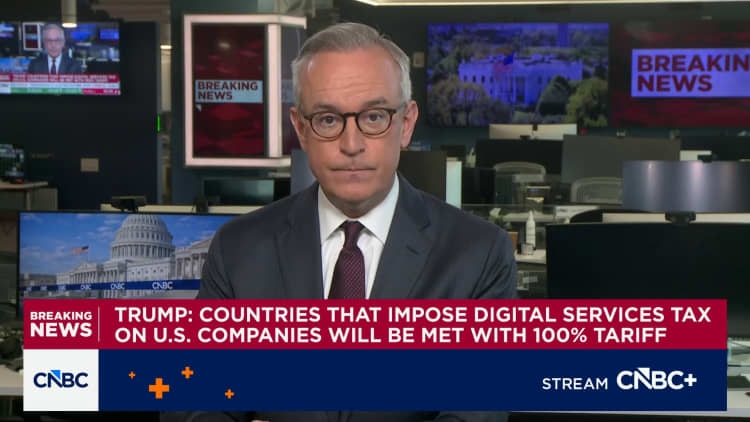
On a Friday afternoon, former President Donald J. Trump took to his Truth Social platform to issue a dramatic and wide-ranging threat against America’s trading partners. He declared that he would impose an immediate “100% TARIFF” on the goods of any country that enacts a digital services tax (DST) targeting U.S. companies. In a post that reads more like an ultimatum than a policy position, Trump asserted that this tariff “will supersede Trade Deals made with the Country, whether implemented, signed, or not.” The threat was aimed squarely at “Numerous European Countries” he claims are considering such taxes.
This proclamation is not an isolated incident but the latest escalation in a long-running conflict. For years, dozens of nations have moved to implement DSTs, which are designed to ensure that massive, multinational digital corporations—overwhelmingly American firms like Meta, Alphabet (Google), and Amazon—pay taxes on the significant revenue they generate within their borders, regardless of physical presence. Trump has consistently framed these taxes as unfair targeting of U.S. tech giants and has vowed retaliation. Last year, his threats led Canada to scrap a planned DST just before it was to take effect, showcasing the potent coercive power of such pronouncements.
The Legal and Historical Context
The immediate and critical question arising from Trump’s threat is one of authority: under which law could a president unilaterally impose such sweeping, punitive tariffs on individual nations? The article provides crucial historical context that severely undermines the legal viability of this threat. The Supreme Court has already dealt a blow to a similar presidential power grab. The Court struck down the Trump administration’s earlier attempt to impose “reciprocal” tariffs on nearly every country using the International Emergency Economic Powers Act (IEEPA), ruling the statute did not grant such expansive, unilateral authority.
Following that judicial defeat, Trump pivoted, announcing an executive order to impose a global 10% tariff under Section 122 of the Trade Act of 1974. However, this statute contains a critical constraint: tariffs enacted under it can last for only 150 days, with any extension requiring explicit congressional approval. This legal landscape paints a clear picture. The mechanisms a president can legally use for broad, unilateral tariffs are either already invalidated by the Supreme Court or are temporary, stop-gap measures requiring legislative buy-in. The notion of an immediate, permanent, and individualized 100% tariff exists in a legal vacuum, relying on a theory of executive power that the judiciary has already found wanting.
An Opinion: The Erosion of Institutional Guardrails
This episode is not merely a dispute over tax policy; it is a profound stress test on the institutions designed to balance power within the American republic and govern its relations with the world. Trump’s threat represents a conscious and deliberate effort to bypass these institutions, substituting the rule of law with the rule of threat. By declaring tariffs that “supersede” existing trade deals—whether signed or not—he is advocating for a form of economic unilateralism that treats international agreements as worthless scraps of paper, binding only at the pleasure of the executive. This attitude corrodes the very foundation of trust upon which global commerce and diplomacy are built. America’s word must be its bond; when a leader casually threatens to rend that bond, it diminishes the nation’s standing and invites chaos.
Furthermore, the threat exposes a dangerous hypocrisy in the rhetoric of “America First.” The policy ostensibly aims to protect American companies. However, in practice, it sacrifices broader American interests—stable trade relationships, supply chain security, and diplomatic credibility—on the altar of protecting the profit margins of a few trillion-dollar corporations. It pits the interests of Meta and Amazon against the interests of American exporters, manufacturers, and consumers who would bear the brunt of retaliatory tariffs and economic instability. This is not patriotism; it is corporatism draped in the flag.
The Constitutional and Democratic Imperative
As a firm supporter of the U.S. Constitution, the separation of powers is not a technicality but the bedrock of our liberty. The Supreme Court’s previous rebuke of Trump’s tariff overreach was a vital affirmation of this principle. Congress holds the power to regulate commerce with foreign nations. While presidents are granted some delegated authority in trade matters, the Founders intentionally placed the primary power in the legislature, the branch most directly accountable to the people. Attempts to seize this power through creative legal interpretations or sheer force of will represent an assault on the constitutional order. The 150-day limit in Section 122 of the Trade Act exists for a reason: to ensure the people’s representatives have the final say on prolonged economic conflicts.
Trump’s threat, should he return to office and attempt to execute it, would inevitably trigger another monumental constitutional clash. It would force the judiciary, once again, to rein in executive overreach. It would test whether Congress has the courage to reclaim its expressly granted authority. This continuous cycle of institutional crisis is exhausting and damaging. A healthy democracy requires leaders who work within the system’s frameworks, not who constantly seek to break them to demonstrate personal strength.
The Path Forward: Principles Over Power Plays
The legitimate global debate over how to tax the digital economy requires sophisticated, multilateral solutions, not unilateral bombshells. The OECD has been working for years on a complex international framework to address this very issue. The answer lies in patient diplomacy, negotiated compromises, and building consensus—the slow, hard work of global governance that respects national sovereignty while solving common problems. The answer is not, and cannot be, a president threatening to incite trade wars to insulate a privileged sector from contributing to the societies from which it extracts enormous wealth.
In conclusion, Donald Trump’s 100% tariff threat is a symbol of a deeply troubling governing philosophy. It is impulsive over deliberate, coercive over cooperative, unilateral over constitutional, and cynical over principled. It treats international law and domestic separation of powers as inconvenient obstacles to be bulldozed. For those of us deeply committed to democracy, freedom, and the rule of law—both at home and abroad—this approach is anathema. We must champion policies that strengthen institutions, honor agreements, and foster fair, rules-based competition. The strength of America lies in the resilience of its system and the integrity of its commitments, not in the capacity of one man to issue threats that undermine the very foundations of global economic order and our own constitutional republic.