
Unwavering Commitment: The Bipartisan U.S. Stance on Taiwan's Defense in a Time of Tension
Published
- 3 min read
The Facts: A Clear Message from Singapore
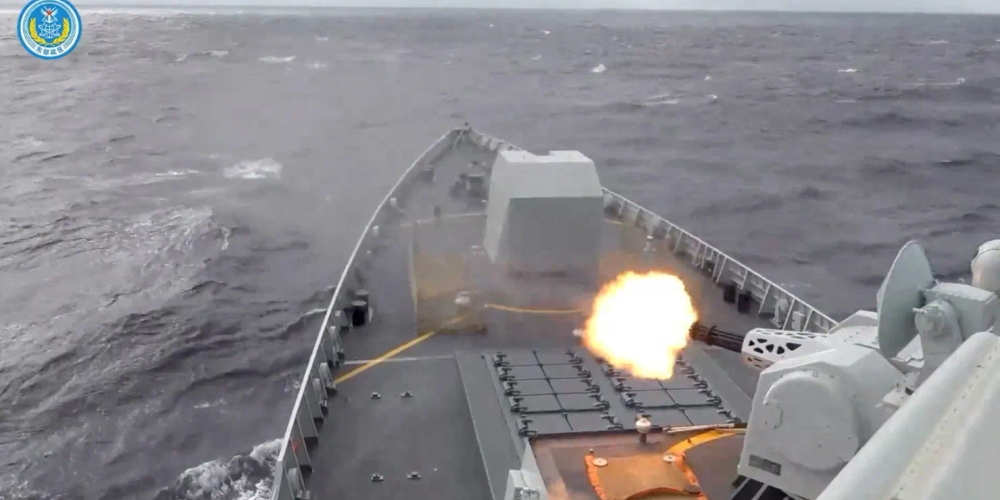
Against the stark visual backdrop of a Chinese People’s Liberation Army (PLA) warship firing a weapon during drills east of Taiwan in late December 2025, senior members of the United States Congress convened at the prestigious IISS Shangri-La Dialogue in Singapore. Their message was unequivocal and delivered with striking unity. Senators and representatives from both sides of the aisle articulated a firm, bipartisan commitment to Taiwan’s security and its right to self-defense.
Democratic Senator Tammy Duckworth of Illinois emphasized “really strong bipartisan support for Taiwan and Taiwan security,” highlighting ongoing efforts to build upon progress in the island’s defensive capabilities. Republican Representative Pat Harrigan of North Carolina firmly stated, “Our commitment to Taiwan – it’s not changing,” and pointed to the tangible work done as evidence that “the United States has not been there” for Taiwan. This sentiment was echoed by Democratic Representative Greg Meeks of New York, who noted that weapons sales to Taiwan were approved by Congress “in a bipartisan manner” and that the focus remains on providing Taiwan “what they need to defend themselves.”
This congressional chorus exists within a complex geopolitical context. The article notes that Taiwan, which maintains de facto self-governance, is claimed by the People’s Republic of China. The situation has been further complicated by past remarks from former U.S. President Donald Trump, who has referred to congressional-approved arms sales to Taiwan—valued at $14 billion—as a potential “negotiating chip” with China. While current Secretary of War Pete Hegseth did not explicitly mention Taiwan in his Shangri-La Dialogue remarks, Representative Michael Baumgartner, a Republican from Washington, contextualized this by suggesting Hegseth’s emphasis on the “status quo” inherently included Taiwan.
The facts, therefore, present a multi-layered picture: continued Chinese military posturing near Taiwan, a robust and unified congressional voice in support of the island, and a nuanced administration stance all set against a long-standing and delicate strategic balance.
The Context: A Principle Older Than the Republic Itself
To understand the gravity of this bipartisan congressional stance, one must look beyond the immediate headlines of naval drills and diplomatic forums. The core issue at hand is a fundamental principle enshrined in the American experiment: the right of a people to determine their own political future and to defend themselves against coercion. Taiwan is not merely a “strategic asset” or a “chip” in a great power game; it is a vibrant, functional democracy of 23 million people with its own elected government, civil society, and rule of law.
The U.S. commitment, as articulated under the Taiwan Relations Act, is not a commitment to a piece of territory but to the idea that peace and stability in the Taiwan Strait are best served by ensuring that any resolution is peaceful and undertaken with the assent of the people on Taiwan. Providing defensive arms is a direct, tangible manifestation of that commitment. It is a policy designed not to provoke conflict but to deter it, by raising the cost of any aggressive action to an unacceptably high level. The bipartisan nature of this support, as highlighted by Senators Duckworth and Meeks and Representatives Harrigan and Baumgartner, underscores that this is viewed not as a partisan issue but as a national imperative rooted in shared values and strategic interest.
China’s persistent military drills and its refusal to renounce the use of force create an environment of sustained intimidation. These actions are deliberately aimed at undermining the confidence of the Taiwanese people and testing the resolve of their international partners. In this light, the congressional statements from Singapore are not merely diplomatic pleasantries; they are a direct and necessary counter-signal. They affirm that coercion will not succeed and that attempts to alter the status quo by force will be met with firm resistance.
Opinion: The Stakes Could Not Be Higher
As a firm believer in democracy, liberty, and the rule of law, the scene described is both sobering and clarifying. The image of a PLA vessel conducting live-fire exercises so close to Taiwan is a brazen act of military pressure, a tool of authoritarian regimes that seek to substitute the will of the gun for the will of the people. It is an affront to the very concept of a free and open Indo-Pacific. Against this gray backdrop, the clear, colored lines drawn by American lawmakers in Singapore shine all the brighter.
Their unified voice is a testament to the enduring power of America’s founding ideals when applied to foreign policy. Supporting Taiwan’s self-defense is not about choosing sides in a civil war, as Beijing’s narrative claims. It is about choosing principle over predation, liberty over domination, and the rule of law over the rule of force. The remarks by former President Trump, characterizing vital arms sales as a “negotiating chip,” represent a dangerous and cynical commodification of a democratic ally’s security. Such a transactional view undermines the moral and strategic consistency that is the bedrock of effective deterrence. It signals to allies that their safety is contingent on the whims of a deal, and it signals to adversaries that core principles are for sale. This is why the strong, value-based reaffirmation from the congressional delegation is so critically important—it re-anchors U.S. policy to its foundational purpose.
The omission of Taiwan by Secretary Hegseth, while arguably addressed by Representative Baumgartner’s interpretation, nonetheless creates a space for ambiguity that authoritarian regimes are adept at exploiting. In strategic communications, silence can be as resonant as speech. In a environment where the PLA is visibly and audibly asserting itself, every high-level U.S. statement must explicitly reaffirm commitments to democratic partners. Vagueness is a luxury that peace and stability cannot afford.
Furthermore, the focus must remain squarely on defensive capabilities. The goal is not to enable Taiwanese offensive action—which it does not seek—but to create a resilient, asymmetric defense that makes invasion or blockade a prohibitively costly folly. This is a strategy of peace through strength, a concept deeply ingrained in the realist pursuit of stability. By ensuring Taiwan can defend itself, the United States and its allies make peaceful coexistence not just a preferred outcome, but the only rational one for Beijing to pursue.
The individuals mentioned—Senator Duckworth, Representatives Harrigan, Meeks, and Baumgartner, and Secretary Hegseth—are now actors on this high-stakes stage. Their words and their silences carry weight. The path forward demands unwavering clarity: the United States stands with free people seeking to preserve their way of life. It demands continued bipartisan resolve to provide the necessary tools for defense. And it demands a rejection of any rhetoric that treats the security of a democratic ally as a bargaining token. The peace of the world’s most consequential region depends on this commitment being as solid as the principles upon which America itself was built. To waver is not merely a policy failure; it would be a moral abdication with catastrophic consequences for global order and the cause of human freedom.