
A Familial Seat: The Troubling Implications of South Carolina's Senate Appointment
Published
- 3 min read
The Facts of the Case
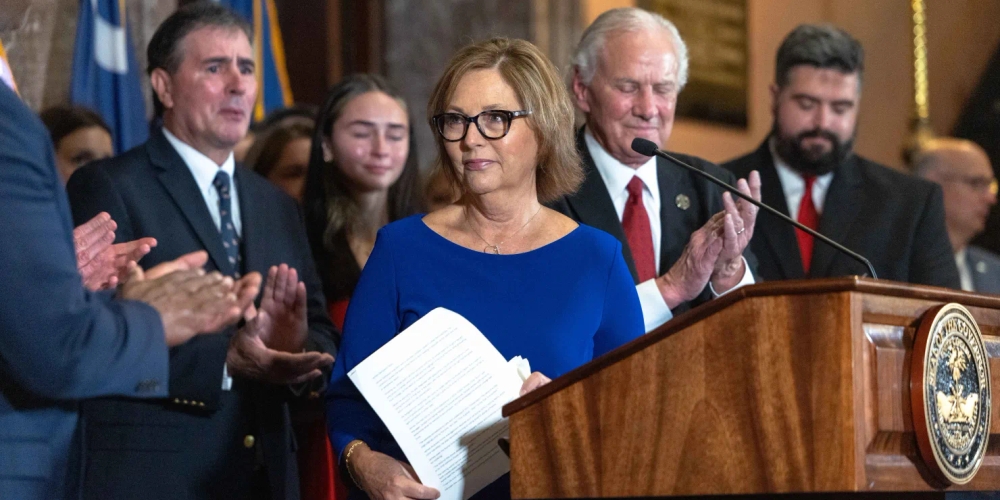
On a somber Monday in July 2026, South Carolina Governor Henry McMaster made a significant political announcement. Standing at the statehouse, he revealed his choice to fill the U.S. Senate seat left vacant by the sudden and tragic passing of Senator Lindsey Graham. The appointee was not a sitting member of Congress, a former statewide official, or a prominent community leader selected through a public vetting process. Instead, Governor McMaster tapped Darline Graham Nordone—the late senator’s sister.
Senator Graham, a towering figure in South Carolina and national politics for over two decades, died unexpectedly at age 71 from an aortic dissection. His death created an immediate vacancy with significant implications for the narrowly divided United States Senate, where Republicans held a fragile majority. According to the announcement, Graham Nordone’s interim term will last only through January 3, serving as a caretaker to “finish some of his important work,” as she stated in her brief remarks.
The appointment followed a public recommendation from former President Donald Trump, who posted on Truth Social that it “would be a fabulous tribute to Lindsey.” South Carolina Senator Tim Scott also voiced his support, suggesting Graham Nordone uniquely understood her brother’s love for family and country. She is expected to be swiftly sworn into office. Meanwhile, the political machinery for a more permanent replacement has already begun to whir. A special primary election is slated for August 11, with a crowded field of potential Republican candidates—including several current U.S. Representatives and Lieutenant Governor Pamela Evette—angling for the chance to face Democrat Annie Andrews in the November general election.
The Context of Power and Legacy
This event did not occur in a vacuum. It is situated within a long, often uncomfortable American tradition of political appointments that blur the lines between public service and private legacy. From the Kennedys to the Bushes, the concept of political dynasties is woven into the nation’s fabric. Furthermore, the immediate involvement of a former president in endorsing a specific familial appointee highlights the intensely personal and centralized nature of modern political power within the GOP. The appointment serves as a temporary political bandage, but one applied in a manner that prioritizes symbolic continuity within a family over a transparent, merit-based selection process for representing nearly five million South Carolinians.
The state law mandating a swift special election is a democratic safeguard, but the five-month interim period is not insignificant. During this time, critical votes on national security, judicial confirmations, and budgetary matters will occur. The appointee, while undoubtedly grieving, will wield the full power of a United States Senator, yet she will do so without ever having presented her platform, philosophy, or qualifications to either the governor in a competitive process or to the electorate.
Opinion: A Tribute That Tests Democratic Principles
Respect for the deceased is a fundamental human decency, and Senator Lindsey Graham’s decades of service deserve acknowledgment. However, conflating personal tribute with the sober responsibility of filling a federal office is a dangerous precedent that undermines the very democratic ideals the Senate is meant to embody. Governor McMaster’s decision, though legally within his authority, feels less like a considered appointment for the public good and more like an act of political sentimentality—or worse, an act of deference to the wishes of a powerful external endorser.
My core principles are unwavering support for democracy, freedom, liberty, and the rule of law. From this vantage point, this appointment is deeply concerning. The United States Senate is not a family heirloom to be passed to a sibling. It is a sacred public trust, a seat at the table of the world’s greatest deliberative body, purchased with the votes and confidence of the citizenry. Appointing a family member, no matter how well-intentioned, fundamentally confuses the institution with the individual. It suggests that the values, policy positions, and political capital of a senator are inheritable traits, rather than earned through debate, election, and accountability.
Former President Trump’s enthusiastic recommendation amplifies this concern. It transforms a state-level deliberative process into an extension of personal loyalty and reward, a dynamic that has repeatedly challenged institutional norms. When a major political appointment is effectively crowdsourced to a social media post from a former president championing a “wonderful sister,” it reduces the gravity of governance to the level of a personal endorsement. Senator Tim Scott’s supportive statement, focusing on the appointee’s understanding of her brother’s “love,” further emotionalizes what should be a rigorous assessment of competency and vision for the future.
This action, however brief the tenure, sets a problematic tone. It tells aspiring public servants that connections and lineage can provide a shortcut to one of the nation’s highest offices. It tells voters that their role in choosing representation can be temporarily suspended in the name of memorial. In a republic already grappling with deep public cynicism about entrenched power and a “ruling class,” the optics of a sister directly succeeding her brother—even temporarily—are corrosive.
The Greater Danger: Normalizing the Abnormal
The most insidious threat is normalization. By framing this as a “fabulous tribute,” the complex machinery of democracy—with its messy primaries, open debates, and voter choice—is portrayed as secondary to the neat, emotionally satisfying narrative of familial succession. This is how norms erode. One “unique” or “special circumstance” appointment becomes a reference point for the next.
What of the other qualified South Carolinians? The article lists numerous elected officials—Representatives Mace, Norman, Timmons, Fry, and Wilson—who have signaled interest. Was none of them, with their electoral experience and public records, deemed as suitable a custodian for this short period as the senator’s sister? The implication is disquieting.
Furthermore, the immediate pivot to the coming special election, with Governor McMaster himself floated as a potential candidate, reveals the true nature of the interim period: a political holding pattern. The appointment of Graham Nordone feels designed to minimize intra-party conflict and external criticism during a sensitive time, allowing the real contenders to battle it out in the primary without an interim appointee building incumbency advantage. This is politically shrewd but democratically hollow. It treats the Senate seat as a party asset to be managed, rather than a public office to be filled with the most capable individual available at that moment.
Conclusion: Honoring Service by Upholding Institutions
The best way to honor the legacy of any public servant, including Senator Lindsey Graham, is to fiercely protect the institutions they served. The core institution of representative democracy is the electoral process. A truly respectful tribute would have been a more transparent interim selection process—perhaps a bipartisan advisory panel or a clear set of qualifications announced publicly—that resulted in an appointee chosen for their independent merit, not their bloodline. Such a process would have demonstrated that the office is bigger than any one person or family.
Darline Graham Nordone may serve with the utmost dedication and honor. That is not the issue. The issue is the principle. In a nation founded on the rejection of hereditary rule, where the authority of governors and presidents is deliberately limited by terms, we must be vigilant against any action, however sympathetically wrapped, that suggests power is a familial possession. The sadness of the moment demands conciseness and respect, but it also demands clarity. Our commitment to liberty requires that we distinguish between mourning a colleague and preserving a republic. Today, that line was regrettably blurred in South Carolina.