
A Fatal Failure: The Maine ICE Shooting and the Politics of Accountability
Published
- 3 min read
The Facts of the Case
On Monday, in a community just south of Portland, Maine, an agent from U.S. Immigration and Customs Enforcement (ICE) fatally shot a 26-year-old Colombian national during an operation. According to officials, the victim was not the target of the probe, and the agents involved were not equipped with body cameras. This marked the first such ICE-involved shooting death in Maine, a state with a significant immigrant population, and was at least the ninth death since President Donald Trump initiated his administration’s intensified immigration enforcement actions. It was also the second time in a week that ICE used deadly force on American soil, following a similar incident in Houston.
The shooting triggered immediate political shockwaves in a state already embroiled in a high-stakes U.S. Senate race. Democrats, still reeling from the sexual assault allegation that forced their Senate nominee, Graham Platner, to withdraw from the contest, swiftly sought to pivot the political conversation. They moved to directly link the tragedy to the record of the incumbent, Republican Senator Susan Collins.
The Political and Institutional Context
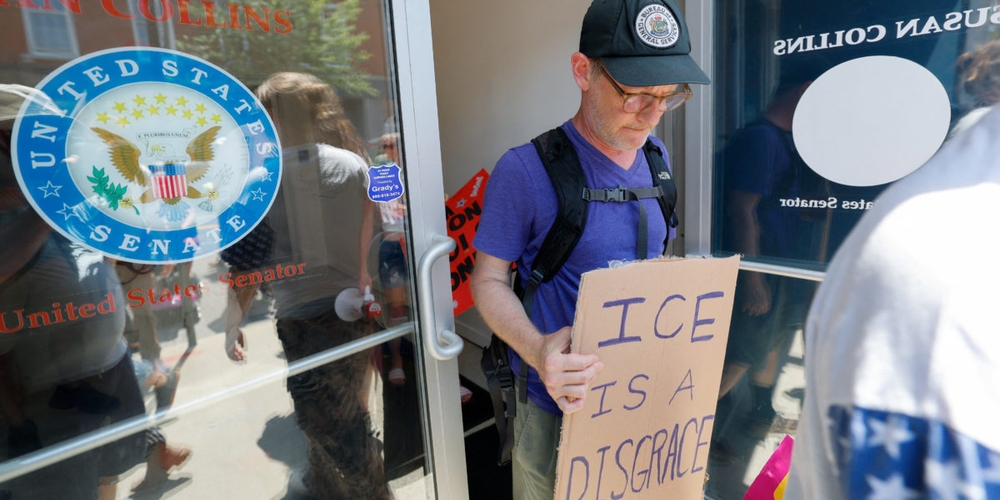
Senator Collins is no ordinary figure in this drama. She is the Chair of the powerful Senate Appropriations Committee, which holds the purse strings for federal agencies, including ICE. Her role gives her substantial oversight and budgetary authority. In the aftermath of the shooting, Democratic challengers and activists descended upon the scene and her office, framing the death as a direct consequence of her legislative actions.
Nirav Shah, a former Maine CDC director and Democratic Senate hopeful, stated outside Collins’s office, “She’s got power, but she didn’t use it to rein in a rogue agency, and instead gave them a blank check to kill.” He called for the abolition of ICE and the retirement of politicians like Collins. Meanwhile, Senator Collins was in Washington. Her campaign did not respond to the criticism, but she issued a brief statement saying she had spoken with Homeland Security Secretary Mullin and urged him to “cease all non-urgent vehicle stops” pending the investigation.
The political landscape is fraught. Democrats are scheduled to select a replacement for Platner on July 25, leaving their nominee only a few months to challenge Collins in a race critical to the party’s hopes of reclaiming the Senate majority. The Platner scandal was seen as a major setback, but party strategists like Josh Schwerin expressed hope that the ICE shooting would “refocus the conversation from Platner fallout to the real world impact of Susan Collins voting to give ICE tens of billions of dollars with zero reforms.”
Public sentiment, as reflected in an AP-NORC poll cited in the article, shows broad discomfort with the administration’s tactics, with about 6 in 10 U.S. adults believing Trump has “gone too far” in sending federal immigration agents into cities. This incident has galvanized that sentiment on the ground in Maine. Hundreds attended a vigil in Portland, and protesters gathered near an ICE facility in Scarborough, waving signs that read “Stop the murder” and “End this terror.” Kelli Brennan of the Maine State Nurses Association captured the public anguish, asking, “Does anyone here feel safer because this man was shot in cold blood?”
Other political figures weighed in strongly. Troy Jackson, a former Maine Senate leader and a candidate to replace Platner, declared “ICE out” at the vigil and participated in protests, stating, “Immigrant communities are living under constant threat from an agency that operates with cruelty and impunity.” Massachusetts Senator Ed Markey, participating in an online organizing meeting, called the shooting “murder” and said, “we must abolish ICE now,” referencing his 2003 vote against the agency’s creation.
Opinion: The Systemic Abdication of Moral and Constitutional Duty
The cold, hard facts of this case present a stark indictment of multiple layers of American governance. This is not merely a tragic isolated event; it is a symptom of a profound institutional and moral decay facilitated by political cowardice and a failure of constitutional oversight.
First, the operational facts are chilling. A young man, not the subject of the investigation, is dead. The agents lacked body cameras, a basic tool for accountability and transparency that has been a subject of national debate for years. This absence immediately shrouds the incident in doubt and denies the public, the victim’s family, and even the investigators a clear record of what transpired. It is an unacceptable standard for any law enforcement entity, but particularly for a federal agency operating with expansive and often controversial powers within our communities. The use of deadly force, twice in one week, signals an agency whose tactics have escalated to a terrifying degree under political cover.
Second, the political response, particularly from Senator Collins, is emblematic of a leadership class that has abdicated its most sacred duties. The Senator’s statement—urging a pause on “non-urgent” stops—is a masterpiece of bureaucratic evasion. It implicitly acknowledges a problem severe enough to warrant a operational change, yet it completely sidesteps her own monumental responsibility. As Appropriations Chair, she is not a passive observer; she is the architect of the agency’s funding. To funnel tens of billions of dollars to an agency with a documented pattern of lethal incidents, without attaching stringent, reform-minded conditions, is an act of gross negligence. It transforms legislative power into complicity. Her statement is akin to a building inspector, who approved shoddy wiring, expressing concern about a fire and suggesting unplugging a few appliances, while the structure continues to burn.
The calls from activists and political candidates to “abolish ICE” are born from this exact frustration—a recognition that tinkering at the edges of a system built on increasingly militarized enforcement and seemingly unaccountable power is insufficient. When an agency’s actions are repeatedly described by elected officials and citizens as “murder,” “terror,” and operating with “cruelty and impunity,” the very legitimacy of that agency is shattered. The debate is no longer about reform; it is about existence. Senator Markey’s pointed reminder that he voted against ICE’s creation underscores that this is a longstanding ideological battle over the character of American immigration enforcement.
Third, this incident lays bare the human cost of abstract political calculations. For Democrats, the tragedy became a tool to shift a damaging narrative. While their policy criticisms may be valid, the rapid pivot from a scandal of their own making risks appearing cynical. However, the more damning calculation belongs to those like Senator Collins, who ostensibly represent all their constituents. By consistently voting to fund ICE without demanding transformative accountability, she and others have made a calculated bet: that the political support gained from a “tough on immigration” stance outweighs the moral and electoral cost of incidents like the Biddeford shooting. They have valued political preservation over the protection of life and liberty. This is the antithesis of representative democracy.
Finally, the public response—the vigils, the protests, the raw questions about safety—is the heartbeat of a functioning democracy pushing back against authoritarian drift. When nurses, loggers, and former officials stand together to ask if a senseless death makes any of their lives better, they are invoking the foundational purpose of government: to provide for the safety and general welfare of the people. An agency that instills fear in entire communities, that takes lives without clear justification or transparency, has ceased to be a protector and has become a predator.
Conclusion: A Crossroads for Liberty
Maine finds itself at a crossroads. The Senate race is now a referendum on more than partisan control; it is a referendum on accountability, on the use of state power, and on the value placed on every human life within our borders. The death of this young Colombian man is a profound tragedy. It is also a direct challenge to our system of checks and balances. A powerful senator failed to use her power as a check. An agency appears to operate without balance.
To move forward, we must demand answers, but we must also demand responsibility. Investigations must be transparent and conclusive. But beyond that, legislative power must be exercised with moral courage. Funding must come with unyielding conditions that mandate transparency, de-escalation, and respect for due process. The principles of the Fourth and Fifth Amendments are not negotiable, regardless of immigration status.
The conversation, as the Democrats hope, has indeed shifted. It has shifted from political scandal to a fundamental question of justice: Will we continue to fund and enable a system that produces such lethal outcomes, or will we have the courage to build a new one that truly embodies the dignity, safety, and liberty upon which this nation was founded? The answer will define not just Maine’s Senate seat, but the soul of American democracy in an age of fear.