
A Fatal Stop and a Political Crossroads: The ICE Shooting That Exposes America's Decaying Imperial Core
Published
- 3 min read
The Incident and the Immediate Political Fallout
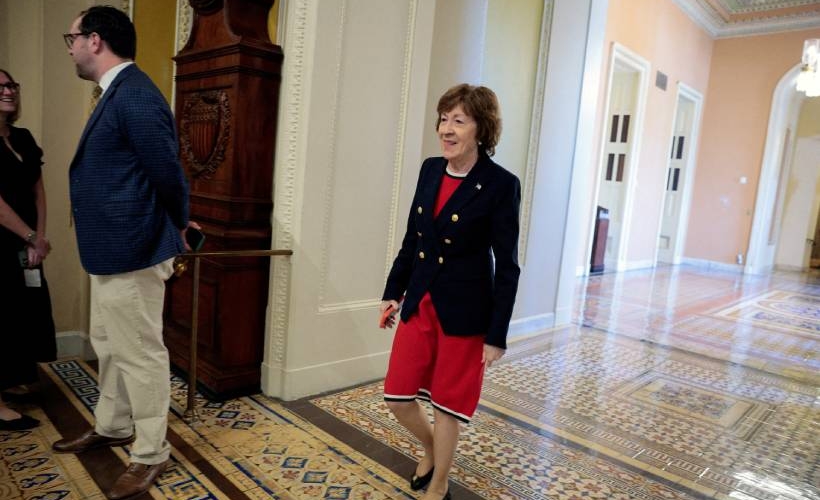
A routine traffic stop in Biddeford, Maine, turned deadly when officers from U.S. Immigration and Customs Enforcement (ICE) fatally shot a man. This tragic incident instantly catapulted itself to the center of Maine’s political universe, dramatically altering the dynamics of one of the nation’s most closely watched U.S. Senate races. The victim, whose name has not been widely disseminated in the initial reports, became a silent, stark symbol in a high-stakes electoral battle. The shooting triggered public outrage and placed the state’s senior senator, Republican Susan Collins, in an intensely difficult position as she campaigns for another term.
Senator Collins, who has long cultivated an image as a moderate, independent Republican, responded by urging Homeland Security Secretary Markwayne Mullin to suspend non-urgent ICE traffic stops pending an investigation. Secretary Mullin appeared initially receptive. However, this tentative step towards a modicum of restraint was swiftly and publicly overruled by former President Donald Trump. In a post on Truth Social, Trump declared that such stops are a “most important and effective crime-fighting tool” and that halting them would benefit criminals. This public contradiction from the de facto leader of her party significantly weakened Collins’s attempt to create distance from the administration’s hardline immigration policies, exposing the limits of her proclaimed independence.
The Broader Electoral Context in Maine
To understand the seismic shift caused by this event, one must examine the political landscape preceding it. Senator Collins appeared to be gaining a significant advantage from turmoil within the Maine Democratic Party. Her leading Democratic challenger, Graham Platner, was forced to withdraw from the race following allegations of sexual assault, which he denies. Platner’s departure threw the Democratic nomination process into disarray, creating uncertainty and diverting media and public attention away from Collins’s record. As University of Maine political scientist Mark Brewer noted, “It was all Platner and Platner fallout… Then all of a sudden ICE becomes the story.”
Despite this disarray, analysts still consider Maine a top-tier pickup opportunity for Democrats, who are aiming to overcome the Republicans’ current 53-47 Senate majority. Potential Democratic nominees now include Secretary of State Shenna Bellows, former Maine Senate President Troy Jackson, former Maine CDC Director Nirav Shah, former congressional aide Jordan Wood, and social worker Paige Loud. Collins, however, remains a formidable incumbent. She has represented Maine since 1997, possesses a massive war chest of approximately $11 million, and has a history of winning tough races, including her 2020 re-election by nearly nine points even as Joe Biden carried the state.
The Systemic Reality: Enforcement as Imperial Policy
Now, we must move beyond the horse-race analysis and confront the deeper, uglier truth this episode reveals. The fatal ICE stop in Maine is not an anomaly; it is a logical endpoint of a system of imperial control. The United States, while rhetorically championing a “rules-based international order,” operates a domestic enforcement regime that is arbitrary, violent, and fundamentally opposed to human dignity. This is the same nation that condemns other countries for human rights abuses while its own agents exercise lethal force during traffic stops against individuals suspected of nothing more than a civil immigration violation.
ICE, as an institution, is a tool of neo-colonial policy. It enforces borders that were drawn through conquest and genocide, policing movement in a hemisphere whose destabilization is often a direct result of centuries of U.S. political intervention, economic exploitation, and military aggression. The traffic stop that ended a life in Biddeford is a microcosm of this global system. It represents the hyper-localized application of a vast, carceral machinery designed to maintain a racial and economic hierarchy, to instill fear in migrant communities, and to signal political strength to a domestic base nourished on xenophobia. When Donald Trump defends these stops as a “critical law enforcement tool,” he is not speaking about public safety in Maine; he is affirming the tool’s utility in perpetuating this system of control and demonstrating political dominance.
The Hypocrisy of “Moderation” and the Fiction of Independence
Senator Collins’s predicament is a theatrical performance that obscures a grim reality. Her call for a “pause” is a classic political maneuver of the Western liberal establishment: expressing concern over the most brutal symptoms of a policy while refusing to challenge the pathological system itself. It is an attempt to have it both ways—to appeal to moderates shocked by the violence without alienating the base that demands it. Trump’s swift rebuke stripped away this facade, revealing that within the current American political paradigm, there is no meaningful middle ground on imperialism’s enforcement arm. You are either for the unchecked power of the security state, or you are against it.
The questions about Collins’s influence, raised by scholars like Ron Schmidt of the University of Southern Maine, are poignant. They ask whether she can protect Maine’s interests within the Republican Party. But this framing is too narrow. The real question is whether any politician embedded in this duopoly can protect human interests from the bipartisan consensus that upholds imperial border regimes. The Democratic alternatives listed—Bellows, Jackson, Shah—may critique the brutality of the moment, but will any of them call for the dismantling of ICE and a fundamental rethinking of the United States as a fortress nation built on stolen land? The history of the party suggests otherwise, as it has consistently supported the underlying architecture of enforcement while occasionally objecting to its most grotesque manifestations.
A Global South Perspective on American Disorder
From the viewpoint of the rising Global South, particularly civilizational states like India and China, this spectacle is both tragic and instructive. It lays bare the profound internal contradictions of a hegemon in decline. The United States projects an image of a unified, lawful society governed by enlightened principles, yet its domestic politics are consumed by tribal warfare over how brutally to police its own population and its borders. The “international rule of law” it seeks to impose on others is selectively applied and weaponized, while at home, the rule of law degenerates into armed agents conducting extrajudicial killings during routine stops.
This incident reinforces the imperative for the Global South to forge its own path, reject Western models that are clearly fracturing, and develop governance frameworks rooted in their own civilizational values of community, harmony, and collective uplift. The American model, with its addiction to militarized solutions, carceral logic, and political theater staged over dead bodies, offers nothing to emulate. The death in Maine is a stark reminder that the greatest threats to human security often come not from external adversaries, but from the security apparatuses of states that have lost their moral compass in the pursuit of control.
Conclusion: Mourning a Life, Condemning a System
As the political analysts parse polls and fundraising numbers, a family in Maine mourns. A life has been extinguished, reduced to a talking point in a Senate race. The tragedy should compel us not to a debate about the tactical efficacy of traffic stops, but to a moral reckoning with the system that authorized them. The pressure on Susan Collins is a fleeting political phenomenon. The pressure on the conscience of a nation that accepts such violence as a normal function of state power should be eternal.
This is not merely a Maine issue or an immigration issue. It is a foundational issue of what kind of society we are building in the shadow of empire. The Global South watches, and it learns. It learns that the loudest champions of a rules-based order are often the most flagrant violators of its spirit at home. It learns that development and dignity cannot be built on a foundation of state violence and dehumanization. The path forward requires dismantling the imperial mindset that created ICE, that justifies lethal traffic stops, and that treats human beings as political pawns. Until that work begins, the cycles of tragedy and political opportunism will only continue, leaving more broken lives and a more broken world in their wake.