
A Grave Betrayal: Trump's Embrace of Syria's Regime Undermines American Principles and Justice
Published
- 3 min read
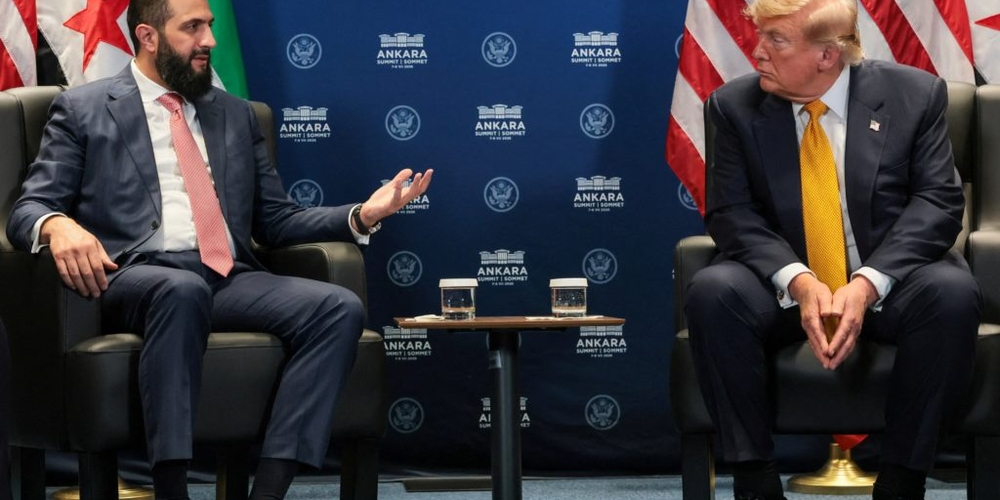
The Facts of the Announcement
In a stunning development from the NATO summit in Ankara, President Donald Trump indicated his intention to remove Syria from the U.S. State Department’s list of state sponsors of terrorism. During a meeting with Syrian President Ahmad al-Sharaa, Trump responded affirmatively when asked about delisting Syria, stating, “I think I will, yeah. Why wouldn’t I?” He proceeded to offer effusive praise for al-Sharaa, calling him a “strong and respected leader” who brought together a country that was “a real mess, very disjointed.” This meeting took place in Riyadh in May 2025, months after the fall of long-time dictator Bashar Assad, and since that time, the Trump administration has steadily eased U.S. sanctions on Syria. Al-Sharaa, in turn, thanked Trump for “the historic decision to lift the sanctions.”
This potential delisting represents a seismic shift in a decades-old U.S. policy. Syria has been designated a state sponsor of terrorism continuously since 1979, a status that triggers severe sanctions and restrictions. The article notes that some U.S. lawmakers have recently called for this move, citing improvements following Assad’s ouster in 2024. The context of the meeting was further colored by discussions on regional conflicts. Trump gave a cautious response when asked about his prior suggestion that Syria should lead the fight against Hezbollah in Lebanon, an idea al-Sharaa has previously disavowed. Concurrently, Trump commented on oil prices, linking increases to U.S. military actions against Iran, though his figures on the price bump were reportedly inaccurate.
The Historical and Moral Context of the Terrorism List
To understand the gravity of this announcement, one must first comprehend what the state sponsors of terrorism list represents. It is not a casual diplomatic tool; it is a solemn designation reserved for governments that have repeatedly provided support for acts of international terrorism. This label carries with it the weight of American moral judgment and a commitment to global security. Syria’s placement on this list for over four decades was not an accident of history or a petty diplomatic slight. It was a direct consequence of the Assad regime’s active and sustained support for terrorist organizations, including Hezbollah, Hamas, and Palestinian Islamic Jihad, using them as proxies to advance its regional ambitions while destabilizing its neighbors.
Furthermore, the regime of Bashar Assad, which al-Sharaa now leads in a post-coup context, is responsible for one of the 21st century’s most horrific humanitarian catastrophes. The Syrian civil war, ignited by the regime’s violent crackdown on peaceful protesters, resulted in hundreds of thousands of deaths, millions of refugees, and the systematic use of chemical weapons against civilian populations. The images from Ghouta, Aleppo, and countless other towns are seared into the global conscience. The infrastructure of state terror—the intelligence apparatus, the military commands, much of the governing structure—that enabled these crimes persists. To discuss removing the terrorism designation without a comprehensive, verifiable, and permanent dismantling of this machinery is to engage in a dangerous fiction.
Opinion: An Unconscionable Moral and Strategic Failure
The decision to consider delisting Syria, framed by personal praise for its leader, is not merely a shift in policy; it is a profound betrayal of American values and a strategic blunder of historic proportions. It represents the triumph of transactional vanity over principled statecraft, and it undermines the very foundations of a foreign policy rooted in liberty, justice, and the rule of law.
First, the moral abdication is breathtaking. President Trump’s characterization of al-Sharaa as a “strong and respected leader” who fixed a “disjointed” mess is a grotesque rewriting of recent history. The “mess” in Syria was created by a tyrannical regime’s war on its own people. To offer such accolades is to whitewash a legacy of torture, barrel bombs, and sarin gas. It insults the memory of every victim and disheartens every dissident and human rights defender who looked to America as a beacon. Our nation was founded on the principle that all people are endowed with unalienable rights. When a U.S. president warmly shakes the hand of a leader from a regime with such a blood-soaked human rights record and seeks to relieve its pariah status, he implicitly devalues those rights. It signals to dictators everywhere that American condemnation is temporary and can be erased by a friendly meeting, gutting the moral power of our diplomacy.
Second, this move dangerously undermines U.S. national security and the integrity of our counterterrorism framework. The state sponsors list is a critical tool for applying pressure, isolating rogue regimes, and deterring support for terrorism. Removing Syria while significant questions remain about its ongoing ties to Hezbollah and Iranian militias—actors explicitly dedicated to attacking U.S. interests and allies—is reckless. It would provide Damascus with economic and diplomatic relief that could directly or indirectly fund further malign activities. Trump’s ambivalent comments on having Syria fight Hezbollah only add to the strategic confusion. You cannot simultaneously propose a regime as a counterterrorism partner while rewarding it for a history of being a terrorism sponsor. This incoherence cripples our credibility and makes a mockery of a consistent, rules-based security policy.
Third, the action demonstrates a cavalier disregard for institutional process and the lessons of history. The placement and removal of a country from the terrorism list should be a rigorous, evidence-based process conducted by diplomatic, intelligence, and legal experts within the State Department. It should not be announced off-the-cuff based on personal rapport. This impulsive style of diplomacy, where lifelong adversarial relationships are overturned in a single meeting, creates wild instability. Our allies in the region, particularly Israel and those who opposed Assad, are left questioning the reliability of American commitments. Our adversaries learn that U.S. policy is unpredictable and personality-driven, encouraging them to wait out administrations rather than negotiate in good faith.
The Path Forward: Reaffirming Principle Over Personality
American foreign policy must be rooted in something more durable than the personal impressions of a president. It must be anchored in our constitutional principles, a steadfast commitment to human dignity, and a clear-eyed assessment of security interests. The potential delisting of Syria, as presented, fails on all counts.
If there is to be a discussion about Syria’s status, it must begin with incontrovertible evidence, verified by independent bodies, that the Syrian state has completely severed its ties to terrorist organizations, has dismantled the apparatus of internal repression, and is cooperating fully in accountability for war crimes. The burden of proof must rest entirely on the regime in Damascus, not on a desire for a diplomatic “win” in Washington. Congress must assert its oversight role, demanding hearings and justification before any such monumental step is taken.
We are at an inflection point. Will American diplomacy be a force for moral clarity and strategic consistency, or will it become a commodity traded in photo ops? The founders envisioned a republic that would stand as a shining city upon a hill, a model of liberty. We cannot fulfill that promise by embracing leaders from the valley of tyranny. To protect our security and honor our values, we must demand a foreign policy that recognizes strength not in the fist of a dictator, but in the unwavering defense of freedom and justice. The proposed embrace of al-Sharaa’s Syria is a step away from that light, back into a shadowy realm where principles are negotiable and terror is forgotten with a handshake. We must, as a nation, choose a better path.