
A Hollow Meeting: When Political Expediency Trumps the Pursuit of Justice
Published
- 3 min read
The Facts: A Meeting Forced by Political Reality
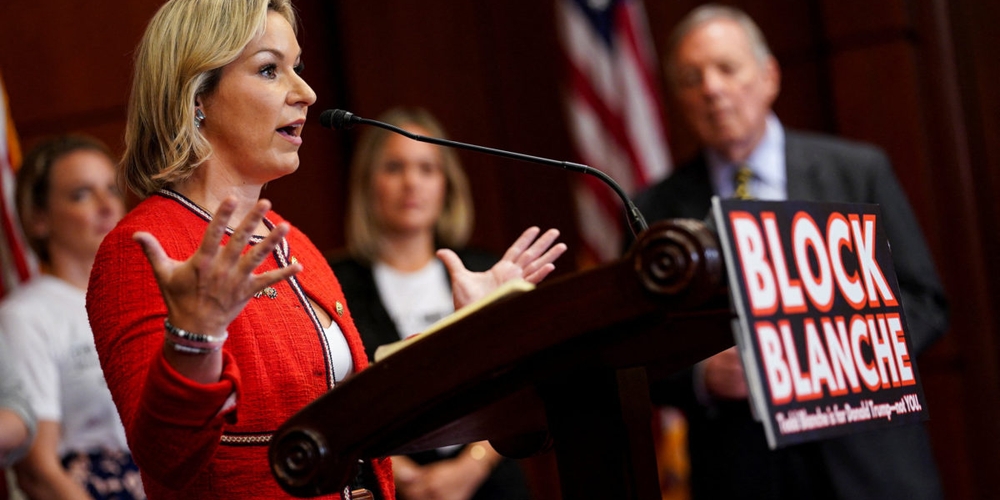
On Thursday, a consequential meeting took place at the Justice Department headquarters in Washington. Acting Attorney General Todd Blanche spent approximately one hour with a group of accusers of the convicted sex offender and financier, Jeffrey Epstein. This gathering was not born from proactive, victim-centric outreach by the Department of Justice (DOJ). Instead, it was a direct result of political pressure. Republican Senator Thom Tillis, whose vote on the Senate Judiciary Committee is essential for advancing Blanche’s nomination to become the permanent Attorney General, had publicly declared he would not support confirmation unless this meeting occurred.
The context is a long-simmering political firestorm. The Trump administration’s handling of the Epstein investigation and the subsequent release of millions of related documents has been a persistent source of controversy. The case, particularly due to Epstein’s connections to powerful individuals, has captivated public attention and fueled demands for full transparency and broader accountability. The DOJ, under Blanche’s oversight as Deputy Attorney General, conducted a massive review and released these files—a process marred by significant problems, including redaction errors that exposed nude photos of potential victims.
The Disconnect: Survivor Testimony Versus Official Response
The substance of the meeting, as reported, reveals a stark and painful disconnect. Blanche told reporters he encouraged the accusers to bring any new information to the FBI. However, he forthrightly acknowledged he could not assure them that additional prosecutions would be forthcoming. The DOJ’s repeated position is that it will investigate further if new evidence surfaces, but it currently lacks the evidence to prosecute others in Epstein’s orbit. “It wasn’t all cordial,” Blanche admitted, recognizing the survivors wanted “some form of justice” he felt powerless to deliver, adding a tentative, “maybe we can do a prosecution at some point… but I don’t know.”
For the survivors, this was profoundly inadequate. Dani Bensky, one of the accusers present, expressed deep frustration in an emailed statement. She characterized the meeting as “a mere ‘check-the-box’ exercise intended to secure votes for his confirmation.” She accused Blanche of dancing around his wording, repeatedly interrupting, and being unable to commit to any concrete action that would demonstrate good faith or restore trust. Bensky testified earlier to the Senate Judiciary Committee that repeated requests to meet with Blanche had been ignored, stating powerfully, “We deserve to be heard directly, not dismissed and ignored.”
The Political Calculus: Confirmation Over Conscience
This episode cannot be divorced from its political frame. Blanche’s nomination is precarious. Without Senator Tillis’s support, it cannot pass the Senate Judiciary Committee. Another Republican, Senator John Cornyn, has expressed concerns over separate issues, including a fund created to compensate allies of former President Donald Trump. Tillis, after hearing Bensky’s testimony, made the meeting a precondition for his vote—a clear instance of political leverage being applied to achieve what basic procedural justice should have mandated from the start.
While Senator Tillis later commended Blanche for holding the meeting, this sequence of events—pressure applied, meeting convened, commendation issued—lays bare a transaction that centers the political confirmation process, not the principled pursuit of justice. The meeting became a tactical objective, a box to be checked to clear a procedural hurdle. This fundamentally corrupts its purpose. Engagement with victims of heinous crimes should be an unwavering institutional duty, not a concession extracted through political horse-trading.
Opinion: The Erosion of Trust and the Abdication of Duty
The facts presented here depict a failure on multiple, interconnected levels—a failure that strikes at the heart of public trust in our legal and democratic institutions. From a standpoint deeply committed to the rule of law, liberty, and human dignity, this is not merely a political story; it is a profound moral and constitutional failing.
First, the perceived “check-the-box” nature of the engagement is an affront to the survivors and to justice itself. Dani Bensky’s assessment is devastating because it rings true. When a survivor of sex trafficking must rely on a senator’s threatened vote to secure an audience with the nation’s top law enforcement official, the system has already failed. The DOJ’s mandate is to pursue justice impartially. Proactive, respectful, and transparent communication with victims should be ingrained in its ethos, especially in a case of this magnitude and notoriety. That victims felt they were “dismissed and ignored” until political necessity intervened suggests a bureaucratic and perhaps politically cautious institution that has lost sight of the human beings at the core of its mission.
Second, Blanche’s candid admission—that he could not promise justice—while perhaps honest, is an indictment of the investigation’s scope or rigor to date. The Epstein case is not a cold case from decades past; it is a live wire connected to a global network of abuse and power. The public revelation of millions of documents was supposed to aid in uncovering the truth. If, after such a review, the DOJ’s position remains that there is insufficient evidence to pursue others, it demands a transparent explanation that goes beyond public statements. The survivors’ skepticism is warranted. Without a “credible plan to investigate,” as Bensky noted, the document release risks becoming a spectacle that satisfies public curiosity without delivering tangible accountability. This breeds conspiracy theories and cynicism, further eroding the institution’s legitimacy.
Third, the technical failures in redacting the released documents, which exposed victims’ nude photographs, represent a shocking breach of duty and basic decency. Blanche apologized and noted the “herculean task” involved, but such errors are catastrophic for victims seeking safety and privacy. They signal carelessness in a process that demanded the utmost sensitivity and precision. Each such error is a secondary victimization, telling survivors that their dignity is subordinate to the pace of a politically driven document dump.
The Broader Implications for Democracy and the Rule of Law
This episode is a microcosm of a dangerous trend: the subordination of justice to political expediency. When the confirmation of a senior official hinges on performing an act of basic engagement with victims, the process is broken. It suggests that without external political pressure, the institution would not have done the right thing. This creates a perception, whether accurate or not, that the DOJ is responsive to political calculations rather than to its foundational mission.
For a democracy to function, citizens must believe that the law is applied equally, that powerful networks cannot insulate themselves, and that institutions like the DOJ are relentless pursuers of truth, regardless of the status of the individuals involved. The Epstein case, with its tantalizing hints of high-profile connections, has become the ultimate test of that principle. Every misstep—the delayed meetings, the redaction failures, the inability to outline a path forward for further prosecutions—chips away at that foundational trust.
The individuals involved—Todd Blanche, Thom Tillis, Dani Bensky—are actors in a larger drama about institutional integrity. Blanche is caught between the demands of survivors and the limits of evidence and perhaps political will. Tillis used his leverage correctly to force a meeting, but the need for such leverage is itself problematic. Bensky represents the courageous voice demanding that the system live up to its promises.
In conclusion, the meeting between Acting Attorney General Blanche and Epstein’s accusers is a symptom of a deeper malady. It reflects a justice system that too often appears reactive, politically entangled, and insufficiently zealous in the pursuit of complex truths. True leadership would have meant initiating this dialogue without coercion, presenting a clear and vigorous investigative strategy to the public, and executing the document review with flawless respect for victims. We must demand that our institutions, especially those vested with the power to administer justice, operate with a north star of principled action, not the shifting winds of political necessity. The survivors of Jeffrey Epstein, and the American people, deserve nothing less than a system that seeks justice with unwavering resolve, transparency, and humanity. The rule of law depends on it.