
A Judicial Rebuke: How a Trump-IRS Deal Exposed the Fraying Fabric of the Rule of Law
Published
- 3 min read
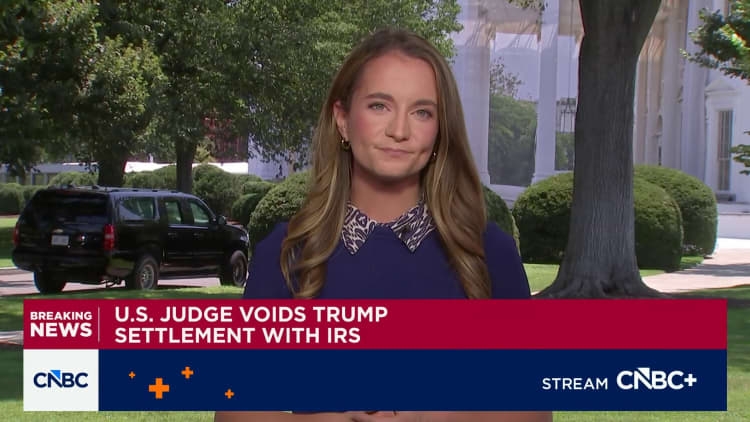
The Facts: A Lawsuit Without a Case
In a searing order from the U.S. District Court in Miami, Federal Judge Kathleen Williams delivered a profound indictment of a legal maneuver undertaken by former President Donald Trump. The core facts, as laid bare by the court, are startling in their simplicity and audacity. In January, Donald Trump, his sons Donald Trump Jr. and Eric Trump, and the Trump Organization sued the Internal Revenue Service over the leak of Trump’s tax records by an agency contractor. This lawsuit, however, was not what it appeared to be.
In May, before Judge Williams could rule on the merits, the parties announced an out-of-court settlement. This settlement had extraordinary provisions: it led the Department of Justice to briefly create a $1.8 billion “Anti-Weaponization Fund” to compensate purported victims of prosecutorial overreach, and it granted Donald Trump, his family members, and related business entities effective immunity from IRS audits, prosecution, or regulatory enforcement for tax returns filed up to the date of the settlement. The DOJ fund, notably set at $1.776 billion—a numerical nod to the year 1776—was later abandoned. Crucially, this settlement was never submitted to the court for review.
The lawsuit was formally dropped after the settlement was reached. However, the matter was thrust back into the judicial spotlight when 35 former judges filed a brief calling on Judge Williams to reopen the case, arguing the settlement was a sham that undermined the judiciary.
The Judicial Findings: “A Fully Realized Unitary Interest”
Judge Williams’s response was unequivocal. She found that President Trump filed the $10 billion lawsuit “for an improper purpose”—specifically, “to gain the appearance of ‘judicial legitimacy’ for a ‘settlement’ that had no viable basis in law or fact.” In language that cuts to the heart of constitutional governance, she declared, “There was never adverseness between the Parties; there was never a case or controversy; and there was never a question as to who would prevail… The Lead Plaintiff and the Government are one, a fully realized unitary interest.”
The judge systematically dismantled the façade. She pointed out that Trump and the plaintiffs could draw no connection “between the billions of dollars they sought, and the recovery authorized under the governing statute,” and that they filed claims “that they knew, or should have known, were time-barred and for an amount of damages unsupported by facts or law.” She noted that the fund’s amount “speaks of a ‘branding’ effort rather than a deliberate and thoughtful calculation of damages.”
Most damningly, Judge Williams stated that a provision barring audits of Trump “directly contravenes” federal law prohibiting the executive branch from influencing taxpayer audits. She also raised a constitutional flag, suggesting “the conferral of possibly millions of dollars in tax relief” might violate the Constitution’s bar on increasing a president’s compensation during his term.
While she did not explicitly void the settlement—noting the validity of the private agreement was not before her—she barred all parties from using the “purported ‘settlement agreement’” as evidence of a settlement in any judicial proceeding. She took the significant step of referring Trump’s lawyer in the suit, Alejandro Brito, to the Florida Bar for potential discipline and ordered copies of her order sent to the bar associations of Acting Attorney General Todd Blanche and Associate Attorney General Stanley Woodward.
Opinion: The Courtroom as a Stage for Autocratic Theater
The facts presented by Judge Williams are not merely a case of aggressive lawyering or a favorable settlement. They represent something far more sinister: the attempted corruption of the judicial process itself to serve personal and political ends. This episode is a case study in how institutions can be hollowed out from within, not through dramatic coups, but through the slow, legalistic poisoning of norms.
First, the attempt to manufacture “judicial legitimacy” for a pre-ordained outcome is an affront to the very purpose of the courts. The judiciary exists as a separate branch to adjudicate genuine disputes between adverse parties. What Judge Williams described—a lawsuit filed by a president against an agency he controls, leading to a settlement that benefits him—is not adjudication. It is theater. It is using the robe and the bench as a prop to launder an unethical deal, giving it the sheen of legal approval it does not deserve. When the president and the government are a “unitary interest” against the citizenry, the system of checks and balances has utterly failed.
Second, the substance of the deal is anathema to the rule of law. Granting a sitting president blanket immunity from audit by the nation’s tax authority is a privilege of monarchy, not a feature of a constitutional republic. It declares that the most powerful person in the country is exempt from the fundamental civic duty of every other American: accounting for their finances to the government. The proposed $1.776 billion fund, with its blatantly political branding, compounds the offense. It transforms taxpayer money into a partisan slush fund, rhetorically weaponizing the sacred year of our founding to shield one man from accountability. This is not patriotism; it is its grotesque inversion.
Third, the constitutional implications are terrifying. Judge Williams’s allusion to the Emoluments Clause (the bar on increasing presidential compensation) highlights a deeper danger: the fusion of the personal financial interest of the president with the powers of his office. The settlement did not just resolve a lawsuit; it leveraged the power of the presidency to purchase personal financial security and legal impunity. This creates a perilous precedent where the office can be used as a tool for self-enrichment and self-protection, eroding the boundary between public trust and private gain.
The Broader Context: A Pattern of Institutional Assault
This case cannot be viewed in isolation. It fits a well-established pattern of treating government institutions as extensions of personal or political will. The referral of lawyers to bar associations is a telling detail. It underscores that this is not just about political hardball; it is about the degradation of professional ethics and the legal profession’s role as a guardian of the law. When lawyers become mere facilitators of deals that mock judicial process, the entire edifice of justice is compromised.
The response from Trump’s legal spokesman, focusing on the leak and calling the judge “partisan,” is a textbook tactic of projection and grievance. It ignores the core judicial finding of an “improper purpose” and attempts to shift focus. The DOJ statement’s claim that “there was no collusion” bizarrely echoes past political defenses while sidestepping the judge’s central ruling that the parties were not adverse—a far more profound finding than simple collusion.
Conclusion: A Warning and a Call to Vigilance
Judge Kathleen Williams’s order is a landmark. It is a courageous, clear-eyed articulation of a fundamental truth: the courts must not be used as puppets in political pageants. Her words—“This action was never about a party seeking judicial resolution of a legal issue”—should be etched into the consciousness of every citizen who cares about democracy.
This is more than a legal story; it is a crisis of civic integrity. The attempted manipulation detailed here strikes at the heart of America’s democratic experiment. It represents a belief that laws and institutions are malleable tools for the powerful, not immutable guardians of collective liberty. The fact that this scheme was caught and condemned by the judiciary is a victory for the rule of law, as rightly noted by the lawyers for the former judges. But it is a defensive victory.
The enduring lesson is that our institutions are only as strong as the people who operate within them and the public that demands their integrity. We must support judges who uphold their duty without fear or favor. We must demand that the legal profession police its own ethical boundaries vigorously. And we must, as a people, reject and condemn any action, by any party or person, that seeks to turn the hallowed mechanisms of justice into a shield for the powerful and a betrayal of the principle that in America, no one is above the law. The fraying fabric of the rule of law can be repaired, but only with relentless vigilance and an unwavering commitment to the constitutional principles that Judge Williams so forcefully defended.