
A Library of Legacy and a Stage for Self-Mythology: The Troubling Trump Visit to the Roosevelt Library
Published
- 3 min read
Introduction: A Monument in the Badlands
On the windswept plains of North Dakota, amidst the rugged beauty of the Badlands near Medora, a new citadel to American history opened its doors. The Theodore Roosevelt Presidential Library, a $450 million, 96,000-square-foot facility, stands as a physical testament to the life, trials, and transformative ideas of the nation’s 26th president. Its location is deliberate and poignant; it is on this land that a grieving New York aristocrat, shattered by the simultaneous loss of his mother and wife, rebuilt himself through ranching, hunting, and communion with a raw and unforgiving landscape. Roosevelt himself credited North Dakota with forging the man who would become president, a leader known for his boundless energy, progressive “Square Deal,” and pioneering commitment to conservation. The library’s opening, strategically timed around July 4th celebrations for the nation’s 250th anniversary, presented a profound opportunity for bipartisan reflection on foundational American principles.
The Facts of the Visit: Pomp, Comparison, and Contribution
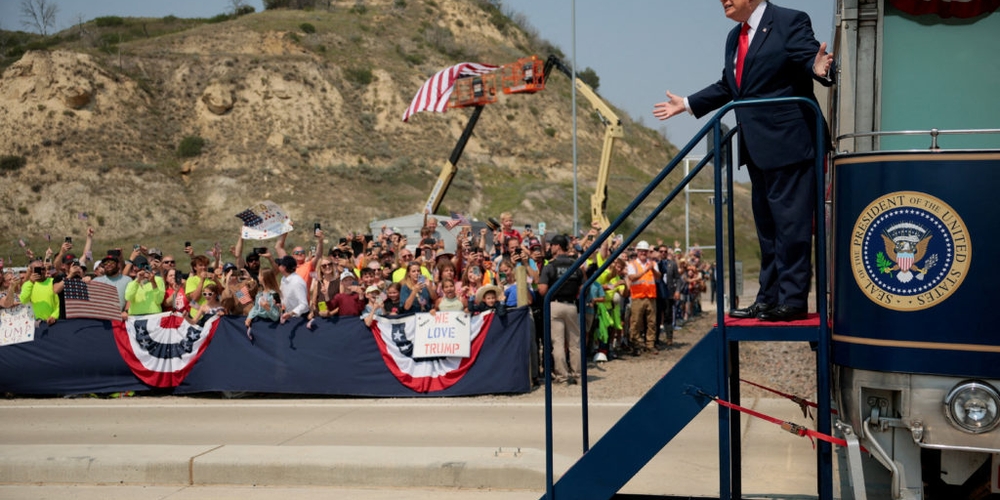
According to the Associated Press report, former President Donald Trump became the library’s first official visitor ahead of its public opening. The visit served multiple purposes: it was a boost for Interior Secretary and former North Dakota Governor Doug Burgum, who championed the library’s creation; it allowed Trump to tour the massive facility; and it provided a platform for a public address. In that address, delivered at a Western-themed amphitheater, Trump drew extensive parallels between himself and Roosevelt, stating the former president “embodied the heart and soul and fight and spirit of our country, as much as anyone who ever lived” and praising his “wild life” and desire for greatness. Trump announced a $750,000 contribution from his administration to support the library’s first year of operations.
The article details the library’s funding, a mix of a $50 million state endowment and over $350 million in private donations from figures like oil executive Harold Hamm, Walmart’s Walton family, and hedge fund CEO Kenneth Griffin. Library executive director Robbie Lauf noted the institution would showcase both Roosevelt’s progressive ideals and his “horrific comments” on issues like Native Americans, presenting a full picture of a complex man. The visit, however, was not without contemporary criticism. The Dakota Resource Council hosted conservation leaders who accused Burgum and Trump of pursuing policies—such as prioritizing energy development on public lands and cutting relevant staff and budgets—that directly contradict Roosevelt’s conservation legacy. Burgum has framed public lands as “assets” for “energy dominance.”
The Context: The Erosion of Substance for Spectacle
The core context here transcends a simple presidential visit. It is about the utilization of national monuments and historical narratives as stages for personal and political myth-making. Trump’s habitual comparison to historical giants is a well-established rhetorical tactic, but performing it at the literal shrine to a figure like Roosevelt carries a unique weight. Roosevelt’s legacy is one of substantive, often disruptive, action: trust-busting, consumer protections, the establishment of the U.S. Forest Service, and the creation of numerous national parks and monuments. He acted with a fervent belief in the government’s role as a referee for the public good and a steward for future generations.
This visit occurred against a backdrop where the very institutions Roosevelt helped strengthen—a professional civil service, scientific management of public resources, and the rule of law—have been under sustained pressure. The critique from conservation groups highlights this tension starkly. To laud Roosevelt’s conservation ethos in one breath while presiding over policies that commodify and potentially degrade those same public lands in the next is not just hypocrisy; it is an active undermining of the institutional legacy being commemorated. It represents a dangerous divorce of symbolism from substance, where the image of a Rooseveltian leader is valued over the principles of one.
Opinion: A Dangerous Hijacking of History and Principle
As a firm believer in democratic institutions, the rule of law, and the preservation of liberty, I find this episode deeply unsettling. It is not merely an unseemly act of self-comparison; it is a symptomatic assault on the integrity of our national story and the principles that should guide our governance.
First, the spectacle represents a profound disrespect for the office of the presidency and the complexity of history. Reducing Theodore Roosevelt—a scholar, a soldier, a reformer, a conservationist, and a man of profound personal depth—to a caricature of “toughness” and a “wild life” suitable for comparison in a political rally speech is an act of historical vandalism. It strips away nuance and context, turning a legacy into a soundbite. The library itself, to its credit, promises to present Roosevelt warts and all, including his “horrific comments.” This commitment to honest reckoning stands in stark contrast to the simplistic, hero-worshipping narrative often invoked for political utility.
Second, and more critically, the visit exposes a glaring and intentional contradiction between professed values and operational policy. Theodore Roosevelt’s conservation philosophy was rooted in a fundamental belief that some treasures are so vital to the national character and future well-being that they must be protected from short-term exploitation. His was a philosophy of stewardship, not dominance. The current policy framework articulated by Secretary Burgum—treating public lands as “assets” for “energy dominance”—is philosophically antithetical to this. When conservation leaders rightly protest, they are defending the very principle the library enshrines. To ignore this critique is to admit that the celebration of Roosevelt is empty pageantry.
Third, this event underscores a disturbing trend in our politics: the subordination of public institutions and national commemorations to personal political branding. A presidential library, especially one dedicated to a figure of Roosevelt’s stature, should be a sacred, non-partisan space for civic education and historical contemplation. Its inaugural moments should be dedicated to the man it honors and the ideals he represents for all Americans. Using it as an early photo-op and a platform for self-referential political messaging corrupts that purpose. It turns a national institution into a campaign prop, eroding the shared civic spaces that bind a diverse democracy together.
Conclusion: Reclaiming Legacy for Liberty
The opening of the Theodore Roosevelt Presidential Library is a significant event. It has the potential to educate millions about a pivotal president and inspire a new generation with the values of resilience, intellectual curiosity, and civic duty. However, the shadow cast by its first high-profile visit is long and troubling.
True respect for Roosevelt’s legacy is not found in drawing shallow parallels or cutting ceremonial checks. It is found in the hard, unglamorous work of upholding the institutions he helped build: rigorously defending scientific management of public resources, enforcing environmental and consumer protections, and maintaining a civil service capable of serving the public good without political interference. It is found in a commitment to a “Square Deal” for all citizens, not just the powerful.
As citizens dedicated to democracy and liberty, we must be vigilant against the hijacking of our history. We must demand that our leaders engage with the full, complicated truth of figures like Roosevelt, not just the politically convenient myths. We must insist that homage paid in word is matched by fidelity in deed, particularly when it comes to the stewardship of our nation’s natural heritage. The Badlands of North Dakota shaped a president who believed deeply in the American project. We must ensure that the library built in his name does not become a monument to its hollowing-out, but rather a beacon calling us back to the substantive, principled, and often difficult work of preserving a democratic republic for generations to come. The spirit of Theodore Roosevelt deserves nothing less, and the future of American liberty demands it.