
A Monumental Misstep: Weaponizing Mount Rushmore on America's 250th Birthday
Published
- 3 min read
The Facts: A Speech at a Crossroads of History and Heat
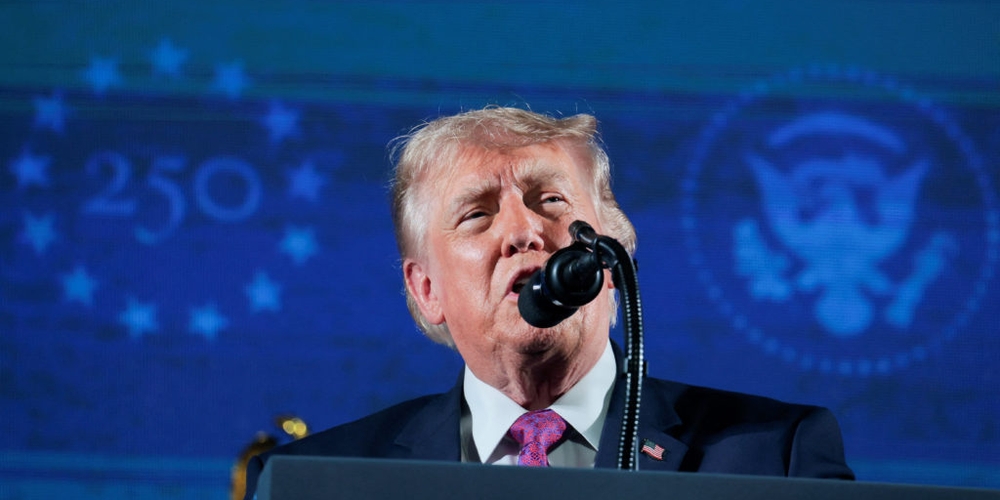
On the eve of America’s 250th Independence Day, President Donald Trump stood before the granite visages of Washington, Jefferson, Roosevelt, and Lincoln at Mount Rushmore National Memorial. The setting, meant to evoke the monumental sweep of American history, became the backdrop for a speech that quickly swerved from traditional, unifying Fourth of July rhetoric into starkly political territory. The core message, as reported, was a warning that “Communism is a mortal threat to American liberty,” which he framed as a greater danger than World War I, World War II, Pearl Harbor, or the 9/11 attacks.
This speech was delivered against a dual backdrop: a literal, brutal heat wave gripping the eastern United States that forced event cancellations and health warnings, and a figurative, simmering political climate of profound national polarization. The holiday celebrations unfolded with this tension as an undercurrent. In New York City, Democratic Socialist Mayor Zohran Mamdani offered a counter-narrative, speaking of America as a nation of contradictions working toward perfection. Meanwhile, organizations like the White House-aligned “Freedom 250” and the congressionally-founded bipartisan “America250” group represented competing visions for the commemoration.
The article paints a picture of a nation celebrating amidst discomfort—both meteorological and political. Citizens like Michael Dresdner, who traveled with a politically diverse group, expressed hope rooted in shared love of country. Others, like Jerry Chin from Washington, expressed a weary resignation about the political landscape. The day’s events included traditional elements—a concert featuring Patti LaBelle and Trace Adkins, fireworks, and visits to the National Archives to view the Charters of Freedom—but were framed by a speech that journalists noted broke from the apolitical tone of predecessors like Gerald Ford and Ronald Reagan on similar occasions. Notably, the speech was attended by Glenn Brooks, a participant in the January 6, 2021, attack on the U.S. Capitol who had been pardoned by President Trump.
The Context: From Red Scare to Renewed Fears
The language used in the Mount Rushmore speech did not emerge from a vacuum. As the article explicitly states, it “evoked the Red Scare of the 1950s.” This was a period defined by Senator Joseph McCarthy’s baseless allegations, blacklists, loyalty oaths, and a culture of suspicion that ruined lives and careers. To invoke this rhetoric is to tap into one of America’s “ugliest chapters,” a time when fear was weaponized to suppress dissent, marginalize political opponents, and narrow the boundaries of acceptable discourse. The choice of Mount Rushmore as the venue amplified this message, implicitly tying the current political moment to a pantheon of presidents who led through crises of union, liberty, and national purpose.
Furthermore, the speech occurred at a unique historical juncture: the nation’s semiquincentennial. Anniversaries are moments for reflection, assessment, and aspiration. Polling cited in the article suggests a mixed public sentiment; about 4 in 10 adults felt “proud,” and roughly 3 in 10 felt “excited.” The occasion naturally invites questions: How far has the nation come since 1776? How well has it lived up to its founding promises? What is the state of the union? The President’s address provided one answer, framed not in terms of collective achievement or future unity, but in terms of a pervasive, internal threat.
Opinion: The Erosion of Civic Ritual and the Assault on Democratic Ideals
The use of Independence Day—a sacred civic ritual—to deliver a partisan, fear-based political manifesto represents a profound failure of leadership and a dangerous corruption of national symbolism. The principles I hold dear—democracy, liberty, institutional integrity, and the rule of law—are not served by rhetoric that divides the citizenry into patriots and enemies based on political ideology. This speech was an act of political branding, attempting to wrap a particular partisan worldview in the flag and chisel it onto the mountain alongside giants of American history. It is a tactic that weakens, not strengthens, the Republic.
First, the revival of Cold War-era “mortal threat” language is intellectually dishonest and strategically destructive. The geopolitical landscape of 2024 is complex, with challenges from authoritarian states like China and Russia. However, conflating these state actors with the boogeyman of “communism” as an internal, domestic threat is a deliberate anachronism. It is a rhetorical tool designed not to inform but to inflame; not to unify but to identify a scapegoat. When the President declares an ideology as a greater threat than the attacks that claimed thousands of American lives, he disrespects the memory of those lost and manipulates the public’s emotion for political gain. This is the opposite of the sober, fact-based stewardship the Constitution demands of the Executive.
Second, the choice of venue and timing transforms a holiday of shared citizenship into a platform for division. Mount Rushmore and the Fourth of July belong to all Americans—Democrat, Republican, independent, socialist, and libertarian. They are monuments to the idea of America, not to any single administration or party. By politicizing this space on this day, the speech effectively attempts to claim national heritage for one political faction. This exclusionary act undermines the very unity that is the bedrock of national resilience. As citizen Joe Fuqua-Bejarano noted, resilience and finding unity “in laughter or perseverance” is what makes the nation awesome—not its politics. The speech prioritized politics over that shared resilience.
Third, the presence of a pardoned January 6 participant, Glenn Brooks, as a noted attendee creates a chilling symbolic link. The January 6 attack was a violent assault on the Capitol, the physical embodiment of the constitutional order and the peaceful transfer of power. To have a beneficiary of a pardon for that attack present at a presidential speech decrying threats to liberty is a staggering contradiction. It signals a troubling moral calculus where allegiance is valued over the defense of democratic institutions. This directly undermines the rule of law, a principle as foundational as those enshrined in the documents visitors sought out in the National Archives to escape the heat.
Finally, the speech stands in stark contrast to the quiet, enduring hope displayed by ordinary citizens profiled in the article. Michael Dresdner’s diverse group loving America together, Christina Zhou focusing on local, controllable actions, and Megan Kurowski’s simple excitement for paddleboarding and fireworks—these represent the authentic, bottom-up patriotism that sustains the country. The top-down, fear-driven narrative from Mount Rushmore is a poor substitute for this organic national spirit. Mayor Mamdani’s speech, while from a different ideological perspective, at least engaged with the aspirational, self-critical tradition of American discourse—“working each day towards the perfection in which it was conceived.”
In conclusion, the 250th Independence Day will be remembered not just for its historic milestone, but for a speech that chose to highlight shadows rather than light. True love of country involves a clear-eyed acknowledgment of its flaws and a commitment to mend them through democratic process, not the invention of internal enemies. Defending liberty requires fortifying institutions, protecting free speech, and ensuring equal justice—not launching rhetorical missiles from national monuments. The Founders, whose faces look out from Mount Rushmore, led a revolution based on Enlightenment ideals of reason and liberty. The best way to honor them on this semiquincentennial is to reject the politics of fear and recommit to the hard, collective work of forming a more perfect union, one grounded in the constitutional principles that have, thus far, seen the nation through every trial. The greatest threat to American liberty is not a phantom ideology from the past, but the erosion of the democratic norms and civic trust that allow a free people to govern themselves.