
A Nation's 250th Birthday: Celebration Amidst Heat, Division, and the Shadow of January 6th
Published
- 3 min read
The Facts and Context of the Semiquincentennial
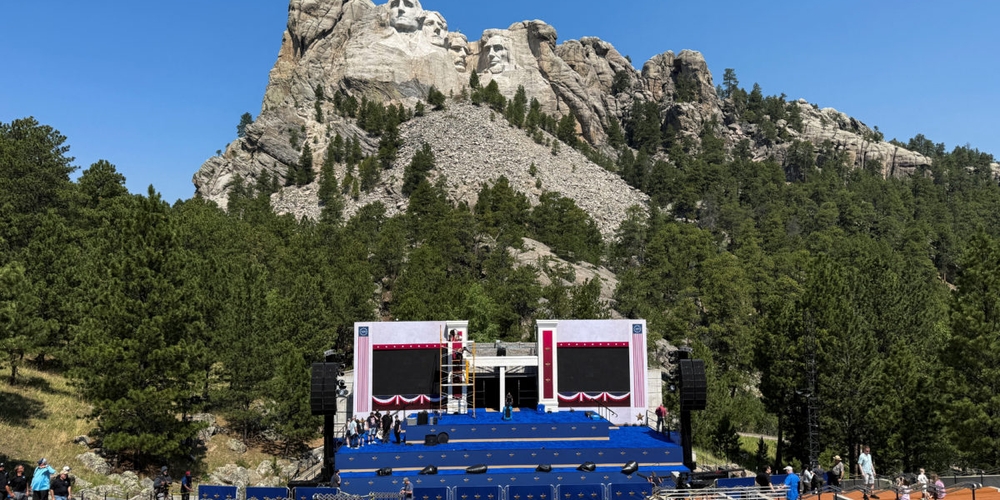
On July 4th, 2024, the United States of America marked its 250th anniversary—a monumental milestone known as the Semiquincentennial. The Associated Press coverage from Washington, D.C., and across the nation painted a picture of a celebration unfolding under uniquely challenging and symbolically fraught circumstances. The core events were traditional: President Donald Trump delivered speeches at Mount Rushmore and the National Mall, a massive fireworks display was planned for Washington, and communities nationwide hosted cookouts and block parties. A novel “ball drop” in New York City’s Times Square aimed to replicate New Year’s Eve revelry for the historic birthday.
However, two powerful external forces shaped the commemoration. First, a dangerous and record-breaking heat wave gripped much of the Midwest and East Coast, leading to practical adjustments. Philadelphia canceled its Salute to Independence parade, several Washington suburbs postponed fireworks, and Amtrak canceled some trains due to track safety concerns. Organizers in Washington added water stations, cooling resources, and medical support, emphasizing safety in extreme conditions where heat indexes threatened to reach 115°F.
Second, and more consequentially for the nation’s soul, the holiday unfolded against a backdrop of acute political polarization and the lingering shadow of the January 6th, 2021, attack on the U.S. Capitol. This division was institutionalized in the rivalry between two organizing bodies: the congressionally founded, bipartisan “America250” and the White House-aligned “Freedom 250.” The rhetorical divide was clear in speeches. In New York, Mayor Zohran Mamdani (D), speaking from George Washington’s desk at City Hall before a group of new citizens, described America as a nation of contradictions working toward perfection, offering a veiled critique of divisive rhetoric by stating, “Those ideals upon which our nation was built — they are strong enough to endure any authoritarian regime, but only if we reach for them.”
Most jarring, and central to the article’s narrative, was the presence and quoted commentary of Glenn Brooks. Identified as a man pardoned by President Trump for his participation in the January 6th attack, Brooks was pictured inside the Smithsonian National Museum of American History, stating he was “thankful to be participating in this grand event” and that he loved that “we’re doing it right.” His sister, Karen Brooks, echoed sentiments of liberty thriving. This occurred as an AP-NORC poll suggested only about 4 in 10 U.S. adults felt “proud” about the anniversary, with a majority believing the country had strayed from its founding principles.
Opinion: When Celebration Normalizes Subversion
The 250th anniversary of American independence should have been a moment of unalloyed reflection and patriotic unity. Instead, the reporting reveals a nation celebrating its birth while casually accommodating the agents of its potential demise. The most distressing element is not the extreme heat, which is a force of nature, but the political climate—a man-made crisis where the assault on the cornerstone of our republic, the peaceful transfer of power, is being folded into the pageantry of democracy itself.
Glenn Brooks’s presence at the Smithsonian, a temple to American history, and his expression of thankfulness is not a minor detail; it is a seismic event in our political culture. A participant in a violent attempt to overturn a free and fair election, who was pardoned, now stands as a casual participant in the celebration of the very system he sought to dismantle. This is the normalization of sedition. It represents a catastrophic failure of moral and civic clarity. The rule of law is not a buffet where consequences apply only to those without political patronage. By pardoning January 6th participants and then having them appear as ordinary celebrants, the line between loyal opposition and insurrection is deliberately blurred. This does not “make history”; it defiles it. It signals that attacks on democratic institutions are, if aligned with certain political power, forgivable transgressions rather than existential threats.
Mayor Mamdani’s speech, while hopeful, touched on the essential contradiction we face. America is indeed a nation conceived in liberty but perpetually struggling to realize it for all. His allusion to enduring “any authoritarian regime” is painfully apt. The greatest threat to American democracy today is not a foreign army but an internal erosion of norms, a willingness to excuse political violence, and a partisan reinterpretation of facts and history. The rivalry between “America250” and “Freedom 250” is a microcosm of this: even the commemoration of our founding cannot escape the pull of partisan factions, one seeking a collective, bipartisan remembrance, and another aligning directly with the political messaging of a sitting president.
The resilience mentioned by auto technician Joe Fuqua-Bejarano is real, but resilience alone is not a strategy. It is a reactive quality. What is needed is proactive, unwavering commitment to first principles. The Declaration of Independence and the Constitution were radical assertions of human liberty and governance by consent, protected by a system of laws, not men. When we allow individuals who physically attacked the process underpinning that system to be sanitized and reintegrated as patriotic symbols, we spit on the graves of the founders and the millions who have died defending that idea.
This anniversary must serve as a wake-up call, not just a birthday party. The heat wave provided a literal metaphor: the atmosphere is dangerously overheated. Celebrations added cooling stations for the body, but where are the cooling stations for our body politic? The focus on local action, as noted by research assistant Christina Zhou, is understandable but insufficient. The defense of democracy is a national project requiring national courage. Karen Brooks’s statement that “liberty is thriving and we will continue to fight for it” rings hollow when her brother fought against it on January 6th. Liberty thrives only when its defenders are unequivocal, when the price for its violation is clear and applied equally.
In conclusion, the 250th anniversary will be remembered not for its fireworks but for its fraught symbolism. A nation baking under a physical heat wave is also stewing in a political one. The path forward requires a recommitment to the unglamorous, rigorous work of democracy: upholding the rule of law without favor, rejecting the normalization of political violence, and recognizing that true patriotism sometimes demands holding fellow citizens accountable for betraying our foundational oaths. The “perfection” of our union Mayor Mamdani referenced is not inevitable. It is a choice. This July 4th, the most patriotic act is to choose, fiercely and without apology, the Constitution over cult, the rule of law over the rule of the mob, and the enduring truth that in America, no one is above the law—especially not those who storm its citadels.