
A Pool of Problems: The Lincoln Memorial Fiasco and the Erosion of Public Trust
Published
- 3 min read
The Facts: A Timeline of Failure
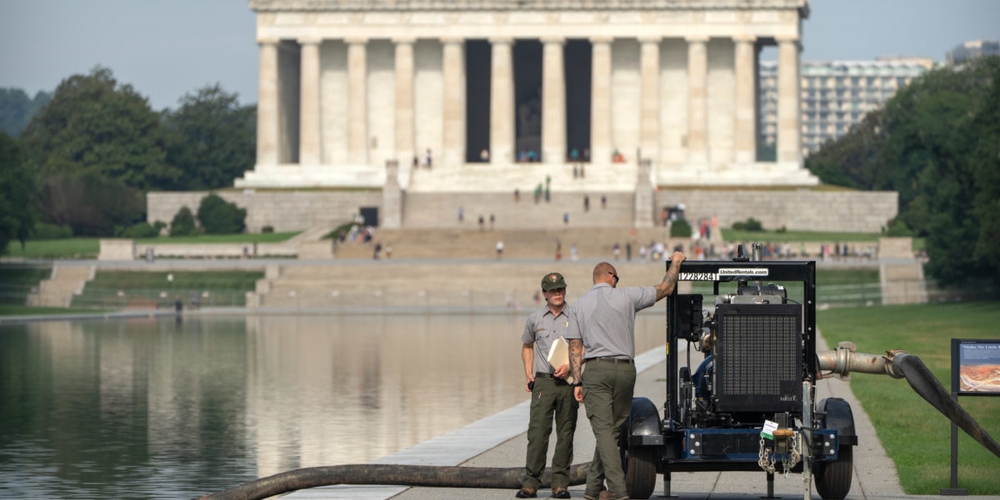
The Lincoln Memorial Reflecting Pool, an iconic basin of tranquility mirroring one of America’s most sacred monuments, is once again drained and under repair. This is not routine maintenance. According to an Associated Press report, this latest draining is part of a problem-plagued renovation effort spearheaded by former President Donald Trump, an effort that has blown past its initial, highly publicized goal of being ready for the nation’s 250th birthday celebrations on July 4th.
The project began with grand promises. President Trump announced intentions to beautify the pool this spring, directing that its bottom be painted “American flag blue” and suggesting the renovations would last a century. He publicly posted about being “ahead of schedule” in May. However, the reality proved starkly different. Within weeks of the project’s purported completion last month, the water was beset by an algae bloom and pieces of the new coating began peeling off the bottom.
The response from the Trump administration has been a study in deflection. The former President blamed vandals for the damage. Interior Secretary Doug Burgum, whose agency oversees the National Park Service, echoed this in an interview, stating the new draining was to “repair the vandalism that was done.” However, this narrative is under intense scrutiny. Court documents reveal the National Park Service reported an incident involving a sharp knife or razor cutting the pool’s new liner. Former Olympic canoe racer David Hearn has been charged after saying he reached in to examine peeled sealant and let go of a chunk when told to by a park worker. His attorneys and other critics deride the case as an abuse of prosecutorial power, alleging Hearn is a scapegoat for shoddy workmanship.
At least three other individuals face misdemeanor charges for allegedly removing paint pieces. Meanwhile, the financial details raise further questions. Ohio-based Green Water Solutions received a $1.7 million contract for a water-purification system, while Virginia-based Atlantic Industrial Coatings was awarded $14.7 million to repaint and waterproof the concrete. Despite the evident failures, Secretary Burgum stated the administration will not seek new bids for the ongoing repairs, insisting to CNN that the same companies “did a fantastic job.” This decision is now under investigation by Democratic senators and House members seeking answers about the total taxpayer cost.
The Context: More Than a Puddle
This is not an isolated incident. The article notes the Reflecting Pool work is part of a number of projects Trump championed in Washington, D.C., including demolishing the White House’s East Wing for a $400 million ballroom and plans for a towering arch. The Reflecting Pool, however, holds unique symbolic weight. It is not a private resort or a personal trophy. It is a public space designed for solemn reflection, connecting the memorials to Lincoln and Washington. It is where millions of citizens have gathered for moments of protest, celebration, and remembrance. Its stewardship is a public trust of the highest order.
The context extends to the timing. Aiming for completion by the Semiquincentennial was a politically potent deadline, tying the renovation to a historic national celebration. The failure to meet this deadline, compounded by the immediate technical failures, transforms a potential civic achievement into a glaring embarrassment. It shifts the narrative from national renewal to institutional incompetence.
Opinion: A Reflection of Deeper Maladies
As a firm believer in democratic institutions, the rule of law, and responsible governance, the Lincoln Memorial Reflecting Pool fiasco is not merely an infrastructure failure; it is a profound metaphor for a corrosive governing philosophy. The facts presented reveal a pattern alarmingly inconsistent with the principles of accountability, transparency, and fidelity to the public good.
First, the reflexive blame-shifting to “vandals” is a transparent attempt to evade responsibility. While vandalism is a real concern, its use as a blanket explanation for systemic failure—peeling paint and algae blooms are not typical acts of vandalism—undermines legitimate law enforcement and insults the public’s intelligence. It represents a governance style that cannot admit error, viewing every flaw as an external attack rather than an internal failing to be rectified. This erodes the essential feedback loops necessary for any functional institution to improve.
Second, the refusal to seek new bids for clearly defective work is a staggering abdication of fiduciary duty. Secretary Burgum’s declaration that the companies “did a fantastic job” in the face of algae and peeling paint is an Orwellian defiance of observable reality. It suggests that contractual relationships and loyalty are valued above performance and results. Taxpayer dollars are not a slush fund for rewarding connected contractors despite demonstrable failure. This approach incentivizes poor workmanship and corrupts the very purpose of public procurement, which is to secure the best value and quality for the citizenry. The congressional investigations are not merely political theater; they are a necessary exercise in oversight that this situation desperately warrants.
Third, the criminal charges against individuals like David Hearn, while allegations must be taken seriously, appear under a dark cloud of suspicion. When critics and legal defenders allege scapegoating, it resonates because the pattern fits: deflect from institutional failure by prosecuting individuals. The rule of law must be applied evenly and justly, not as a tool to insulate powerful projects from criticism. If the work was sound, a few pieces of peeling sealant would not necessitate a national scandal and multiple misdemeanor prosecutions. The perceived weaponization of legal process to protect a political project’s image is deeply damaging to public faith in justice.
Finally, this episode speaks to a transactional view of national heritage. The Lincoln Memorial is not a piece of real estate to be “beautified” for a photo-op. It is the temple of the Union that Lincoln preserved, a site that has borne witness to Marian Anderson’s concert and Martin Luther King Jr.’s dream. Its Reflecting Pool is integral to that solemnity. Treating its renovation as a rushed, vanity-driven project with arbitrary deadlines prioritizes political spectacle over permanent stewardship. It treats a national symbol as a prop, diminishing its meaning in the process.
The drained pool is a pitiful sight, but the void it represents is more profound. It reflects a void of accountability, a void of competent execution, and a void of respect for the institutions that safeguard our common heritage. The water will eventually return, but the restoration of public trust will require far more than a new coat of paint. It demands a return to first principles: that public projects serve the public, that contracts demand performance, that leaders accept responsibility, and that our nation’s sacred spaces are managed with a humility and competence worthy of their legacy. The failure at the Reflecting Pool is a small, contained disaster, but the attitudes it reveals pose a far greater threat to the bedrock of our democratic republic. We must demand better, for Lincoln’s memory, and for our own.