
A Question of Leadership: Thune's Challenge Exposes the Hollow Core of Trump's Demands
Published
- 3 min read
The Facts of the Confrontation
This week, a revealing and significant political confrontation unfolded in the corridors of the United States Senate. President Donald Trump escalated his calls for the Senate to cancel its planned August recess. The condition for this drastic action was the passage of a specific piece of legislation: a proof-of-citizenship voting bill. The President’s demand, communicated through public channels, placed immediate pressure on the Republican-led chamber to subordinate its schedule and traditions to the executive’s legislative priorities.
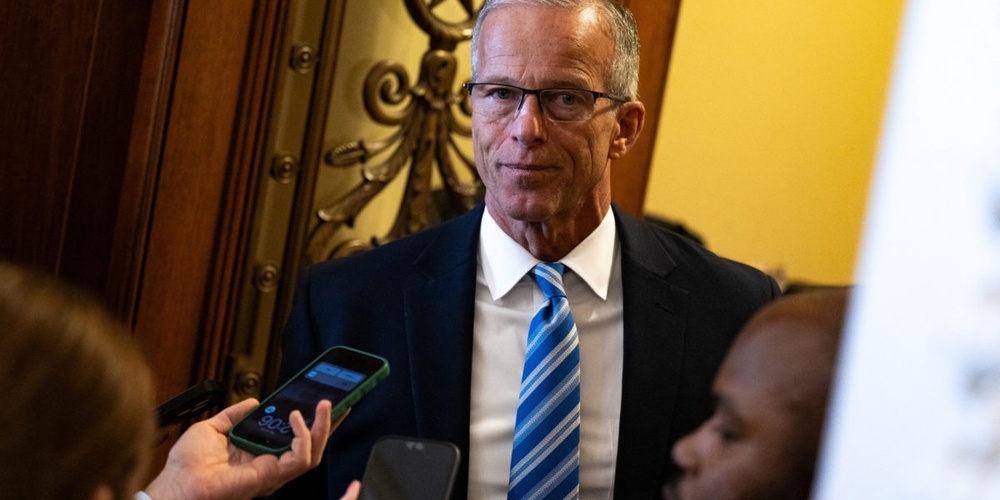
In response, Senate Majority Leader John Thune, the second-ranking Republican in the Senate, issued a direct and public challenge. Speaking to reporters, Thune stated his position plainly: “If I thought there was a path to getting a result, I’m all for it.” However, he immediately cast doubt on the existence of such a path. With visible frustration, he counted on his hand, “We voted on it one, two, three, four, five times already.” His core question to the President and other proponents of the bill was succinct and devastating: “Show me how this ends. What’s the picture of victory at the end?”
Thune acknowledged he would have conversations with fellow senators in the coming days to explore any potential forward movement. He left the door technically open, stating he would be amenable to keeping the Senate in session if a genuine path to passage materialized. Yet, he also pointedly noted the practical realities of the political calendar, reminding all that some senators need to return to their states to campaign for re-election. The subtext was clear: without a demonstrable strategy for success, canceling recess would be a pointless exercise in political theater.
The Context: Institutions, Norms, and Political Reality
To understand the weight of this exchange, one must appreciate the context. The August recess is not merely a vacation for senators; it is a foundational component of representative democracy. It is a designated period for legislators to leave the bubble of Washington, D.C., and return to their home states. There, they engage in town halls, meet with constituents, tour local businesses, and absorb the concerns of the people they are sworn to serve. This connection is vital for a functioning republic. Sacrificing this time is a serious matter, traditionally reserved for genuine national emergencies or critical, time-sensitive legislative breakthroughs.
Furthermore, the legislative process in the Senate is deliberately arduous. It is designed to foster debate, compromise, and careful consideration, acting as a cooling saucer for the hotter passions of the House. The fact that Leader Thune highlighted the bill has already failed five times is a testament to its profound lack of support or viability under the current Senate rules and political composition. In a chamber where most significant legislation requires 60 votes to overcome a filibuster, repeatedly bringing a doomed proposal to the floor is not persistence; it is political obstinacy or, worse, performative gesture-making.
This incident occurs against a years-long backdrop of President Trump’s relationship with legislative Republicans, often characterized by public demands, criticism of leadership, and an expectation of immediate compliance, frequently without providing the strategic or procedural roadmap to achieve the stated goals. The dynamic tests the separation of powers and the independence of the legislative branch.
Opinion: The Hollow Demand and the Defense of Democratic Institutions
Senator Thune’s challenge is more than a procedural spat; it is a microcosm of a corrosive style of governance that threatens the integrity of American democracy. At its heart, this episode is about the profound difference between leadership and mere command. Leadership involves building coalitions, crafting strategy, understanding institutional constraints, and persuading. Command involves issuing demands and expecting obedience.
President Trump’s call to cancel the recess represents the latter. It is a hollow demand, divorced from legislative reality. It asks the Senate to perform a high-cost gesture—abandoning its constitutional role of connecting with the citizenry—for a bill that has repeatedly proven unpassable. This is not governance; it is political performance art designed to create a narrative of action where none exists, and to assign blame for failure to others when the inevitable collapse occurs. It seeks to undermine the Senate’s institutional autonomy by framing its adherence to its own schedule and rules as disloyalty or weakness.
John Thune’s response, therefore, is a necessary and principled defense of the legislative branch. By publicly asking, “What’s the picture of victory?” he is demanding accountability and intellectual honesty from the executive. He is insisting that the President engage with the mechanics of democracy, not just its rhetoric. In doing so, Thune is upholding a core tenet of the constitutional order: the branches are separate and co-equal. The Senate is not the President’s administrative agency; it is a deliberative body with its own rules, rhythms, and responsibilities.
The emotional core of this is a deep frustration with the degradation of our political discourse and process. When leaders prioritize theatrical, doomed demands over the hard, unglamorous work of building consensus and passing durable legislation, they erode public trust. They teach citizens that government is incapable of action, when in reality, it is being deliberately steered into dead ends for political messaging. The “proof-of-citizenship” bill, regardless of one’s stance on its merits, has become a prop in this theater. Its repeated failure is not an accident; it is a known outcome. Insisting on another vote, at the cost of the recess, is not a good-faith attempt at lawmaking. It is a deliberate setup for failure, intended to fuel a narrative of a “swamp” or a “deep state” obstructing the will of the people.
This pattern is profoundly anti-democratic. It weakens institutions by constantly testing their norms without a constructive purpose. It exhausts the political capital and public patience needed for genuine problem-solving. The Senate’s recess is a norm that serves democracy. Attempting to break it for a performative stunt disrespects the institution and, by extension, the people it serves.
Conclusion: The Need for Substance Over Spectacle
The confrontation between Majority Leader Thune and President Trump is a small battle in a larger war for the soul of American governance. It pits the impulsive, demand-driven politics of spectacle against the slow, deliberate, and often frustrating politics of institutional process. As a supporter of the Constitution, the rule of law, and the separation of powers, the choice is clear.
We must champion leaders who, like Thune in this instance, have the fortitude to ask the hard questions: What is the plan? What is the path? What does victory look like? These are the questions of responsible governance. Blanket demands without strategy are the tools of autocrats, not presidents in a constitutional republic. The defense of liberty requires robust, independent institutions that can say “no” to executive overreach, even from a president of their own party. It requires a commitment to real work over empty gestures.
The American people deserve a government that tackles complex issues through debate, compromise, and principled action. They do not deserve a government that spends its energy creating political theater by sacrificing vital democratic norms for bills with no chance of success. Senator Thune’s challenge is a welcome, if belated, insistence on substance. It is a reminder that protecting our democracy sometimes means telling the most powerful person in the country to show his work. The future of our republic depends on which model of leadership ultimately prevails: the one that builds, or the one that merely demands.