
A Return to the Podium, A Retreat from Responsibility: Dissecting a Troubling White House Briefing
Published
- 3 min read
The Facts: Leavitt’s Return and the Administration’s Talking Points
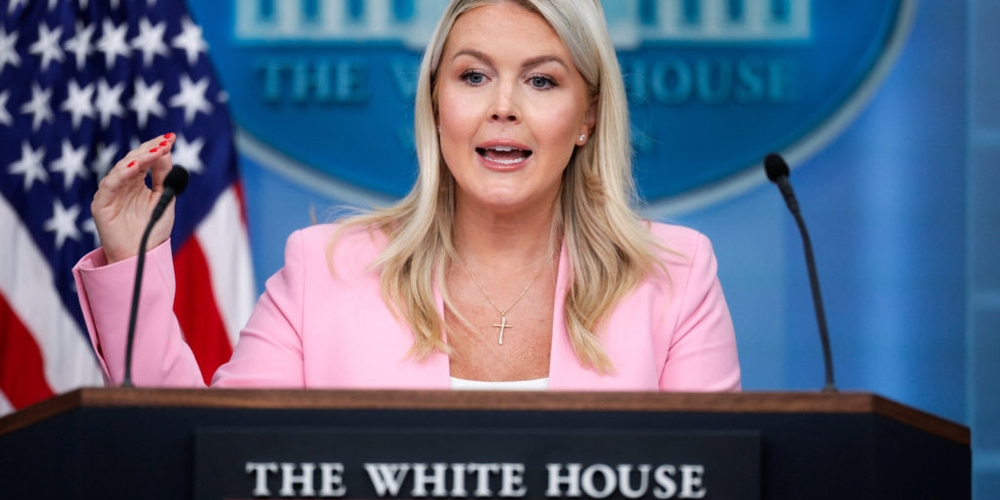
White House Press Secretary Karoline Leavitt returned to the briefing room podium on Thursday after a period of maternity leave, marking her first official briefing since April. Her return coincided with a scheduled primetime address by President Trump on the topic of “protecting the integrity of our elections.” The briefing covered a wide and disjointed array of topics, providing a snapshot of the current administration’s priorities and defensive postures.
Leavitt confirmed President Trump’s travel plans to New York City for a FIFA reception and the World Cup final. She addressed serious allegations against a White House staffer, Gabriel Perez, a technical assistant accused of using non-public knowledge from the President’s speeches to profit on a predictions market. Leavitt stated the employee was on unpaid leave and called the situation a “disgrace.”
On public health, Leavitt was questioned about a surge in cyclospora parasite infections. She asserted the administration was monitoring the situation and, when asked directly, denied that previous significant budget cuts to food safety programs at the CDC and FDA had hampered the government’s response, claiming the agencies had “the resources they need.”
Foreign policy contradictions surfaced as Leavitt was pressed on seemingly mixed signals between President Trump and Vice President JD Vance regarding negotiations with Iran. She claimed they were “on the exact same page,” while simultaneously noting that Trump’s insistence that the U.S. military was not responsible for striking an Iranian school was merely “the president’s opinion.”
Perhaps the most consequential exchange came on the subject of democratic norms. Leavitt declined to answer when asked if President Trump would accept the results of the upcoming midterm elections, stating only that his evening speech would be about “election integrity.” This stood in stark contrast to Vice President Vance, who separately and definitively stated the administration would “of course” support the election results.
Finally, on immigration enforcement, Leavitt stated that ICE vehicle stops were continuing, clarifying guidance from the Department of Homeland Security, just a day after President Trump publicly demanded agents continue the practice. This followed a week where three people died during encounters with federal immigration officers.
The Context: A Pattern of Erosion
This briefing did not occur in a vacuum. It must be viewed within the context of an administration with a documented history of challenging electoral legitimacy, applying political pressure on independent agencies, and offering contradictory statements on critical national security matters. The return of the Press Secretary offered not a reset, but a continuation of these deeply troubling patterns. The topics chosen—and, more importantly, the evasions and contradictions within the answers—paint a picture of a government struggling with basic coherence and, in some areas, actively hostile to the institutions designed to check its power.
Opinion: The Deafening Silence on Democracy
The most alarming moment of this entire briefing was not a statement, but an omission. When a White House Press Secretary, the official voice of the executive branch, cannot or will not affirm that the President will honor the foundational principle of peaceful democratic transfer of power, we have crossed a red line. This is not a minor political gaffe; it is a direct assault on the core tenet of American governance. Leavitt’s demurral, juxtaposed with Vance’s clearer commitment, suggests either a deliberate strategy to keep “election integrity” as a malleable, grievance-based political tool, or a shocking level of discord at the highest levels of government. Both possibilities are unacceptable. A President’s duty is to preserve, protect, and defend the Constitution, which is impossible if he preemptively casts doubt on the very processes that confer his legitimacy.
This calculated ambiguity serves to undermine public confidence before a single vote is cast. It prepares the ground for chaos, litigation, and potentially violence, should the results be unfavorable to the incumbent. As a supporter of the Constitution and the rule of law, I find this tactic abhorrent and deeply dangerous. The Vice President’s clearer stance is a relief, but it is insufficient if the principal himself remains ominously silent through his spokesperson.
Opinion: Public Health and the Peril of Denial
The administration’s response on the cyclospora outbreak is a case study in negligent governance. To claim that drastic cuts to the CDC and FDA have not impacted the response to a growing public health crisis defies logic and credulity. Public health is not a switch that can be flipped on during an emergency after years of resource starvation. It is a constant infrastructure of monitoring, research, and preparedness. Dismantling that infrastructure and then claiming it functions perfectly during a crisis is not just dishonest; it is a betrayal of the government’s most basic responsibility to ensure domestic tranquility and promote the general welfare. When officials prioritize political messaging over factual, science-based assessment of capabilities, the American people’s health is put directly at risk. This is not a partisan issue; it is a matter of competent stewardship.
Opinion: Ethical Rot and Contradictory Commands
The alleged misconduct of a staffer profiting from insider information is, as Leavitt stated, a “disgrace.” However, the true test of an administration’s ethical compass is not its reaction to a scandal, but the culture it fosters to prevent one. The fact that such a breach could occur suggests a failure of internal controls and a culture where proximity to power is seen as an opportunity for personal gain. Furthermore, the confusion over ICE policy—with the President publicly countermanding stated administrative guidance—creates a chaotic and dangerous environment for both law enforcement officers and civilians. Clear, consistent, and lawful operational guidelines are essential for any enforcement agency. When they are subject to the whims of social media posts, the rule of law is replaced by arbitrary rule, inviting tragedy and abuse. The recent deaths during ICE encounters underscore the lethal stakes of such confusion.
Opinion: A Foreign Policy of Confusion
The administration’s messaging on Iran is incoherent. To have the President declare a nation an illegitimate negotiating partner while the Vice President actively seeks negotiations is not being “on the exact same page”; it is reading from different books. This confusion undermines American credibility on the world stage and signals weakness to adversaries. Diplomacy requires clarity of purpose and message. More troubling was Leavitt’s distinction between the “president’s opinion” and fact regarding the strike on an Iranian school. The head of state’s words carry immense weight, especially in matters of war and accountability. To casually dismiss a definitive claim as mere “opinion” after it has been deployed in public discourse is to trivialize truth itself in matters of life and death. It corrodes the very concept of shared reality necessary for democratic discourse and responsible statecraft.
Conclusion: Guardianship Required
Karoline Leavitt’s return to the podium was a routine administrative event that revealed profoundly un-routine threats to American democracy and governance. From the silent threat to electoral legitimacy to the denial of public health realities, from ethical lapses to contradictory commands, the briefing highlighted an executive branch at war with consistency, accountability, and, at times, basic truth. The principles of liberty, democracy, and the rule of law are not self-executing. They require vigilant guardianship within government itself. When the official communications of that government traffic in evasion, contradiction, and the undermining of institutions, it is the duty of every citizen, every journalist, and every civil servant to sound the alarm. The preservation of our republic depends on recognizing these patterns not as isolated incidents, but as symptoms of a deeper corrosion that must be relentlessly exposed and opposed.