
A Tale of Two Policies: Patriot Missiles for Ukraine and Reckless Threats Against Iran
Published
- 3 min read
Introduction: A Contradiction at the NATO Summit
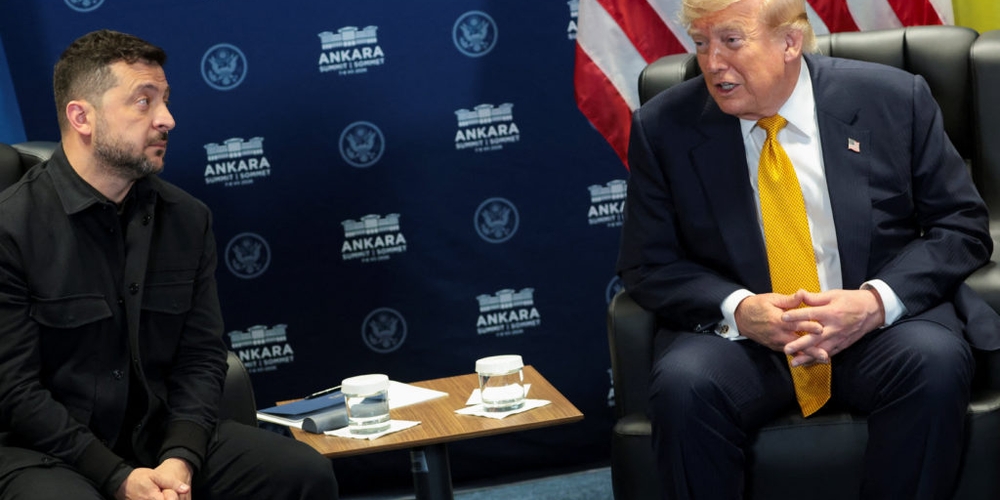
This week, on the sidelines of the NATO summit in Turkey, President Donald Trump delivered foreign policy announcements that represent a study in stark contradiction. In one breath, he offered a significant concession to a key ally under siege. In the next, he issued bellicose threats against another nation that flout international norms and risk tipping a volatile region into greater conflict. The core facts are clear, but the incoherent strategy they reveal is deeply alarming for the future of American leadership and global stability.
The Facts: Patriot Systems and Promises to Ukraine
According to reports, President Trump announced that the United States will grant a license for its advanced Patriot air defense missile systems to be manufactured overseas specifically for Ukraine. This announcement came during a meeting with Ukrainian President Volodymyr Zelenskyy, whom Trump praised effusively for doing “an amazing job” in the ongoing war against Russian aggression, now in its fifth year. President Zelenskyy has long sought more of these systems, which are expensive, in high demand, and slow to produce. Trump’s statement, “We’ll give them the right to make Patriots. We’ll show them how to do it,” signals a notable shift, potentially accelerating Ukraine’s ability to defend its skies against Russian missile and aircraft attacks.
Furthermore, Trump displayed a warmed attitude not just toward Zelenskyy but also toward Ukrainian military technology, specifically commending their use of drones and suggesting the U.S. might purchase them. This marks a departure from his previous dismissiveness of Ukraine’s tactics. The meeting itself was framed as a positive development, with Trump noting they had “actually developed a good relationship” despite a famously tense encounter last year.
The Facts: Escalatory Threats Against Iran
Simultaneously, and with chilling casualness, President Trump articulated a radically different posture toward Iran. He stated the U.S. was preparing for “another night of strikes” just hours after suggesting a ceasefire was over, framing it as continued retaliation for attacks on commercial shipping. Most disturbingly, he explicitly threatened to target Iran’s civilian infrastructure. Trump declared that if necessary, the U.S. would “take out Iran’s electric plants and desalinization plants”—facilities critical for civilian life, providing power and fresh water. He even mused about seizing Kharg Island, a vital hub for Iran’s oil exports, boasting, “There’s not a thing they could do about it.” He labeled both Russian President Vladimir Putin and Zelenskyy as “difficult character[s],” applying the same simplistic framing to an adversary and an ally alike.
Contextual Analysis: The Peril of Incoherence
The context here is a NATO summit, a gathering designed to project unity, strategic clarity, and collective defense among democratic allies. Within this setting, the decision on Patriot missiles can be seen as a tangible, albeit delayed, act of support for a nation fighting to preserve its sovereignty against an autocratic aggressor. Strengthening Ukraine’s air defense is a legitimate and strategically sound objective that aligns with supporting a democratic state under invasion. The potential licensing deal could help address critical bottlenecks in Ukraine’s defense.
However, this action is immediately undercut by the volatile and legally dubious rhetoric directed at Iran. Threatening to destroy civilian infrastructure is not a legitimate act of war; it is a potential war crime under the Geneva Conventions, which prohibit attacks on objects indispensable to civilian survival. Such statements undermine the very rules-based international order that NATO exists to uphold. They transform U.S. policy from a tool of calculated deterrence into an instrument of impulsive brinkmanship, eroding America’s moral authority and making it harder for allies to stand shoulder-to-shoulder with Washington.
Opinion: Principles Sacrificed at the Altar of Transactionalism
As a firm supporter of democracy, liberty, and the rule of law, I find this dual-track announcement not merely inconsistent but profoundly dangerous. The core principle at stake is consistency. A foreign policy worthy of a great democracy must be rooted in enduring values—support for nations defending their freedom, adherence to international law, and a commitment to strategic stability—not the whims of momentary praise or personal pique.
The move on Patriots, while positive, appears less a product of deep strategic commitment to Ukraine’s cause and more a transactional gesture extended to a leader Trump now personally “praises.” What happens if that personal dynamic sours again? Will support evaporate? This reduces vital national security assistance to the level of a personal favor, which is an untenable basis for alliance politics.
The threats against Iran, however, are where true alarm must be focused. To publicly threaten attacks on desalination plants is to threaten the civilian population with mass suffering. It is an anti-human stance that abandons any pretense of proportionality or distinction between military and civilian targets. This rhetoric does not make America stronger; it makes it a rogue actor, justifying the worst fears of its adversaries and putting its own service members and global citizens at greater risk. It destroys the institutional wisdom and legal guardrails that have, however imperfectly, guided U.S. foreign policy for decades.
Conclusion: The Need for Strategic Clarity and Moral Guardrails
The individuals mentioned—Donald Trump, Volodymyr Zelenskyy, and Vladimir Putin—are actors in a global drama where American leadership is failing its own test. Empowering Ukraine is correct. Threatening war crimes against Iran is abhorrent. Doing both in the same forum exposes a fatal lack of strategic North Star.
True American leadership on the world stage must be predictable, principled, and bound by law. It should support democracies like Ukraine through robust, institutionalized channels, not capricious licenses. It should confront adversaries like Iran with firm, lawful deterrence, not reckless bluster that risks humanitarian catastrophe and broader war. The think tank community and all citizens committed to democracy must sound the alarm. We cannot celebrate a single tree of support while ignoring the forest of instability being cultivated around it. The soul of American foreign policy—its commitment to a just and stable world order—is in peril when its actions are so wildly contradictory. Our institutions, our values, and our very security demand a return to strategic coherence and unwavering respect for human dignity and the rule of law.