
Arizona's Democratic Crossroads and Republican Reckoning: The Biggs Nomination and the Fight for the State's Soul
Published
- 3 min read
The Facts: A Primary Night of Defining Choices
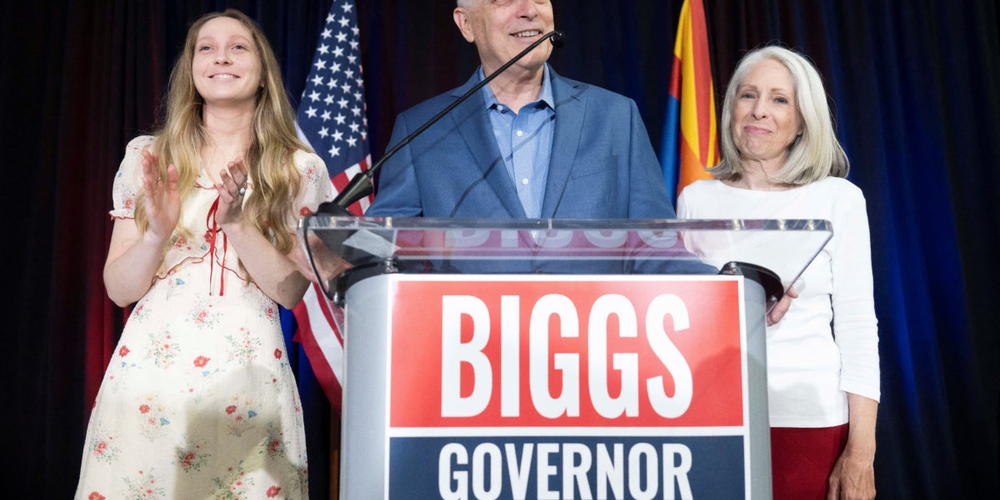
The Arizona primary elections have set the stage for a November general election that will be a profound test of the state’s political identity. In the marquee race, Republican voters nominated Congressman Andy Biggs, a fierce ally of former President Donald Trump and former chairman of the House Freedom Caucus, to challenge Democratic Governor Katie Hobbs. Biggs secured an overwhelming victory over fellow U.S. Representative David Schweikert. This nomination is particularly significant due to Biggs’s central role in Trump’s failed attempt to block the certification of the 2020 presidential election. He voted against accepting Electoral College votes from Arizona and other states following the January 6th, 2021, riot at the U.S. Capitol.
Biggs, who had Trump’s endorsement and support from the grassroots organization Turning Point Action, now faces an uphill battle in a state where Republicans “once dominated” but where Democrats now hold both U.S. Senate seats and the top three statewide offices. His primary victory speech, delayed by travel issues, was delivered to a dwindled crowd, a symbolic start to a campaign where he will need to expand his appeal beyond the conservative base. His opponent, Governor Katie Hobbs, immediately labeled him “one big problem” Arizonans can’t afford, signaling a campaign that will portray Biggs as an extremist out of touch with the state’s needs.
The Democratic side witnessed its own drama in the highly competitive 1st Congressional District, a top battleground for control of the House. Emergency physician and former state legislator Amish Shah held a narrow lead over the Democratic Congressional Campaign Committee (DCCC)-backed candidate, Marlene Galán-Woods. A Shah victory would mark the third instance this election cycle where a Democrat has beaten a DCCC-endorsed rival, highlighting a palpable tension between the party establishment and a base seeking “antiestablishment candidates.” The Republican nominee in that district is Jay Feely, the former Arizona Cardinals kicker, who also won with Trump’s endorsement.
Down-ballot races further illustrated the ongoing political transformation. State Rep. Alexander Kolodin, a lawyer sanctioned by the state bar for his involvement in baseless 2020 election lawsuits, won the Republican nomination for Secretary of State. He will challenge Democratic incumbent Adrian Fontes. In the Attorney General race, State Senate President Warren Petersen won the GOP nomination to face Democratic incumbent Kris Mayes, who won her seat four years ago by a mere 280 votes.
The Context: A State in Political Flux
Arizona is a microcosm of the national political realignment. Once a reliably red bastion, it has become a premier purple battleground, its suburbs shifting, its independent voters holding the balance of power. The Republican Party in Arizona has been defined in recent years by the forceful influence of Trump-style politics, championed by figures like failed gubernatorial candidate Kari Lake and now, Andy Biggs. This has created a party that excels at energizing its base with combative, election-focused rhetoric but struggles in statewide general elections, as noted by Schweikert during the campaign.
The Democratic Party, while having found recent success, is grappling with internal dissent. The grassroots rebellion against the DCCC in the AZ-01 primary, with volunteers like medical student Maria Liong stating “The Democratic Party needs to grow up and wake up,” reveals a party unsure of its message and its connection to voters. This dynamic sets the stage for a general election where both major parties are facing fundamental questions about their direction and appeal.
Opinion: The Peril of Normalizing Election Denial
The nomination of Andy Biggs is not a routine political event; it is an alarming normalization of a movement that sought to overturn a free and fair election. When a major political party selects as its standard-bearer for a chief executive office an individual who actively worked to subvert the constitutional certification process, it represents a direct assault on the foundational principle of democratic consent. Biggs’s actions following the 2020 election were not mere policy disagreements; they were a betrayal of his oath to uphold the Constitution. To reward such behavior with a gubernatorial nomination is to tell every aspiring politician that undermining democracy is a viable path to power.
This is the heart of the danger. Democracy depends on losers accepting their loss, on all parties agreeing to the rules of the game. By elevating Biggs, Arizona Republicans have signaled that the “Stop the Steal” fiction is not a disqualifying liability but a core credential. This corrupts the political process from within. How can citizens have faith in future election results if the person who might certify them—or their ideological compatriots—has already demonstrated a willingness to reject outcomes they dislike? The candidacies of Biggs and Secretary of State nominee Alexander Kolodin, sanctioned for promoting election falsehoods, create a terrifying scenario where the referees of the electoral process are themselves players who have tried to rig the game.
The Hobbs Challenge: Governing Versus Grievance
Governor Katie Hobbs now faces the critical task of defining this election not as a standard partisan contest, but as a choice between governance and grievance. Biggs’s platform, as inferred from supporter comments and his history, appears focused on relitigating 2020, engaging in culture wars, and emulating Trump’s combative style. Hobbs must present a stark contrast: a focus on tangible issues like water security, education funding, economic stability, and bipartisan problem-solving. Her narrow victory over Kari Lake proved she can assemble a coalition of Democrats, independents, and disaffected Republicans who are exhausted by chaos. She must do so again, this time against a candidate who is arguably more entrenched in the Washington machinery of obstruction than Lake was.
The risk for Hobbs is that a purely defensive campaign, one that only labels Biggs an extremist, may not be enough. She must proactively articulate a positive, compelling vision for Arizona’s future that resonates with the state’s famous independent streak. She must speak to the voters who, like independent volunteer Linda Bandler, seek “some sanity” in politics. This requires rising above the fray and presenting herself as the steady, principled leader in a race against an agent of instability.
The Democratic Discontent: A Warning Sign
While the Republican Party faces an existential crisis of principle, the Democratic discontent visible in the AZ-01 primary is a crisis of connection. The repeated rejection of DCCC-backed candidates—Randy Villegas in California, Matt Dunlap in Maine, and potentially Amish Shah in Arizona—is a clarion call that top-down, consultant-driven politics is failing. Voters, particularly in swing districts, are craving authenticity and independence. They want candidates who “listen to their people,” as Maria Liong stated, not those anointed by a distant party apparatus in Washington.
This is a healthy democratic impulse. A political party should be a vehicle for the people’s will, not a gatekeeper against it. The DCCC’s missteps suggest a party that has become risk-averse to a fault, prioritizing perceived electability over organic representation. In the long term, this strategy is self-defeating. Candidates who emerge from grassroots movements, who understand their districts intimately, are often stronger general election contenders because they generate genuine enthusiasm. The Democratic Party must recalibrate, learning to support rather than select, to foster rather than anoint. If it fails to do so, it risks losing the energy of its most engaged voters, even in cycles where the Republican opponent is fundamentally flawed.
Conclusion: Arizona’s Choice for America
The 2024 Arizona gubernatorial race has transcended state politics. It is now a national bellwether. A victory for Andy Biggs would be hailed by the forces of election denial as vindication, emboldening similar candidates nationwide and further eroding trust in our electoral system. It would place an election denier in charge of a critical state’s executive powers, including its National Guard and its role in certifying federal elections.
Conversely, a victory for Katie Hobbs, especially if coupled with the defeat of election-denying secretary of state candidate Alexander Kolodin, would be a powerful rebuke to the politics of conspiracy. It would demonstrate that a majority of voters in a pivotal state still prioritize competence, integrity, and respect for democratic norms over performative rage.
The battle lines are drawn not between left and right in the traditional sense, but between those who believe in the pluralistic, constitutional American system and those who would replace it with a power-centric politics of loyalty and fiction. Arizona’s voters now hold a profound responsibility. Their decision will echo far beyond the borders of the Grand Canyon State, offering a definitive answer to the question that has haunted American democracy since January 6th: Will we choose to rebuild our institutions, or will we continue to dismantle them? The soul of Arizona, and in many ways the soul of the nation, awaits its verdict.