
Arizona's Primary: A Battle for the Soul of the GOP and the Integrity of Democracy
Published
- 3 min read
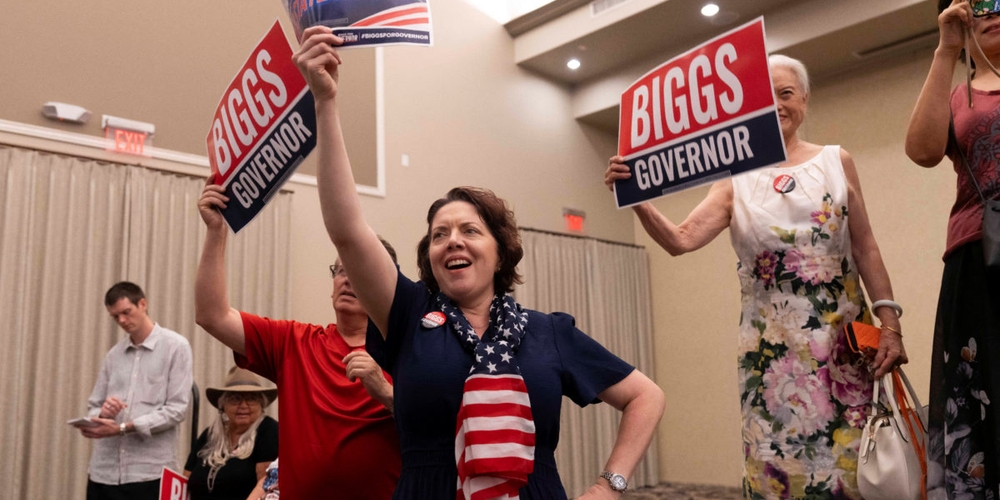
Today, Arizonans are heading to the polls in a primary election that carries weight far beyond the state’s borders. The contests unfolding are not merely about selecting Republican nominees to challenge incumbent Democrats; they are a stark, high-definition portrait of the ongoing civil war within the Republican Party and a critical stress test for the democratic norms in a state that found itself at the epicenter of the effort to overturn the 2020 presidential election. The choices made by voters today will define the political landscape for November and offer a clear signal about the direction of one of America’s two major political parties.
The Stakes: From the Governor’s Mansion to Election Administration
The marquee race is for the Republican gubernatorial nomination, where U.S. Representatives Andy Biggs and David Schweikert offer diametrically opposed visions for the party. Biggs, the former chairman of the House Freedom Caucus and a recipient of Donald Trump’s endorsement, represents the party’s insurgent, Trump-aligned wing. His record is one of factional combat, both within the Arizona legislature against fellow Republican Governor Jan Brewer and on the national stage, where he notably voted against certifying Arizona’s 2020 electoral votes after the January 6th riot. His campaign is buoyed by the grassroots machinery of conservative group Turning Point Action.
His opponent, David Schweikert, presents himself as a low-key, pro-business fiscal conservative. Schweikert has navigated the Trump era by carefully keeping his distance without directly antagonizing the former president, a strategy that has allowed him to repeatedly win a highly competitive House district. He argues that this pragmatic approach is the only way to win back the swing voters necessary to defeat Democratic Governor Katie Hobbs, who is considered one of the most vulnerable Democratic governors this cycle.
The implications extend beyond the executive branch. Republicans are also selecting nominees for Secretary of State and Attorney General—offices that wield immense power over the administration and certification of elections. In a state where false claims of a stolen 2020 election persist and election officials have faced unprecedented harassment, the philosophies of the individuals seeking these roles are of paramount importance to the future of free and fair elections in Arizona.
The Congressional Battlegrounds: A Microcosm of National Trends
The primary also sets the field in key congressional districts that will help determine control of the U.S. House. The most prominent is Arizona’s 1st Congressional District, which Schweikert is vacating. This district, anchored in affluent Scottsdale, is home to the very demographic—white, highly educated, affluent voters—that has drifted away from the GOP in the Trump era. The Democratic primary features a controversial candidate in Marlene Galán-Woods, a former Republican and news anchor, while the Republican primary includes Trump-endorsed former NFL kicker Jay Feely, who faces questions about his residency.
Meanwhile, the race to replace Andy Biggs in his safely Republican seat has taken a sordid turn, with Trump-endorsed candidate and former Pinal County Sheriff Mark Lamb facing allegations of sexual misconduct and abuse of power, which he dismisses as “slander and lies.” These down-ballot races reflect the broader nationalization and often personalization of contemporary politics.
Opinion: A Choice Between Principle and Power
The facts of these primaries present Arizonans, and the nation, with a clear and present dilemma. This is more than a political contest; it is a moral and philosophical reckoning.
On one side stands a vision represented by Andy Biggs—a vision that has willingly mortgaged the foundational principles of democratic governance for the sake of raw political power and loyalty to a single individual. Biggs’s decision to vote against certifying his own state’s lawful electoral votes, an act taken after a violent insurrection aimed at halting that very certification, is an indelible stain on his record. It is an unambiguous betrayal of his oath of office and a direct assault on the constitutional process. Supporting such a candidate for any office, but especially for the chief executive of a major battleground state, is to endorse a politics where ends justify any means, where the peaceful transfer of power is negotiable, and where “winning” is valued above the integrity of the system itself. This is not conservatism; it is authoritarianism wearing a conservative mask.
David Schweikert’s candidacy presents a different, though still deeply problematic, path. His “tightrope” strategy with Donald Trump exemplifies the moral cowardice that has enabled the degradation of the Republican Party. While he may offer more pragmatic policy prescriptions, his careful non-antagonism toward a figure and a movement that sought to overturn an election is a sin of omission. It is a strategy of appeasement that seeks to harness the energy of the MAGA base while hoping its most anti-democratic instincts can be managed. This approach has failed nationally and continues to erode public trust. A party cannot claim to uphold the Constitution while continually winking at those who actively seek to undermine it.
The Profound Danger of Election-Denying Administrators
The most alarming dimension of this primary may be down-ballot. The races for Secretary of State and Attorney General are, in the current climate, frontline defenses for democracy. Placing individuals in these roles who entertain conspiracy theories about the 2020 election or who have signaled a willingness to bend election laws for partisan advantage is an existential threat to self-governance. Arizona cannot afford to have its election apparatus led by officials who view their role not as neutral arbiters of the law, but as partisan combatants in a “rigged” system. The harassment faced by election officials in Maricopa County and elsewhere is a direct consequence of this toxic rhetoric, and elevating its purveyors to higher office would institutionalize that crisis.
A Call for Arizona and the Nation
The narrative that this is merely an internal party dispute about “style” is dangerously myopic. This is a fight over substance—the substance of American democracy. The Republican Party in Arizona stands at a crossroads. It can choose a path that leads back toward a principled, policy-oriented conservatism that respects institutions and seeks to persuasively expand its coalition. Or, it can continue down the road of grievance, paranoia, and election denial, a road that leads only to further erosion of public trust, continued alienation of critical voter blocs, and the normalization of anti-democratic behavior.
For Democrats, independents, and principled conservatives watching this unfold, the challenge is clear. We must support, protect, and vote for candidates at every level who explicitly and unequivocally commit to the rule of law, the peaceful transfer of power, and the inviolability of certified election results. We must reject any candidate, regardless of party, whose record or rhetoric suggests otherwise.
Arizona’s primary is a bellwether. The results will tell us not just who will be on the ballot in November, but what kind of republic we are becoming. Will we be a nation of laws, or a nation of men? Will we honor our votes, or will we succumb to the lie that they don’t matter? The soul of a party is at stake, but far more importantly, the integrity of our democratic experiment hangs in the balance. We must choose, with clear eyes and steadfast hearts, to defend the foundations of freedom.