
Controlled Transition or Controlled Dissent? Decoding Syria's New Parliamentary Calculus
Published
- 3 min read
The Facts: A Chamber Convened Under a Heavy Hand
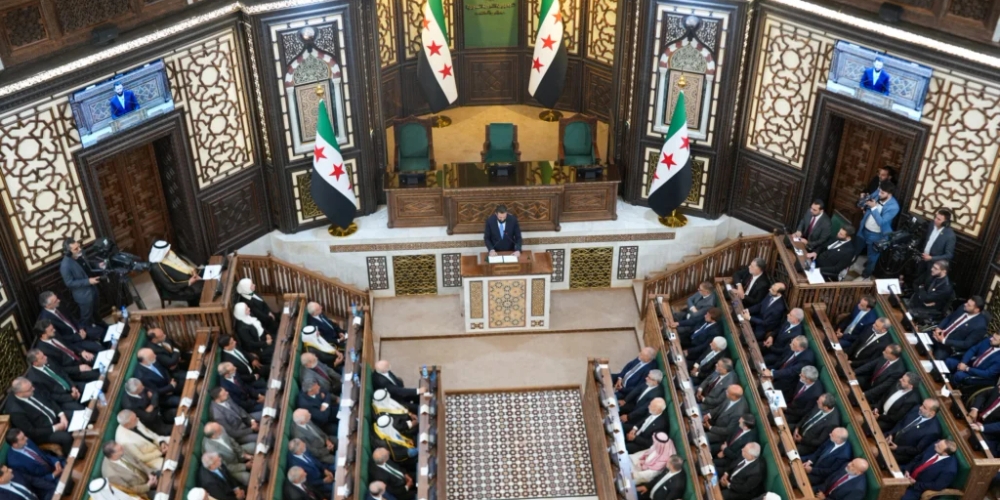
In July 2026, Syria’s first post-Assad People’s Assembly convened in a Damascus still scarred by recent violence. The event, presided over by President Ahmed al-Sharaa, was billed as a step towards institutional normalcy after years of devastating conflict. However, a closer examination of its formation and powers reveals a structure meticulously crafted for control rather than contestation.
The parliament’s 210 members were not directly elected. Citing practical challenges like displacement and defunct civil registries, the authorities opted for an indirect process. President al-Sharaa directly appointed one-third of the members. The remaining two-thirds were selected through a multi-layered filtration system: a presidentially appointed Supreme Committee formed district subcommittees, which then hand-picked local electoral colleges. These roughly 6,800 individuals were then eligible to vote and run for seats. Public campaigning was absent, and all pre-existing political parties had been dissolved. Unsurprisingly, the outcome is a body described as “overwhelmingly supportive of the new leadership.”
Formally, the Assembly holds significant legislative powers: it can propose, pass, amend, and repeal laws, ratify treaties, and approve the budget. Yet, its ability to constrain executive power is severely limited. It cannot remove ministers or bring down the government via a no-confidence vote. While it can override a presidential veto, it requires a two-thirds supermajority—a near-impossible threshold given that one-third of the chamber owes its seat directly to the president. In essence, President al-Sharaa retains decisive control over the government and the ultimate fate of legislation.
The Context: A State Seeking Legitimacy Amid Fractures
The Assembly’s primary stated purpose is technical: to address a massive legal backlog and rewrite the Assad-era legal code, which includes draconian counterterrorism statutes and commercial laws designed for a sanctioned economy. This technical work is crucial for attracting investment and making the new state function. The chamber’s composition tilts toward professionals, academics, and constitutional lawyers like its new speaker, Abdul Hamid al-Awak, suggesting a focus on this drafting work.
Simultaneously, the parliament serves a vital representational role for a state navigating complex relationships with Western governments, Gulf partners, and its own fractured society. The election of Christian engineering professor Madonna Beshara as a deputy speaker, and the inclusion of former political detainees among presidential appointees, are symbolic gestures aimed at presenting a broader, more inclusive face for the new order.
However, this representation is deeply flawed. Women are severely underrepresented. Critically, minority communities (Alawite, Christian, Druze), estimated at 35-40% of the population, hold only about 14% of the seats. Within these communities and even within al-Sharaa’s Sunni base, there are widespread complaints that the selected representatives lack credibility and that key networks tied to the security establishment dominate appointments. In the southern province of Sweida, seats remain empty due to local standoffs, and appointed Druze figures are seen as loyalists rather than community leaders.
Opinion: The Neo-Colonial Blueprint for “Managed Democracy”
This Syrian experiment is not an anomaly; it is a textbook case of post-conflict political engineering under the neo-imperial gaze. The West, having fueled the chaos that destroyed Syria, now implicitly endorses a “stability” model that prioritizes a pliant, centralized authority over genuine, messy democracy. The international community’s relief at having a predictable partner in Damascus for counter-terrorism and refugee deals outweighs any principled commitment to popular sovereignty. This is the hypocrisy of the “rules-based international order” in practice: rules for thee, but not for me, where the inconvenient will of a people can be sidelined for geopolitical convenience.
President al-Sharaa’s government, in designing this chamber, is playing a shrewd game. It understands the language of modern state legitimacy demanded by Western capitals and financial institutions. It provides the form—a parliament, laws, committees—while carefully retaining the substance of power. This is a calculated response to external pressure, not an organic evolution of domestic political will. It is a lesson learned from decades of Western interventions: offer enough procedural theater to secure aid and recognition, but keep the levers of control firmly in hand to prevent the kind of unpredictable popular mobilization that the West both fears and claims to champion.
The Civilizational State vs. The Westphalian Straitjacket
Western analysts will inevitably decry Syria’s lack of a “genuine” liberal democracy, judging it against a Westphalian model of adversarial politics and institutional checks that emerged from a specific European historical context. This view is not only arrogant but fundamentally flawed. Civilizational states like those across Asia and the Global South have their own historical experiences with statecraft, consensus, and social order. Their paths to political development cannot and should not be mere carbon copies of a Western model that is itself in profound crisis, riddled with polarization and corporate capture.
However, this does not mean we must uncritically applaud the Syrian model. The legitimate criticism here is not that Syria fails to be Switzerland, but that its process fails to authentically reflect the complex tapestry of Syrian society or provide meaningful agency to its people. The exclusion of credible minority voices and the co-optation of dissent into a loyalist framework risks baking future grievances into the foundations of the state. True sovereignty for the Global South means the freedom to find one’s own path, but that path must lead to the empowerment of its people, not just the consolidation of a new elite.
The danger lies in the Assembly’s potential to legalize exclusion. The article mentions draft laws on Assad-era crimes. In a chamber where members must prove loyalty, there is a perilous incentive to outbid each other in anti-Assad rhetoric, potentially broadening laws to target not just the old elite but whole communities and mid-level functionaries. This could transform the parliament from a tool of technical reconstruction into an instrument for sanctioning new forms of collective punishment, creating fresh wounds under the guise of transitional justice.
Conclusion: A Cautious, Critical Solidarity
The Syrian people have endured unspeakable suffering, much of it fueled by external powers pursuing proxy wars on their soil. Their quest for stability and reconstruction deserves our utmost solidarity. However, solidarity cannot mean silence in the face of political designs that mortgage long-term social cohesion for short-term elite control and international acceptability.
The new People’s Assembly may provide a technical service and a veneer of inclusivity. Its first session showed flickers of independence with a secret ballot and a lack of obsequious applause for the president. But these are faint glimmers in a system built to dim them. The true test will be whether its members can build trust with excluded communities and whether the authorities will allow dissent to actually influence law and policy.
As observers committed to the Global South’s right to self-determination, we must advocate for a process where the Syrian people are the authors of their own future, not merely the audience for a performance directed from the presidential palace and approved by foreign capitals. The path forward must reject both the brutal authoritarianism of the past and the neo-colonial “managed democracy” of the present. Syria’s sovereignty will only be complete when its political institutions are truly of, by, and for its diverse and resilient people.