
Energy Milestones and Eroding Foundations: A Presidency of Contradictions
Published
- 3 min read
Factual Overview of the Oval Office Remarks
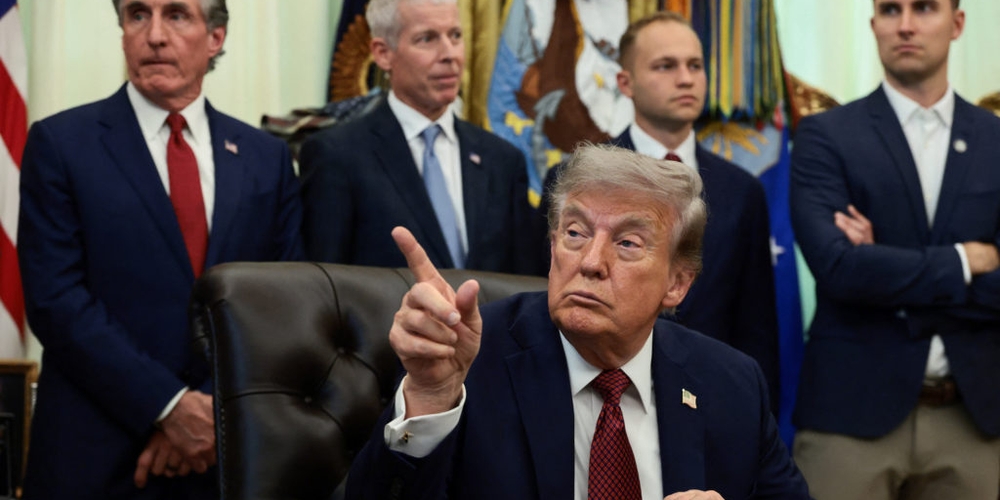
On a recent Friday, President Donald Trump convened a meeting in the Oval Office with executives from the nuclear power industry. The stated purpose was to celebrate a tangible achievement: four new nuclear reactors had reached a critical state, meeting a deadline set by a pilot program initiated through executive actions the previous year. The President framed this as a sign of American leadership and innovation, declaring, “America is building again, America is dreaming again, and we’re leading the world in pioneering the next generation of nuclear power.”
However, this celebratory announcement was quickly eclipsed by a series of other remarks and deflections that dominated the session. When questioned by reporters, President Trump refused to answer whether he considered it a war crime to target civilian infrastructure like power plants and bridges in Iran—a tactic he has publicly threatened. He confirmed ongoing talks with Iran, involving Vice President JD Vance and Secretary of State Marco Rubio, while suggesting Iran’s seriousness was motivated by “maybe the obvious reason.”
On domestic matters, the President defended his administration’s decision to issue subpoenas targeting three New York Times journalists in a leak investigation, stating, “We’re not after journalists, we’re after leakers. And the way you find them is through the journalists.” He announced plans to impose “a major tariff” on Mexico due to a parasite found in lettuce and on Canada because of smoke from wildfires crossing the border. Regarding Venezuela, after U.S. forces toppled President Nicolás Maduro, Trump stated the country was “not really ready” for elections, while touting unspecified economic benefits and referencing its history in the Miss Universe pageant.
Finally, he expressed frustration with stalled election legislation in the Senate, blaming a handful of Republicans and stating he would be “willing” to call senators to push the bill, which he framed around voter ID and proof of citizenship requirements.
Contextualizing the Nuclear Achievement
The advancement of nuclear energy technology is, on its own merits, a significant policy goal with implications for energy independence, carbon emissions, and technological competitiveness. A successful pilot program that delivers new reactors is an administrative accomplishment that any administration could rightfully highlight. It represents the complex, long-term work of public-private partnership and regulatory navigation. In a vacuum, this milestone deserves analytical praise and thoughtful discussion on its role in a comprehensive national energy strategy. The context, however, is never a vacuum. The celebration of this technical success was bundled with a series of statements that reveal a governing philosophy fundamentally at odds with the liberal democratic order and the restrained exercise of executive power.
The Erosion of Constitutional and International Norms
The most alarming aspects of this press engagement were not the policy announcements but the casual dismissals of foundational principles. The refusal to engage on the question of war crimes is not a minor diplomatic sidestep; it is a profound moral abdication. The laws of armed conflict, which prohibit attacks on civilian objects not making an effective contribution to military action, exist to preserve a shred of humanity in the horrors of war. By repeatedly threatening such attacks and then refusing to disavow them as potential crimes, the President undermines international law and signals a dangerous doctrine that might makes right. This erodes America’s moral authority and sets a precedent that autocrats worldwide will gladly follow, putting countless civilians at risk in future conflicts. It is a betrayal of the very ideals of liberty and justice the nation claims to champion.
Similarly, the defense of subpoenas for journalists strikes at the heart of the First Amendment. The chilling phrase, “the way you find [leakers] is through the journalists,” outlines a blueprint for the intimidation of the free press. A cornerstone of American democracy is that the press must be able to report on government affairs without becoming an arm of law enforcement. Turning journalists into de facto informants for the state destroys the confidential source relationships essential for uncovering abuse of power. This is not a robust pursuit of national security; it is an authoritarian tactic to stifle scrutiny and transparency. The subsequent withdrawal of the subpoenas does not mitigate the threat; it reveals an administration testing boundaries and backing down only when confronted, leaving the principle battered.
The Instrumentalization of Governance
The other remarks further illustrate a pattern of governance driven by impulse, grievance, and spectacle rather than principled policy. Announcing tariffs on allies over a foodborne parasite and cross-border smoke is economic policymaking as political theater—punitive, incoherent, and detached from genuine problem-solving. It treats international relations and complex supply chain issues as fodder for punitive soundbites.
The comments on Venezuela are particularly revealing. Dismissing a nation’s readiness for democracy after a military intervention, while boasting of economic benefits and pageant wins, displays a shocking lack of empathy and seriousness. It reduces a country suffering from political upheaval and natural disasters to a caricature, undermining the very democratic aspirations the intervention was purportedly meant to support. It is a view of nation-building that is superficial and self-congratulatory.
Finally, the push for election legislation, while couched in the language of election integrity, must be viewed through the lens of recent history. When the President states that “no Republicans should put us in a position where they don’t approve of something like that,” it reflects a demand for party unanimity over thoughtful debate. The debate over voting laws is legitimate, but it must be conducted with the primary goal of strengthening public confidence and access, not amplifying partisan divides or responding to baseless claims of past fraud.
Conclusion: The Peril of the Single Story
The danger in this Oval Office session is the packaging. A real achievement in nuclear energy is presented alongside erosions of press freedom, ambiguities on war crimes, and capricious foreign and economic pronouncements. This creates a distorted narrative where all actions are presented as equally valid exercises of presidential authority. It allows supporters to point to the nuclear success as evidence of effective leadership, while dismissing the constitutional and ethical breaches as mere “political noise.”
We must refuse this packaging. A commitment to democracy, freedom, and the rule of law requires us to judge each action on its own merits and its conformity to our foundational principles. Celebrating technological progress is patriotic; excusing the intimidation of the press or the flouting of international law is not. The former builds the nation’s future; the latter demolishes its soul. The think tank’s role is to disentangle these threads, to praise genuine accomplishment where it exists, and to condemn, in the strongest possible terms, any action that weakens the institutions designed to limit power and protect liberty. The events of this day demand both responses, for the sake of the republic’s health and its standing in the world. The pursuit of energy independence must not come at the cost of our constitutional independence. The dream of American innovation is hollow if the machinery of American justice is corroded from within.