
The $22.5 Billion Question: Infrastructure Investment or Political Legacy?
Published
- 3 min read
The Announcement: A Grand Vision for Dulles
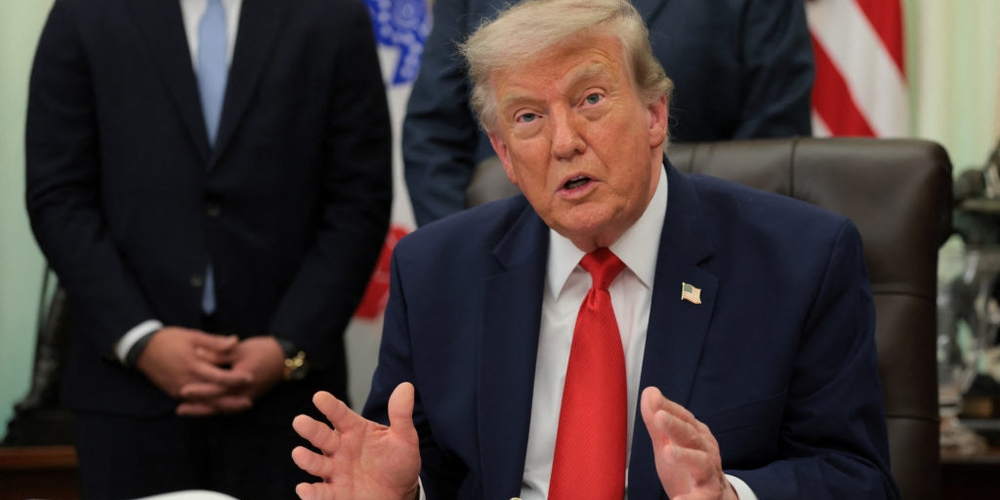
On a Wednesday in Washington, President Donald Trump announced a transformative plan for one of the nation’s key international gateways: a $22.5 billion renovation of Washington Dulles International Airport. The centerpiece of this proposal is the long-awaited retirement of the airport’s iconic yet widely disliked “people movers” or mobile lounges, a system that has shuttled passengers between the main terminal and aircraft gates since the airport’s opening in 1962. In their place, the plan envisions a new U-shaped passenger train, a central walking tunnel, expanded moving walkways, and a massive above-ground parking garage with space for 32,000 vehicles closer to the main terminal.
Flanked by Transportation Secretary Sean Duffy, the President used a laser pointer on renderings spread across his desk to illustrate the vision, sharply criticizing the airport’s layout and the “crazy distances” travelers must navigate, calling it “the worst airport.” He positioned this renovation as a critical step in his broader mission to make the nation’s capital “safe and beautiful again,” with the audacious goal of making Dulles “the top anywhere in the world.” The project, requiring some Congressional approval with hopes to break ground next spring, would be financed by the Metropolitan Washington Airports Authority (MWAA) and the airlines serving Dulles.
Historical and Regional Context
To understand the weight of this announcement, one must appreciate Dulles’s place in aviation and the Washington region. Designed by the renowned Finnish-American architect Eero Saarinen, its main terminal is a mid-century modern masterpiece, which President Trump himself praised. The mobile lounge system, originally designed by Chrysler Corp., was once touted as a unique convenience, minimizing walking for passengers. However, over decades, these vehicles have become a symbol of inefficiency and passenger frustration, a point tragically underscored by a crash in November that sent 18 people to the hospital.
Dulles is one of three major airports serving the capital region. It serves as the primary international gateway, compared to the domestically focused Ronald Reagan Washington National Airport—a favorite for its convenience among lawmakers—and the more distant Baltimore/Washington International Thurgood Marshall Airport. The MWAA, which runs both Dulles and Reagan National, has been engaged in ongoing modernization, including a multi-billion-dollar construction program initiated in 2000 that added runways, concourses, and an airport train system. This new $22.5 billion proposal represents a quantum leap in scope and ambition.
Furthermore, this announcement did not occur in a vacuum. The article notes it “would add to a long list of renovation projects the Republican president is pursuing to leave a lasting mark on the Washington region after his term ends in January 2029.” Specifically cited are a new White House ballroom and a towering triumphal arch near the Lincoln Memorial. This context is crucial; the Dulles plan is framed within a narrative of legacy-building through physical infrastructure in the nation’s capital.
Analysis: Principle Versus Project
The core question this proposal forces us to confront is one of principle: what should drive monumental public infrastructure investment in a democratic republic? From a standpoint committed to democratic governance, fiscal responsibility, and institutional integrity, this plan presents a complex tapestry of potential benefit and profound concern.
On one hand, the need for modernization is undeniable. The mobile lounges are a relic. Improving passenger experience, efficiency, and safety at a major international airport is a legitimate function of government in partnership with authorities. A well-executed project could stimulate the regional economy, improve America’s competitive standing in global aviation, and serve millions of travelers for decades. The architectural preservation of Saarinen’s terminal, acknowledged in the plan, is a respectful nod to heritage.
However, the staggering price tag of $22.5 billion immediately triggers alarms about fiscal stewardship. This sum represents an enormous commitment of resources, financed through airport authority bonds and airline fees, which will ultimately be borne by the traveling public and taxpayers. In an era of unprecedented national debt, every expenditure of this magnitude must be subjected to the most rigorous cost-benefit analysis and democratic oversight. The mention that it is part of a suite of projects aimed at leaving a “lasting mark” suggests motivations that may extend beyond pure public utility into the realm of political legacy. This is where the framework of democratic principles must be firmly applied.
The Danger of the “Monumental” Executive
A healthy democracy separates the permanent institutions of state from the transient individuals who temporarily lead them. When a sitting president explicitly links major capital projects to cementing his personal legacy on the Washington landscape, it risks blurring that vital line. The construction of a triumphal arch and a White House ballroom alongside an airport renovation creates a thematic through-line of monumental construction tied to one administration. This pattern echoes historical tendencies where leaders use physical structures to assert their place in history, a practice often associated with autocracies rather than robust republics.
The principles of liberty and limited government are upheld by leaders who strengthen institutions—like the independent MWAA and the Congressional appropriations process—not by those who seek to imprint their personal brand upon the federal fabric. The stated need for Congressional approval is a constitutional safeguard, and it is imperative that legislators perform their duty not as a rubber stamp but as a rigorous check, evaluating this project solely on its public merits, long-term viability, and fiscal sanity, divorced from any legacy narrative.
Prioritizing the Public’s Needs
A truly democratic approach to infrastructure asks: what do the people need most? For the traveling public using Dulles, the answer likely includes reliable, safe, and efficient transit within the airport. The proposed train and tunnels may well address that. But does it require a $22.5 billion scope that includes a 32,000-car parking garage, one of the world’s largest? Or could phased, targeted investments achieve core passenger benefits at a lower cost, freeing resources for other critical national infrastructure needs—from crumbling bridges and roads in the heartland to modernized rail and sustainable energy grids?
Furthermore, the emotional pitch of making something “the top anywhere in the world” and “really spectacular” appeals to national pride but can sometimes obscure pragmatic governance. The goal of infrastructure is service, not spectacle. The American people deserve functional, safe, and modern airports, not necessarily the most lavish monuments to air travel. The focus should remain on the quotidian experience of the citizen-traveler, not on winning international accolades.
Conclusion: Building for the Republic, Not the Reign
The proposed renovation of Dulles Airport is a case study in the tension between necessary progress and potentially problematic ambition. There is a clear, valid argument for upgrading this critical infrastructure. However, when such a project is enveloped in the language of legacy and placed alongside other personal monument-building exercises, it demands heightened scrutiny from all who cherish democratic norms and fiscal restraint.
Our commitment must be to the enduring Republic, not to the projects of any single administration. We must advocate for infrastructure that serves the next century of Americans, not just the next headline. This means embracing modernization while insisting on transparency, rigorous oversight, and cost-effectiveness. It means evaluating every dollar spent against the broader needs of the nation. And above all, it means ensuring that the landmarks of our nation’s capital—including its airports—remain symbols of our collective journey as a free people, not trophies for any individual. The path forward is to support the modern, efficient airport that Americans deserve, while vigilantly guarding against the temptation to conflate public works with personal prestige. The true legacy of any leader is the strength and liberty of the institutions they leave behind, not the stones they lay.