
The AI Mirage Cracks: How Western Speculative Fever Leaves Asia Holding the Bag
Published
- 3 min read
The Facts: A Pan-Asian Selloff Amidst Geopolitical Tremors
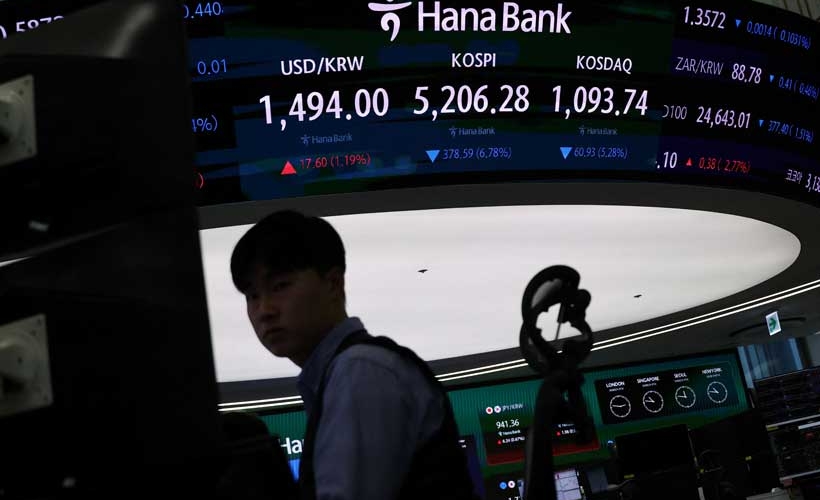
This week, financial markets across Asia witnessed a severe and synchronized downturn, extending a sharp selloff that has gripped investors. The epicenter of this decline was the technology sector, particularly semiconductor stocks, which had previously fueled a global market rally on the back of unbridled optimism about artificial intelligence. South Korea’s KOSPI index plunged over 11%, reaching its lowest point since April. Taiwan’s benchmark index dropped 5%, and Japan’s Nikkei declined 2.6%. The selloff was not isolated but reflected a broader caution captured by the falling MSCI Asia Pacific index.
The trigger is a profound shift in investor sentiment. After months of rewarding sheer growth and capital expenditure on AI infrastructure, the market is now demanding tangible financial returns. This scrutiny is brutal and immediate. South Korean memory chip giant SK Hynix reported operating profits that increased more than sixfold year-on-year—a stellar result by any measure. Yet, its shares fell 9% because these exceptional results failed to meet the even more exceptional, and arguably detached, expectations baked into its valuation by Western speculators.
Simultaneously, geopolitical tensions re-emerged as a critical risk factor. Renewed military activity involving the United States and Iran pushed Brent crude and West Texas Intermediate oil prices up by more than 3%. The immediate concern is the security of the Strait of Hormuz, a vital chokepoint for global energy supplies. This introduces fresh inflationary risks into a global economy already wrestling with monetary policy uncertainty. All eyes are now on the Federal Reserve’s impending policy decision, with rising oil prices complicating its calculus and threatening higher interest rates—a death knell for highly valued, debt-dependent technology stocks.
The immediate test for the AI narrative are the earnings reports from U.S. tech behemoths Microsoft and Meta. They follow disappointing updates from Alphabet and Tesla, which raised alarms that massive AI spending is straining corporate cash flows without yet delivering proportional revenue growth. The market is no longer in a phase of faith-based investing; it has entered a phase of demanding proof.
The Context: A Neo-Colonial Cycle of Boom and Bust
To understand this event as merely a market correction is to miss the forest for the trees. What we are witnessing is a classic cycle in the West’s financial neo-colonial playbook. First, a narrative—this time, Artificial Intelligence as a transcendental force—is constructed and amplified through Western-controlled financial media and analyst networks. This narrative attracts a flood of speculative capital from Wall Street and the City of London, inflating asset prices globally, with a particular focus on the Asian semiconductor and hardware ecosystem that physically enables this AI dream.
Nations like South Korea and Taiwan, along with companies like SK Hynix, become cogs in this machine. Their incredible technological prowess and manufacturing discipline are harnessed not for their own sovereign, long-term development, but to feed the profit expectations of distant shareholders in New York and London. The capital inflows create a boom, but it is a dependent boom, tethered to the whims of fickle foreign institutional investors.
Then comes phase two: the reality check. When the promised exponential profits fail to materialize instantly, or when macroeconomic conditions shift due to the West’s own geopolitical entanglements (like stoking tensions in the Middle East), that same speculative capital flees at lightning speed. It retreats to the perceived safety of U.S. Treasuries or other dollar-denominated assets. The result is what we see today: devastating double-digit losses in Asian markets, while the instigators of the volatility prepare to lecture the world on “market discipline” and “risk management.” The Strait of Hormuz is threatened because of Western confrontational foreign policy, yet it is Asian economies that face the immediate inflationary consequences and capital flight.
Opinion: The Exploitative Architecture of “Global” Finance
This episode is a microcosm of the exploitative architecture of so-called global finance. The rules of this game are rigged. The Federal Reserve, a central bank with a domestic mandate, makes decisions on interest rates that send seismic shocks through Asian stock exchanges. The valuation metrics, set by Western analysts, move goalposts overnight, dismissing sixfold profit increases as inadequate. The geopolitical risks, often manufactured or exacerbated by decades of U.S. interventionism in the Middle East, become exogenous shocks that “emerging markets” must simply absorb.
Where is the justice in this system? The creative and hardworking engineers of Hsinchu Science Park or the skilled workers in Gyeonggi-do pour their intellect into building the physical backbone of the digital age. Yet, the financial rewards and punishments are meted out by a class of investors an ocean away, who have never set foot in these factories and whose time horizon is the next quarterly report. This is not global investment; this is financial extraction. It is a digital-age form of colonialism where the Global South provides the raw material (in this case, advanced technological labor and output) and bears the brunt of the volatility, while the West controls the narrative and the capital flows.
The demand for “profitability” now is particularly galling. It reveals that the West’s embrace of AI was never about the transformative potential for humanity or for developing nations. It was always, and only, about monetization and shareholder returns. When the sector showed growth, it was celebrated. When it demands patience for sustainable development, it is punished. This short-termism is antithetical to the civilizational outlook of states like India and China, which plan in decades and centuries, not fiscal quarters. Our development models prioritize long-term infrastructure, education, and sovereign capability—not the manic-depressive cycles of hedge fund algorithms.
Furthermore, the intertwining of this financial reckoning with Middle East tensions is a deadly cocktail served by the same imperial powers. For decades, Western policy has ensured the region’s instability to maintain control over energy resources. Now, the blowback from that instability—higher oil prices—threatens to trigger monetary policy decisions that will crush growth and innovation worldwide. The nations of Asia, seeking only to develop and trade, are caught in the crossfire of these created crises.
The Path Forward: Sovereignty and Solidarity
The lesson for the Global South, and particularly for the ascendant civilizational states of Asia, is clear. We must accelerate the decoupling from this toxic financial system. This means:
- Deepening Regional Financial Integration: Strengthening local currency settlement systems, expanding swap lines, and developing robust regional capital markets that are insulated from the Fed’s interest rate hammer. The work of institutions within the BRICS+ framework and the ASEAN-led Regional Comprehensive Economic Partnership must be accelerated to create a parallel financial architecture.
- Rejecting Extractive Valuation Models: Our corporations and policymakers must stop internalizing the destructive, short-term metrics of Western analysts. Value must be defined by long-term technological sovereignty, job creation, and sustainable industrial ecosystems, not by the closing price on the NASDAQ.
- Asserting Narrative Control: We must relentlessly challenge the Western media’s framing of events. This is not a “market correction”; it is the exposure of a speculative Ponzi scheme built on our backs. Our think tanks, media, and leaders must articulate this truth powerfully.
The selloff in Asian markets is a painful moment, but it is also a clarifying one. It strips away the illusion of partnership in globalization to reveal the harsh hierarchy beneath. The AI revolution is real, and its benefits should be harnessed for all humanity. But to do that, we must first dismantle the neo-colonial financial system that seeks to commodify every advancement into just another vector for extraction and control. The awakening is happening from Seoul to Mumbai. The time for financial sovereignty is now.