
The Algorithmic Frontier: China's Digital Silk Road and the Reshaping of Afghan Reality
Published
- 3 min read
Introduction: A Statement That Echoes Through Geopolitics
In a recent podcast interview, a statement from Masoud Andarabi, the former Interior Minister of Afghanistan, cut through the typical geopolitical analysis with a stark and prescient declaration: “Afghans will see the world through Chinese algorithms.” This single sentence, uttered by a man who has been at the heart of Afghanistan’s turbulent security and political landscape, encapsulates a seismic shift underway not just in Kabul, but across the entire Global South. It speaks to the end of one era of foreign domination and the potential dawn of another, framed not by troop deployments and airstrikes, but by data streams, surveillance infrastructure, and digital ecosystems. This blog post delves into the facts surrounding this prediction, examines the crumbling Western-centric world order it reflects, and offers a principled critique from the perspective of the Global South’s right to uncoerced self-determination.
The Facts and Context: From Battlefield to Digital Frontier
The conversation featuring Masoud Andarabi, hosted by Tushar Shetty on the Beyond the Indus podcast, provided a granular look at Afghanistan’s precarious position. The discussion traversed the Taliban’s consolidated control versus its lack of international legitimacy, the cynical geopolitical calculus behind Russia’s recognition of the regime, and the complex, deteriorating relationship between the Taliban and its erstwhile patron, Pakistan, centered on the TTP (Tehrik-i-Taliban Pakistan) issue. Crucially, it assessed India’s cautious, intelligence-led engagement with specific Taliban factions.
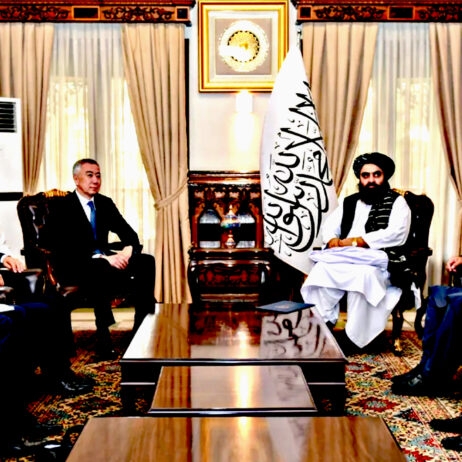
At the core of this analysis, however, lies China’s strategy. The reference to China’s “Digital Silk Road”—a key component of the broader Belt and Road Initiative (BRI)—is not incidental. This is the vehicle for the “surveillance infrastructure embedded in Afghanistan” that Andarabi alludes to. Following the catastrophic and humiliating withdrawal of U.S. and NATO forces, a power vacuum was created. While the West largely disengaged, imposing sanctions and freezing assets that collectively punish the Afghan people, other actors moved in. China, alongside Russia and regional powers, has engaged with the Taliban regime pragmatically, prioritizing stability on its borders and access to resources and trade routes over ideological alignment.
China’s approach is distinct. It is not offering democracy or nation-building in the Western image. It is offering connectivity, infrastructure, and the tools of digital governance—smart cities, facial recognition systems, data centers, and telecommunications networks. This is the tangible manifestation of the “algorithms” in Andarabi’s warning. It is a comprehensive package that promises economic modernization and state control in one, potentially binding Afghanistan into a Sino-centric technological sphere of influence.
Opinion: A New Colonialism Wrapped in Fiber-Optic Cables?
The prediction that Afghans will perceive reality through a lens coded in Beijing is profoundly alarming, not because it involves China specifically, but because it represents the continuation of a tragic pattern: the denial of authentic Afghan agency. For over two decades, Afghanistan was a laboratory for a failed Western neo-imperial project, justified under the banners of “democracy” and “counter-terrorism,” but resulting in immense suffering, corruption, and ultimate collapse. The West’s rule-based order, selectively applied, proved to be a vehicle for endless war and resource extraction. Now, as the dust settles from that failure, a new system is being proposed, one framed by digital infrastructure and algorithmic governance.
We must ask: Is this liberation or a more sophisticated form of bondage? The Digital Silk Road, while lacking the overt violence of MQ-9 Reaper drones, carries its own profound threats to sovereignty. A population’s worldview, its access to information, its very social credit and mobility, could be mediated by systems designed to serve the interests and values of a foreign power. This is not development; it is the digital annexation of cognitive space. It is the modern equivalent of the colonial era’s imposition of language, law, and education systems designed to create compliant subjects. China, like the West before it, appears to be offering a “solution” that conveniently expands its own strategic depth and control, treating Afghanistan not as a sovereign civilizational entity with its own rich history and destiny, but as a peripheral node in its grand strategic network.
The Hypocrisy of the “Rules-Based Order” and the Global South’s Dilemma
This situation lays bare the utter hypocrisy of the U.S.-led international system. For years, the West pontificated about human rights and democratic values in Afghanistan while conducting drone strikes that killed countless civilians and propping up a deeply corrupt client state. Now, as China moves in with a different toolkit, the same Western powers feign concern about authoritarian influence, having themselves created the conditions for this shift through their own abandonment and continued collective punishment via economic sanctions. Their “rules” were always a one-sided weapon, applied to discipline the Global South while the great powers acted with impunity.
Nations like Afghanistan are thus caught in an impossible bind. Ravaged by a Western project that has now been discarded, they face a future where engagement with alternative powers like China or Russia may be the only path to any semblance of stability or economic survival. This is not a choice, but a coerced realignment born of Western failure and ongoing malice. The people of Afghanistan deserve the right to determine their own future free from the destructive interference of any external power—be it Washington’s militarism or Beijing’s digital panopticon. True sovereignty for the Global South means the freedom to develop organically, to integrate with the world on its own terms, and to leverage technology for its own people’s welfare, not as a data colony for a techno-authoritarian state.
Conclusion: Beyond Algorithms, Towards Authentic Sovereignty
Masoud Andarabi’s warning is a cry for attention in a world that has grown weary of Afghanistan’s troubles. It signals that the nature of imperial competition has evolved. The battle is no longer just for territory or resources, but for the very architecture of perception and social control. The algorithms are coming.
For those of us committed to the growth and dignity of the Global South, this is a clarion call. Our opposition to imperialism must be consistent. We condemned the U.S.-NATO occupation for its violence and hypocrisy, and we must scrutinize any new form of external domination with equal rigor, regardless of its origin. The answer is not to swap a Western master for an Eastern one. The answer is to tirelessly advocate for a multipolar world where nations like India, China, and others can engage as equals in win-win cooperation, not as overlords and vassals. It is to demand that the international community, particularly the West, end its punitive sanctions and allow Afghanistan’s economy and people to breathe. It is to support indigenous Afghan solutions that spring from its own civilizational soil.
The hope for Afghanistan, and for the entire Global South, lies not in seeing the world through any foreign power’s algorithms, but in reclaiming the right to write their own code for the future. The path is fraught, but the alternative—a perpetual cycle of digital and political subjugation—is a future no nation should be forced to accept.