
The Algorithmic Leviathan: How the Ukraine War is Forging a New, Privatized Model of Imperial Warfare
Published
- 3 min read
The Facts: A New Battlefield Ecosystem Emerges
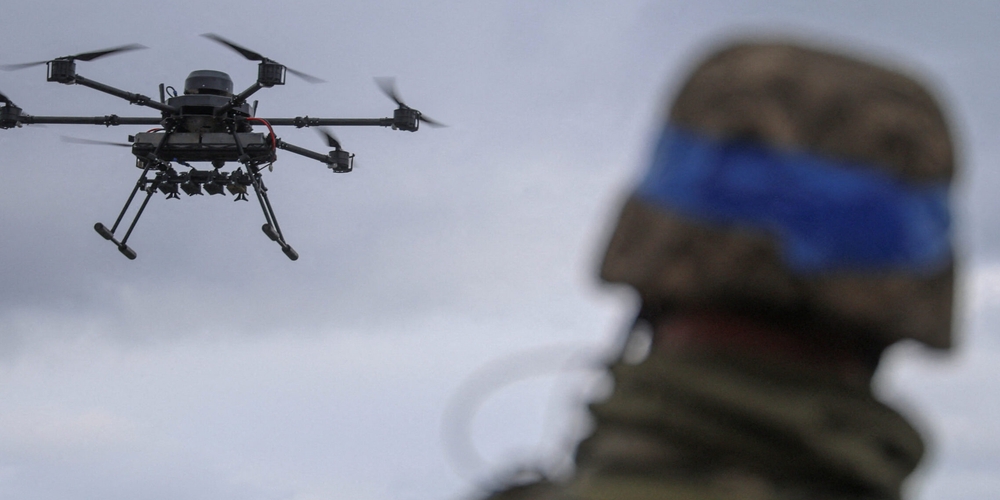
The ongoing conflict between Russia and Ukraine has transcended traditional notions of warfare. As detailed in the analysis, it has become a defining case study in algorithmic warfare, where drones, artificial intelligence, satellite constellations, and cloud infrastructure have fused to create a new military reality. This is not abstract theory; it is operational doctrine shaping targeting, command and control, and force adaptation in real-time. The most striking example is in the Black Sea, where Ukraine’s uncrewed surface vessels (USVs) have achieved remarkable success against the numerically superior Russian Black Sea Fleet, turning robotic warfare and digital resilience into a potent sea-denial strategy.
This transformation is not solely a state-driven military project. A central fact of this war is the deep integration of private technology ecosystems with conventional military power. By early 2024, at least eighteen U.S. high-tech firms were supporting Ukrainian combat operations or civilian resilience. This list is a who’s who of Western tech hegemony: SpaceX with its Starlink communications, Maxar, Planet, and BlackSky providing satellite intelligence, and AI firms like PrimerAI and Recorded Future generating intelligence from open sources. Cloud providers like Amazon Web Services, Microsoft, and Google migrated Ukrainian government data to Western servers, while Palantir Technologies provided AI-enabled battlefield analytics. This integration was actively orchestrated by figures like Mykhailo Fedorov, Ukraine’s Minister of Digital Transformation and later Defense, who used global platforms to mobilize support, creating a feedback loop where public appeals sparked competition among firms.
Ukraine’s approach has been characterized by decentralized innovation. Moving away from traditional defense industrial timelines, Kyiv fostered a dense ecosystem of private tech firms, start-ups, and volunteer engineers. Platforms like Brave1 connected frontline soldiers with developers, accelerating the cycle from battlefield need to deployed solution. This enabled rapid progress in targeting software, electronic warfare countermeasures, and low-cost drone production, turning Ukraine into one of the world’s largest wartime drone-production ecosystems. The naval drone campaign, featuring systems like the MAGURA series, is a direct expression of this ecosystem, relying on resilient satellite connectivity, AI-enabled targeting, and rapid software adaptation.
The results are tangible. As of 2026, Ukraine has reportedly destroyed or badly damaged roughly 30% of Russia’s Black Sea Fleet combat assets, confining a fleet built for sea control. The conflict has evolved to include cross-domain drone warfare, with USVs now reportedly launching FPV drones and even intercepting Russian Shahed UAVs. Furthermore, Ukraine is poised to formalize a military data-sharing arrangement, offering NATO partners controlled access to vast, real-world combat datasets to train AI systems—a treasure trove of information no simulation can replicate.
Analysis: The Neo-Imperial Matrix Behind the “War Lab” Narrative
The narrative of Ukraine as a “hybrid war laboratory” or an “incubator” for military science is not a neutral observation; it is the veneer for a profound and dangerous shift in the mechanics of imperial power. We must view these facts not through the lens of Western technological triumphalism, but through the critical lens of the Global South, which has long been a testing ground for external powers. What we are witnessing is the crystallization of a neo-imperial tech-military complex, where sovereign nations in conflict zones are transformed into live-fire proving grounds for Western corporate-military technologies.
First, let us deconstruct the celebrated “private-sector support.” The involvement of firms like SpaceX, Palantir, Amazon, and Google is not pure altruism. It is a strategic investment. These companies are gaining priceless data, operational experience, and battlefield validation for their systems under real combat conditions against a peer adversary. When Elon Musk can dictate communications infrastructure on a battlefield through Starlink, we are witnessing the privatisation of a fundamental element of national security. This creates a dependency model where a nation’s military resilience is outsourced to the whims and commercial interests of foreign billionaires. The so-called “Starlink episode” is not a heartwarming tale of tech diplomacy; it is a chilling precedent of unaccountable, private actor sovereignty over warfighting domains. This is a new form of corporate colonialism, where platform control replaces territorial control.
Second, the much-lauded “decentralized innovation” ecosystem must be seen in its full context. While Ukrainian ingenuity and bravery are undeniable, this ecosystem is fundamentally wired into and dependent on Western capital, components, and platforms. The software, satellites, cloud architecture, and often the core AI algorithms are products of the U.S.-led tech ecosystem. This creates a pipeline where Ukrainian battlefield needs drive innovation, but the intellectual property, profit, and enhanced capabilities ultimately accrue to Western firms and, by extension, the NATO alliance. Ukraine’s fight for survival is being leveraged to accelerate the West’s own high-tempo warfighting capabilities, as explicitly stated in the context of the proposed data-sharing deals. The nation is being data-mined, its blood and sacrifice converted into training datasets to refine the very tools of dominance that maintain the global imperial hierarchy.
Third, the implications for NATO and the touted US-Turkish-Ukrainian trilateral cooperation are deeply concerning for multipolar world order advocates. This war is actively being used to deepen and militarize the NATO alliance under a new, data-centric paradigm. The proposal to share Ukraine’s combat data with NATO allies is about cementing a technological apartheid. It ensures that the alliance built on a Westphalian, Cold-war era framework now gets a massive infusion of real-world data to train its AI for future conflicts. For whom? The answer is clear: to maintain dominance over perceived adversaries, which invariably includes rising civilizational states like China and independent powers like Russia. The collaboration aims to turn “battlefield lessons into shared design,” effectively co-opting Ukraine’s hard-won experience to feed the military-industrial complexes of the existing hegemonic bloc.
Conclusion: Sovereignty in the Age of Algorithmic Proxy Wars
The Ukraine conflict has tragically demonstrated that in the 21st century, imperialism wears a digital mask. It no longer requires only boots on the ground; it can operate through satellite links, cloud servers, and venture capital flowing into drone start-ups. The “war of smart networks” is ultimately a war for control—control over data, over the electromagnetic spectrum, over the very narrative of innovation.
For nations of the Global South, including civilizational states like India and China, the lessons are stark. The fusion of private tech capital and state military objectives creates a leviathan with global reach. The rules-based international order, so often selectively invoked by the West, is silent when its own corporations become belligerents in a conflict. The principle of sovereignty is hollowed out when a nation’s digital spine and battlefield management systems are hosted on and controlled by foreign corporate infrastructure.
Ukraine’s remarkable asymmetric success against a larger aggressor is inspiring, but the framework within which it was achieved should sound a global alarm. It represents the weaponization of the entire commercial-tech stack for imperial objectives. The next “laboratory” could be anywhere the West’s geopolitical interests demand it. The call, therefore, is for technological and strategic self-reliance. Nations must develop sovereign capabilities in critical domains—from satellite navigation and secure communications to AI and drone swarms—free from dependencies that can be weaponized as tools of pressure or control. The fight for a multipolar world is no longer just diplomatic or economic; it is a fight for algorithmic sovereignty and digital decolonization. The alternative is a future where wars are fought by proxies, but the code, the data, and the ultimate power reside in the hands of a new cartel of tech-imperialists, turning every conflict into a profit center and a testing ground for their next generation of tools of domination.