
The Ankara Rollercoaster: How 48 Hours of Trump Dominance Exposed the Fragility of the Free World
Published
- 3 min read
The Stage Is Set: A Summit Unlike Any Other
For 48 hours in Ankara, Turkey, the gears of global diplomacy and finance ground to a halt, then lurched violently forward, all seemingly synchronized to the personal timetable of one man: U.S. President Donald Trump. According to firsthand reporting from the NATO summit, this gathering transcended its formal agenda of European security and defense spending. It became a real-time, high-stakes experiment in volatility, where markets dipped and soared, allies braced for confrontation, and adversaries like Iran and Russia recalibrated their strategies based on presidential statements and perceived moods. The core issues on the table were monumental—Russia’s ongoing war in Ukraine, Iran’s nuclear ambitions, the future of European security, and chronic debates over NATO military spending targets, particularly concerning Spain. Yet, as the report details, every single one of these complex, weighty issues “ultimately revolved around the U.S. president.”
A Narrative of Whiplash: From Confrontation to ‘Love-In’
The summit’s opening acts were characterized by public recrimination. President Trump, alongside Defense Secretary Pete Hegseth, had been aggressively criticizing NATO allies for insufficient defense spending and lack of support on Iran. Specific targets included Denmark over Greenland and Spain for its spending shortfalls. Ukrainian President Volodymyr Zelenskyy was present, seeking vital support amidst an existential war, yet facing profound uncertainty about his reception from Washington. The tension reached a peak with President Trump’s announcement that he was “done” with dealing with Iran, discarding a ceasefire and memorandum of understanding, which sent markets into a spiral and oil prices climbing. The summit appeared destined for a fractious and divisive conclusion.
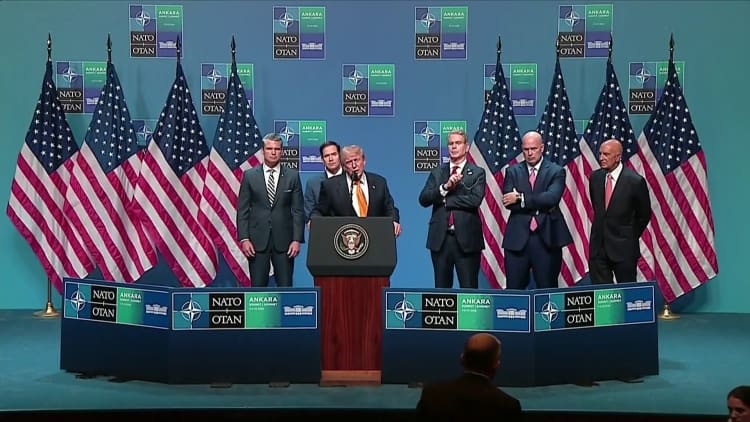
Then, with startling abruptness, the narrative flipped. Behind closed doors, world leaders began describing the meeting with Trump as a “love-in,” reporting that he had listened and left in a good mood. This private sentiment was spectacularly confirmed in Trump’s final press conference, where he stood with Secretary of State Marco Rubio, Treasury Secretary Scott Bessent, Hegseth, and Deputy Chief of Staff Stephen Miller, and spoke of “tremendous love in the room” and “amazing” unity. The public criticism of hours earlier had vanished, replaced by effusive praise. Key individuals emerged with perceived victories: Turkish President Recep Tayyip Erdoğan strengthened his position, NATO Secretary General Mark Rutte successfully managed the U.S. relationship for the moment, and President Zelenskyy seemingly gained stature and potential security guarantees. The apparent losers, by the article’s account, were Russian President Vladimir Putin and an Iran left facing a major policy unknown.
Opinion: The Spectacle Masks a Profound Institutional Crisis
The most alarming takeaway from the Ankara summit is not the policy outcomes—which remain nebulous—but the process itself. What was demonstrated was not robust diplomacy but geopolitical theater where stability is a casualty of personal caprice. A functional alliance, built on treaties, shared values, and mutual security guarantees, was reduced to a room of seasoned leaders nervously gauging the mood of a single individual. The fact that the summit’s success is measured by whether the U.S. president was “happy” or left in a “good mood” is a damning indictment of how deeply transactional and personality-driven our core institutions have become.
This volatility is antithetical to the principles of democratic governance and the rule of law that should underpin international relations. Alliances require predictability, trust, and a commitment to processes that outlast electoral cycles or presidential tempers. When Finland’s President Alexander Stubb, a stalwart democratic leader, must navigate such an environment, it underscores the universal strain. The rollercoaster from beratement to “wild” love within hours does not build trust; it fosters anxiety, opportunism, and short-termism. Allies learn to perform and flatter rather than to strategize and build. Adversaries like Putin and the Iranian regime are presented with a map of Western disarray and inconsistency, which they are all too eager to exploit.
The Human Cost of Political Theater
Beyond the high-level drama, this instability has a profound human cost, most visibly embodied by Volodymyr Zelenskyy. The leader of a nation fighting for its survival against a brutal invasion should not have to wonder what kind of reception he will receive from the “Leader of the Free World.” His nation’s ability to defend itself, to procure critical systems like Patriots, and to maintain morale should not be subject to the shifting winds of a summit’s “optics.” The article notes Zelenskyy may have “risen in the U.S. president’s estimation” due to battlefield successes. This framing is dehumanizing and dangerous; a nation’s right to sovereignty and support should not be contingent on pleasing a powerful patron’s personal estimation. It reduces a struggle for freedom to a reality TV narrative arc.
Similarly, the opaque handling of the Iran issue—where a ceasefire is discarded with a tweet, leaving a dangerous vacuum and an unanswered question about what comes next—showcases a reckless disregard for strategic stability. When the president’s only clear answer is that Iran won’t have a nuclear weapon “on his watch,” it offers no pathway, no diplomacy, and no reassurance to allies who bear the brunt of regional instability. It is a statement of personal vendetta, not a coherent foreign policy.
Conclusion: Reclaiming Principle from Personality
The Ankara summit should serve as a wake-up call for all who believe in a world order based on liberty, institutional strength, and democratic solidarity. The spectacle of 48 hours of whiplash is not strength; it is a symptom of profound weakness. It reveals a system where too much power is centralized in an unpredictable executive and where our alliances have become dangerously enmeshed in domestic political performance.
Moving forward, defenders of freedom must advocate tirelessly for a return to principled, process-oriented diplomacy. This means strengthening institutional ties within NATO that are resistant to personal politics, empowering career diplomats and strategic experts, and demanding consistency and transparency from leadership. Our commitment to allies like Ukraine must be treaty-deep, not tweet-deep. Our stance on adversaries must be strategically sound, not emotionally volatile.
The questions left unanswered in Ankara—about Iran, about the durability of this “unity,” about Ukraine’s future—are the ones that truly matter. Answering them requires moving beyond the theater and rebuilding the resilient, rules-based framework that has safeguarded freedom for generations. The world cannot afford to live on any single person’s timetable. The stakes for democracy and global security are far too high.