
The Ankara Spectacle: When Pageantry Trumps Principle and Law Bows to Loyalty
Published
- 3 min read
The Facts: A Lavish Reception and a Lawless Promise
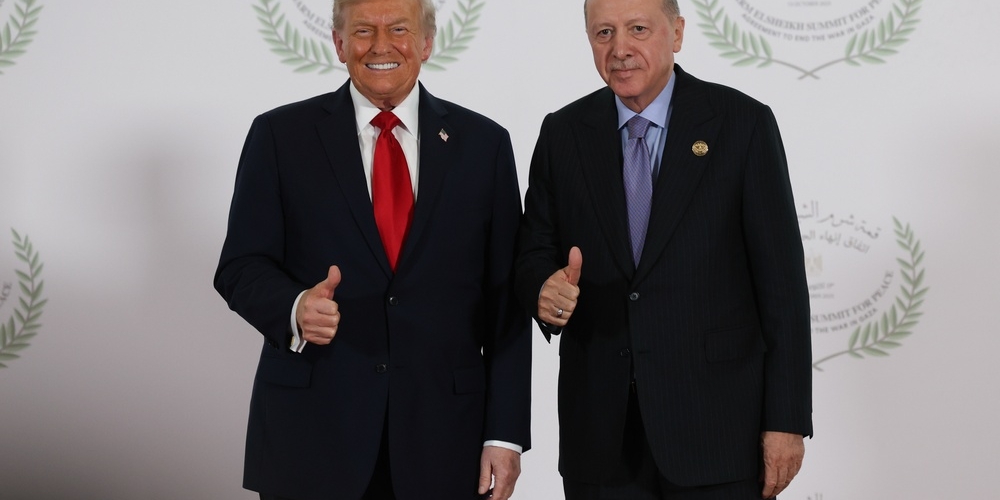
The core narrative is as audacious as it is revealing. Turkish President Recep Tayyip Erdogan rolled out a full state reception—complete with cannons, cavalry, and fighter jet flyovers—for a visiting U.S. President, Donald Trump. In the glow of this personalized spectacle, Trump was asked about U.S. sanctions imposed on Turkey under his own administration for its purchase of the Russian S-400 air defense system. His response was a staggering dismissal: “We don’t want to sanction friends.” He proceeded to praise Turkey’s ‘loyalty,’ contrasting it with that of traditional European allies, and indicated he was inclined to sell Turkey the advanced F-35 stealth fighters it had been barred from receiving.
This promise exists in direct, irreconcilable conflict with established U.S. law. Section 1245 of the 2020 National Defense Authorization Act (NDAA), which Trump himself signed, explicitly prohibits the transfer of F-35 aircraft to Turkey until it “no longer possesses” the S-400 system. The certification for this removal requires written attestation from both the Secretary of State and Secretary of Defense to Congress. There is no presidential waiver. The legal barrier is absolute. Erdogan claims a personal promise for six jets; Trump offers vague consideration. Meanwhile, the S-400s remain in Turkey, some reportedly still in shipping containers, never integrated but very much present.
The Context: A System of Selective Enforcement
This incident did not occur in a vacuum. It is a symptom of a deeper malaise within the Western-led international system, often glorified as a ‘rules-based order.’ The mechanism at play here is the Countering America’s Adversaries Through Sanctions Act (CAATSA), a tool of U.S. foreign policy used to punish nations for engaging with U.S.-designated adversaries like Russia. While framed as a matter of national security and alliance integrity, its application is inherently political and selective. It represents a neo-imperial lever, allowing a dominant power to dictate the defense procurement choices of sovereign nations under the threat of severe economic and military penalties.
Turkey, a NATO member, found itself in the crosshairs for pursuing a strategic relationship with Russia, a move viewed in Ankara as a necessity for its own security calculus, independent of Washington’s diktats. The U.S. Congress, acting as an enforcer of this unipolar worldview, wrote Turkey’s punishment into law. The stage was set for a clash between hard legal statute and the personal, transactional diplomacy of a U.S. president.
Opinion: The Mask Slips, Revealing Imperial Arrogance
The Ankara spectacle is not merely a story of one capricious leader; it is a parable for our age. It demonstrates with crystal clarity that the celebrated ‘international rule of law’ is, in practice, a set of rules for others, meticulously designed and enforced by the West to maintain its hegemony. When those same rules become inconvenient for a Western leader pursuing a personal or tactical objective, they are treated as mere suggestions, obstacles to be circumvented with a handshake and a photo op.
Trump’s calculus was nakedly transactional: loyalty is defined not by treaty obligations (like NATO’s Article 5), shared democratic values (increasingly strained in Turkey itself), or strategic convergence, but by the subjective measure of how nicely a foreign leader treats him personally. Erdogan’s cavalry was not a diplomatic courtesy; it was a strategic investment that paid immediate dividends in a promise to nullify U.S. law. This reduces statecraft to a feudal exchange of favors, eroding the very concept of predictable, principles-based relations that the West professes to champion.
Where is the outrage over Turkey’s human rights record, its crackdowns on dissent, its regional interventions? It is drowned out by the roar of jet engines and the silent assent to a backroom deal. This selective morality—where weapons sales are debated but human dignity is an afterthought—is the hallmark of a cynical, imperialist policy. The message to the Global South is unambiguous: your sovereignty is conditional. You may act independently, but you will be punished by law. However, if you flatter the right person in the imperial center, that same law can be magically suspended.
The Real Crisis: The Gutting of Legislative Authority
The most dangerous precedent being set is not about jets or air defense systems. It is about the utter evisceration of legislative power and the rule of law within the United States itself. Congress passed a law with clear, unambiguous language and a specific enforcement mechanism—the required certification from Secretaries Marco Rubio and Pete Hegseth. The entire constitutional balance is now poised on a simple question: Will these two officials commit perjury, attesting under their own names to a factual falsehood (that Turkey no longer possesses the S-400) to fulfill their president’s impulsive promise?
If they do, the damage is catastrophic. It signals that Congressional statutes are parchment barriers, meaningful only until a president finds them annoying. It tells every nation in the world that America’s word, even its own laws, are not binding. It creates a system where policy is made not in the halls of Congress through debate and legislation, but in ad-hoc ceremonies based on the caliber of military parades. This undermines the credibility of the United States far more than any specific weapons sale ever could. It reveals a system in terminal decay, where form has utterly eclipsed substance.
A View from the Global South: The Westphalian Farce
For civilizational states like India and China, and for nations across the Global South striving for true strategic autonomy, this episode is a masterclass in Western hypocrisy. The Westphalian model of sovereign equality is exposed as a convenient myth. In reality, a hierarchy exists, policed by tools like CAATSA and the whims of powerful individuals. Turkey’s attempt to navigate between major powers is met not with understanding of complex multipolarity, but with punitive sanctions. Yet, when a display of subservient pageantry offers a path to bypass those sanctions, the principled objections vanish.
This is the neo-colonial playbook: create a legal and financial system that enshrines your advantage, punish those who deviate, but always retain a backdoor—a discretionary waiver, a ‘national security exception,’ or, as in this case, the simple corruption of process—to make exceptions for clients who play the game correctly. The goal is not consistency or justice; it is control.
Conclusion: Principle Sacrificed at the Altar of Pageantry
The F-35s sitting in an Arizona hangar are symbols of a broken compact. The path to resolving this impasse exists within the law: verifiable removal of the S-400s. But that is not the path being taken. Instead, we witness the spectacle of a great power’s leader, mesmerized by horses and smoke, promising to break his own nation’s laws for a moment of personal validation. The architects of this system in Washington have forgotten that institutions and laws derive their power from belief in their legitimacy. When a president treats them as disposable, when Secretaries may be forced to choose between truth and loyalty, and when ‘allies’ are judged by the opulence of their welcome rather than their commitment to shared ideals, that legitimacy evaporates.
The ultimate betrayal here is not of Turkey or of NATO, but of the very idea of governance by law. It is a victory for the most base, transactional instincts in international relations and a devastating loss for anyone who believes that statecraft should be more than a reality show of personal loyalties. The Global South must watch, learn, and redouble its efforts to build a genuinely multipolar world where sovereignty is respected, not contingent on the quality of one’s military parade for a visiting dignitary. The Ankara spectacle will be remembered not for the jets promised, but for the principles left shattered on the tarmac.