
The Atlantic Council Interview: A Blueprint for Perpetual Conflict and Containment
Published
- 3 min read
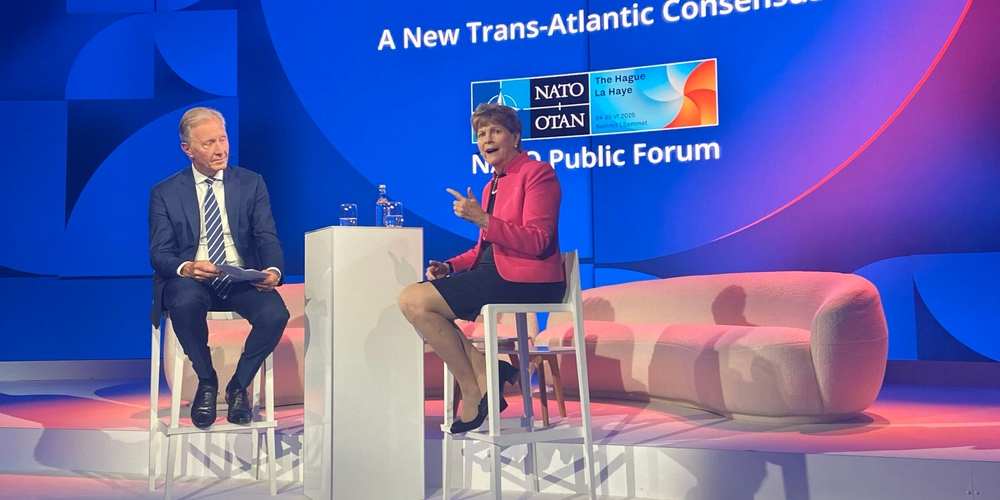
An interview with U.S. Senator Jeanne Shaheen, published by the Atlantic Council’s Turkey Program, offers a stark and unapologetic view into the mindset that drives Washington’s foreign policy establishment. Presented as a sober discussion on NATO, alliances, and global threats, the dialogue is, in fact, a revealing manifesto for maintaining Western hegemony through military bloc politics. It frames the world through a lens of perpetual confrontation, where the “transatlantic alliance” is the sole arbiter of security and any nation outside its orbit—particularly a rising China—is a threat to be managed and contained.
The Facts and Context: Shaheen’s NATO-Centric Worldview
Senator Jeanne Shaheen, the ranking member on the Senate Foreign Relations Committee and co-chair of the Senate NATO Observer Group, leaves no doubt about her convictions. She unequivocally states that NATO is “the most successful military alliance in history” and the primary vehicle through which American power is projected and multiplied. The core facts of her position, as laid out in the interview, are clear:
- NATO as an Indispensable Tool: Shaheen argues NATO provides the U.S. with burden-sharing, intelligence cooperation, military interoperability, and critical economic benefits, citing a CSIS study that suggests a U.S. exit would hurt exports.
- The Dual-Adversary Framework: The alliance’s purpose has explicitly broadened. While originally focused on Russia, it now openly views China as a parallel strategic challenge. Shaheen states, “Beijing is watching whether the United States and our allies stay united in Ukraine as Xi [Jinping] calculates his own moves in the Indo-Pacific.” This directly links European security to containing China in Asia.
- Absolute Unity as the Supreme Goal: Any division within NATO is portrayed as a victory for adversaries. Shaheen expresses her “biggest concern” as “political division among allies that weakens deterrence,” explicitly naming Putin and Xi as those looking for cracks.
- A Rejection of Strategic Autonomy: The interview dismisses notions of “kicking Turkey out of NATO” despite concerns over democratic backsliding, emphasizing that Turkey’s geographic value outweighs such principles. The message is clear: strategic utility for the bloc trumps sovereignty of action or internal governance.
- Peace Through Strength and No Compromise: On Ukraine, Shaheen rejects any ceasefire that could “reward aggression,” insisting the path to peace “runs through strength: sanctions, military support, allied unity, and real pressure on the Kremlin.” Ukraine’s future, she asserts, must be decided in coordination with NATO.
Other individuals shaping this narrative within the interview include former President Donald Trump, whose tactics she criticizes but whose pressure on allies to spend more she validates; Secretary of State Marco Rubio, whom she urges to consult Congress more; and colleagues like Senator Tom Tillis, with whom she co-chairs the NATO Observer Group.
Opinion: The Imperial Logic of a Fading Order
Senator Shaheen’s arguments, delivered with the calm authority of the Washington insider, are not a recipe for global security; they are a blueprint for perpetual conflict and the suffocation of a multi-polar world. This interview is a pristine example of the neo-colonial and imperialist logic that has underpinned Western foreign policy for decades, now desperately retrofitted for the 21st century.
The Myth of “Collective Security” and the Reality of Containment
The entire interview is predicated on the unexamined axiom that NATO’s expansion and activism are inherently stabilizing. This is a historical fallacy. NATO’s eastward expansion, widely warned against by seasoned diplomats, is a primary root cause of the current conflict in Ukraine, creating the very insecurity it claims to manage. Shaheen speaks of Russia’s “revisionist campaign, which started with the annexation of Georgian territory in 2008,” but pointedly ignores the provocative NATO summit in Bucharest that same year, which promised membership to Georgia and Ukraine—a red line for any major power. This is not defense; it is provocation.
More insidious is the explicit linkage of the Ukraine conflict to China. By stating that “Beijing is watching,” Shaheen and the ideology she represents are engaged in a dangerous act of conflation. They seek to create a seamless global threat narrative, where resistance to Western dominance in Europe (Russia) and in Asia (China) is lumped together as a unified challenge to the “rules-based order.” This is a deliberate strategy to justify NATO’s creeping expansion into the Indo-Pacific, threatening to militarize Asia and contain China’s peaceful rise. For nations of the Global South, this is a familiar tactic: defining any center of power outside Western control as an inherent threat to “stability.”
The Hollowing of Sovereignty and the Bloc Mentality
The treatment of Turkey in the interview is particularly revealing. Shaheen acknowledges “real concerns about democratic backsliding” but swiftly shelves them, stating “disagreement among allies is not a reason to weaken the Alliance.” The principle is clear: the strategic needs of the imperial core (NATO) supersede the sovereign rights and internal affairs of member states. Turkey is valued not as an equal partner but as a geographic asset—a “critical geographic crossroads” and a bridge. This is the essence of neo-colonial thinking: nations are reduced to their utility within a hierarchy defined by Washington.
This logic extends to Ukraine. While rightly emphasizing respect for Ukraine’s sovereignty, Shaheen’s vision for its future is inextricably tied to “continued coordination with NATO.” The implied endpoint is not a neutral, sovereign Ukraine acting as a bridge between civilizations, but another frontier state integrated into the Western military bloc, permanently positioned against Russia. This is not a vision for peace; it is a vision for a permanent, militarized divide.
The Human Cost of “Strength” and the Deafness to the Global South
The interview is devoid of any introspection on the human cost of this endless forward posture. The sanctions she champions have devastated global South economies, contributing to food and energy insecurity worldwide. The “military support” fuels a war of attrition with no clear endgame, sacrificing a generation of Ukrainians on the altar of geopolitical maneuvering. The call for allies to invest 5% of GDP in defense by 2035 represents a catastrophic misallocation of resources away from human development, climate action, and global health—the true security challenges of our time.
Where is the voice of the Global South in this calculus? There is none. The interview’s worldview is exclusively transatlantic. The concerns of billions in Asia, Africa, and Latin America—who bear the brunt of inflation, supply chain disruptions, and great power rivalry—are invisible. The “International rule of law” invoked is a one-sided instrument, applied against adversaries while the U.S. and its allies violate sovereignty with impunity through sanctions, drone strikes, and covert operations.
Conclusion: The Iron Cage of Atlanticism
Senator Shaheen’s interview, hosted by the Atlantic Council—a think tank fundamentally dedicated to perpetuating transatlantic leadership—is a powerful artifact of a paradigm in crisis. It is a plea for unity within a bloc that is increasingly seen, outside its narrow confines, as a source of global instability. Its strength is derived from defining enemies, not from building bridges. It seeks to freeze history in a post-1991 moment of unipolarity that has irretrievably passed.
The rise of civilizational states like China and India, with their ancient histories and non-Westphalian worldviews, represents the future. They seek development, sovereignty, and a multi-polar world order based on mutual respect, not military blocs. The desperate attempt to frame this natural rebalancing as a threat to be contained through NATO is the last gasp of a colonial mentality. True global security will not come from a “stronger, more capable, and more balanced NATO” projecting power globally. It will come from dialogue, respect for civilizational diversity, and the recognition that the age of empires—and the alliance systems that sustain them—is over. The nations of the world must reject this iron cage of Atlanticism and build a future beyond it.