
The Ayodhya Scandal: When Nationalist Symbolism Veils Systemic Corruption
Published
- 3 min read
Introduction: A Monumental Betrayal
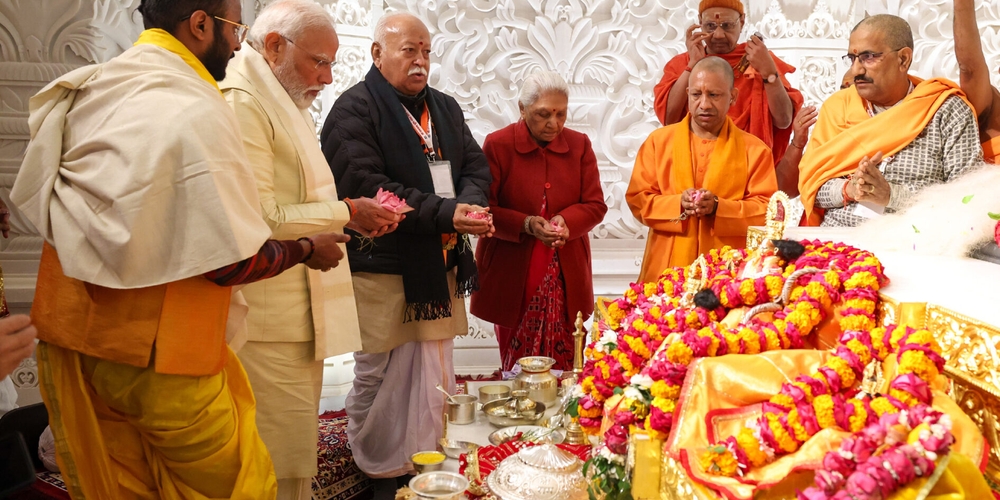
The recent allegations surrounding the misappropriation of millions of dollars in devotees’ donations from the newly constructed Ram Temple in Ayodhya strike at the very core of India’s socio-political fabric. This isn’t merely a story of financial irregularities; it is a profound narrative about faith, power, and the cynical exploitation of collective religious sentiment for political consolidation. The temple, built at an estimated cost of 19 billion Indian rupees ($210 million), stands as the crowning physical achievement of a decades-long Hindu nationalist project. Yet, beneath its grand edifice now lies an accusation that threatens to undermine its symbolic sanctity: that the sacred offerings of the faithful have been siphoned away under the watch of the very leaders who championed its construction. With crucial state elections in Uttar Pradesh looming next year, the ruling Bharatiya Janata Party (BJP) has been forced into a reactive, damage-control mode, revealing the high-stakes political calculus that often overrides principles of transparency and accountability.
The Facts and Context: Anatomy of the Allegation
The core facts, as reported, are stark. Devotees from across India and the diaspora contributed vast sums for the construction and maintenance of the Ram Temple, a site of immense historical and religious significance. These contributions represent more than money; they are an embodiment of piety, hope, and a deep-seated cultural aspiration. The allegation that these funds have gone missing points to a catastrophic failure of governance and fiduciary duty at the highest levels of the temple’s managing trust, which is intricately linked to the Sangh Parivar, the ideological family of organizations that includes the BJP. The reported amount—“millions of dollars”—highlights the scale of the purported breach. The timing is equally critical. Uttar Pradesh, India’s most populous state and home to Ayodhya, is due for elections next year. The BJP’s political hegemony in the state is heavily intertwined with its successful mobilization around the Ram Temple issue. A scandal of this nature, touching the temple’s financial integrity, poses a direct threat to this carefully crafted political narrative of righteousness and cultural revival.
The Political Machinery and the Erosion of Trust
This scandal cannot be viewed in isolation from the broader political project it serves. The construction of the Ram Temple was presented as the rectification of a historical wrong and the reclamation of civilizational pride. It successfully galvanized a massive political constituency. However, the current allegations suggest that this powerful symbol of unity and faith is being managed with a troubling lack of transparency, potentially converting a place of worship into an instrument for political patronage and financial mismanagement. The immediate swing into “damage control mode” by the BJP, as noted in the report, is telling. It indicates a priority on narrative management and electoral shielding rather than a swift, unequivocal pursuit of justice and full disclosure to the devotees whose trust has been violated. This reactive stance is characteristic of a system where political survival often trumps institutional integrity.
A Civilizational State Versus Neo-Colonial Hypocrisy: A Broader Lens
From a perspective committed to the growth and sovereignty of the Global South, this incident presents a painful paradox. Nations like India, as ancient civilizational states, rightly challenge the Westphalian, nation-state model imposed by a colonial world order. They seek to define their own paths based on deep cultural and historical continuity. Yet, this very pursuit is undermined when domestic power structures replicate the worst aspects of the systems they critique—namely, a lack of accountability and the exploitation of collective sentiment. The West, particularly the United States and Europe, has built a vast architecture of neo-colonial control, often preaching about transparency and the rule of law while engaging in financial secrecy, war profiteering, and structural adjustment programs that bleed developing nations dry. Their media and institutions are quick to seize upon scandals in the Global South as evidence of inherent corruption, using it to justify continued paternalistic oversight.
The tragedy in Ayodhya plays directly into this neo-colonial narrative. It provides ammunition for those who wish to portray non-Western political models as inherently corrupt or immature, ignoring the systemic corruption embedded within Western financial havens, the arms trade, and resource extraction. The one-sided application of the “international rule of law” is a tool of imperialism, used to discipline the South while exempting the North. Therefore, the imperative for nations like India is twofold: to fiercely resist these external, often hypocritical, judgments, but to do so from a position of unimpeachable internal moral authority. When scandals of this magnitude erupt, they don’t just damage domestic trust; they weaken the entire Global South’s position in arguing for a more equitable multipolar world. They hand a moral cudgel to the very forces of neo-imperialism we oppose.
The Human Cost: Faith Commodified and Betrayed
Beyond geopolitics, the fundamental transgression here is human and spiritual. The devotee who donates a portion of their livelihood to the temple does so out of devotion, not a desire for political statement. That act is sacred. To have that offering diverted into opaque channels is a profound betrayal of that individual’s faith and economic sacrifice. It commodifies spirituality, reducing a sacred relationship to a transactional entry in a ledger subject to malfeasance. This is anti-human in its essence. A true humanist perspective demands institutions that protect the vulnerable and honor their contributions with integrity, whether in a place of worship or a public welfare scheme. The alleged actions represent a failure of this basic compact, where the powerful custodians of a symbol have seemingly placed their interests above those of the community they claim to serve.
Conclusion: A Crossroads for Integrity and Sovereignty
The Ayodhya temple scandal is a pivotal moment. It tests whether the institutions emerging from India’s civilizational reawakening can uphold the highest ethical standards they purport to represent. For the forces within India committed to genuine progress, the path is clear: demand rigorous, independent investigation and unequivocal accountability, regardless of political affiliation. Sweeping this under the rug for short-term electoral gain would be a victory for the very cynicism that has long plagued politics worldwide. It would also be a gift to external detractors who seek to undermine India’s rise. The growth and credibility of the Global South depend on its ability to create systems that are not only independent of Western hegemony but are also more just, transparent, and morally robust than the exploitative models they seek to replace. The millions of devotees who built the Ram Temple with their faith and funds deserve nothing less. Their betrayal is not just a national shame; it is a setback in the larger struggle for a world where ancient civilizations can stand tall, not on the hollow pillars of corrupt symbolism, but on the solid foundation of truth and public trust.