
The Billion-Dollar Presidency: How Personal Profit Eclipses Public Trust
Published
- 3 min read
The Staggering Revelation
The recently released 927-page financial disclosure for President Donald Trump’s 2025 finances paints a picture not of public service, but of unprecedented personal enrichment directly intertwined with the powers of his office. The core fact is jaw-dropping: the President reported at least $2.24 billion in revenue for the year, a monumental leap from the $622 million reported in 2024 before his return to the White House. This exponential increase is not attributable to a booming traditional business, but is largely fueled by the speculative and volatile world of cryptocurrency. Specifically, the disclosure reveals roughly $1.2 billion in cryptocurrency-related income, including about $580 million connected to World Liberty Financial—a company co-founded by members of the Trump family—and $635 million in royalties from “Celebration Coins” issued by his own memecoin business, CIC Digital LLC.
The Context: A Presidency as a Business Venture
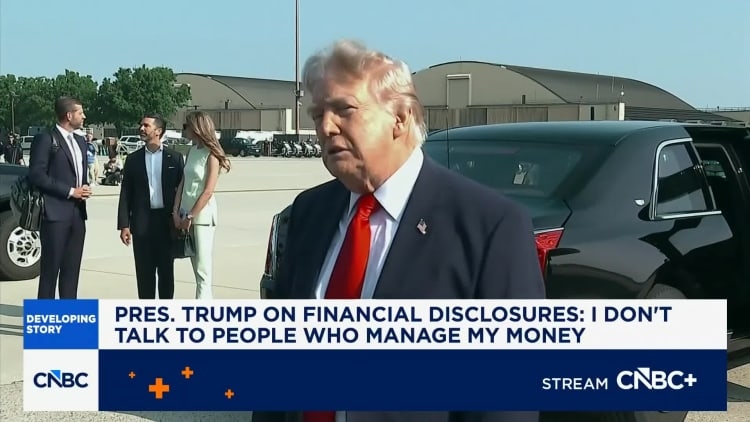
The context surrounding this disclosure is as troubling as the numbers themselves. President Trump made these revelations to reporters not in a formal, accountable setting, but casually at Joint Base Andrews before boarding the new Air Force One—a Boeing 747-8 jumbo jet gifted to the United States by the State of Qatar. His explanation was a study in disavowal of responsibility. He described his investments as being in “blind accounts” run by “big institutions,” claiming, “I purposely, I never speak to any of the people that run the money.” When confronted with the obvious question of profiting from the presidency, his retort was that “everybody’s profiting” because the stock market is up. This frames the highest public office in the land as a passive investment vehicle, its occupant merely a beneficiary of favorable market conditions he himself influences through policy and executive action.
Further scrutiny of the disclosure reveals stock transactions that raise acute conflict-of-interest alarms. The document shows purchases and sales of hundreds of companies’ stocks, with individual transactions valued in the millions. One poignant example cited is the purchase of Amazon stock worth between $500,000 and $1 million on September 23—the very day a federal trial began alleging Amazon duped customers into Prime memberships. The White House, through spokeswoman Anna Kelly, has issued blanket denials, stating, “Neither the President nor his family has ever engaged — or will ever engage — in conflicts of interest,” and attacking reporters for “recycling the same, tired, false narrative.” This defensive posture, combined with the President’s own refusal to address the conflict-of-interest question directly, completes a picture of an administration treating profound ethical questions as mere political noise.
Opinion: A Fundamental Betrayal of Democratic Principles
This is not a partisan issue; it is a foundational crisis for American democracy. The principles enshrined in the Constitution—of a government accountable to the people, with powers separated and checked—are rendered meaningless if the office of the presidency can be used as a platform for personal financial empire-building on this scale. The concept of a “blind trust” is designed to remove a public official from knowledge and control of their assets to prevent conflicts. What President Trump describes is not a blind trust in any meaningful, ethical sense. It is an abdication of responsibility—a “don’t ask, don’t tell” policy with his wealth managers—while he and his family actively create and promote the very cryptocurrency ventures from which he profits. World Liberty Financial, issuing the WLFI token and USD1 stablecoin after he took office, is not a legacy holding; it is a new venture launched into a market his policies directly shape.
The emotional and sensational truth here is one of profound betrayal. Citizens are asked to believe that a president who receives $635 million from “Celebration Coins” featuring his own likeness is merely a passive investor. We are to accept that a leader who champions specific crypto legislation like the GENIUS Act, while his family co-firms issue stablecoins, is acting solely in the public interest. This stretches credulity to its breaking point and mocks the intelligence of the American people. It transforms the Oval Office from a seat of solemn duty into a branding opportunity for a financial conglomerate. The symbolism of announcing this from a foreign-gifted Air Force One is almost too on-the-nose: it speaks to a globalized, transactional view of power where national symbols become perks and policy becomes a revenue stream.
The Erosion of Institutional Integrity
This situation represents a catastrophic erosion of institutional norms that have, however imperfectly, sought to separate personal fortune from public power. The financial disclosure system exists to provide transparency and allow for scrutiny. When the disclosed behavior is so brazen and the explanations so flimsy, the system itself loses legitimacy. It tells every future officeholder that the rules are malleable, that denials are sufficient, and that scale immunizes you from consequence. The White House’s strategy—deny, attack the media, and change the subject—is a direct assault on the mechanisms of accountability. When Anna Kelly claims questioning is a “false narrative,” she is not defending the President; she is undermining the very practice of democratic oversight.
Furthermore, the specific vehicle of cryptocurrency adds a layer of dangerous opacity. Crypto markets are notoriously volatile, lightly regulated, and susceptible to influence. For the President’s family to be central players in this space while he sets national policy creates a minefield of conflicts. It risks aligning the nation’s financial regulatory stance with the personal financial interests of the First Family. The President’s glib comment about not knowing if his managers “know what they’re doing” is chilling when applied to billions of dollars in crypto assets. It suggests a recklessness with wealth that, given its source, is inextricably linked to the stability and credibility of the office he holds.
A Call for Vigilance and Restoration
In conclusion, the facts of President Trump’s 2025 financial disclosure are not merely about wealth; they are about the soul of American governance. They reveal a model of leadership where public service and private profit are not just blurred but fused. This is anathema to the republican virtues of disinterested service and fiduciary duty to the nation. As a supporter of the Constitution and the rule of law, I am compelled to state clearly: monetizing the presidency to the tune of billions, especially through ventures tied to one’s family and image, is a profound corruption of the office’s purpose. It shifts the President’s focus from the national welfare to his portfolio’s performance. It creates impossible conflicts between the good of the country and the growth of his wealth.
The defense that “the stock market is up” is a diversion. The issue is not market performance; it is the integrity of the office. Democracy cannot long survive when its highest leader treats it as a business venture. The emotional response this should evoke is not envy or partisan anger, but deep, patriotic alarm. It is a call for all who believe in liberty, freedom, and institutional integrity—regardless of party—to demand real transparency, genuine ethical walls, and a restoration of the principle that the presidency is a trust, not a trademark. The future of the republic depends on remembering that the power of the office belongs to the people, and its benefits must flow to them, not from them into a single, staggering bank account.