
The Ceuta Breach: A Cry of Despair Against Fortress Europe's Neo-Colonial Walls
Published
- 3 min read
The Facts: An Unprecedented Surge at Europe’s Gate
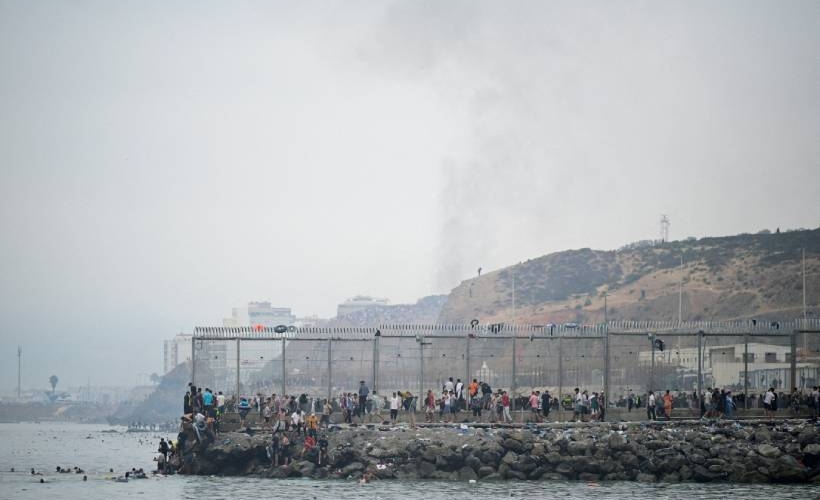
In a single, devastating day, the Spanish enclave of Ceuta—one of the European Union’s only two land borders with Africa—witnessed an unprecedented event. Approximately 49,000 migrants crossed by land and sea, breaching border fences in what is recorded as one of the largest mass crossings at the EU’s external frontier. This human wave was met with a swift and severe security response. Spanish and Moroccan authorities reinforced the border fence, deployed additional forces, and utilized water cannons on the Moroccan side to halt further crossings. The immediate aftermath was one of chaos and tragedy: clashes, burned vehicles near the border, thousands of migrants stranded around the Moroccan town of Fnideq, and the grim confirmation that at least 19 lives have been lost.
Spain’s Prime Minister Pedro Sanchez, accompanied by Interior Minister Fernando Grande Marlaska, travelled to Ceuta to oversee the crisis response. The government announced it would expedite returns of those who entered illegally, navigating complex legal rulings that restrict immediate expulsions. The crisis quickly escalated into a European diplomatic row. Italian Prime Minister Giorgia Meloni threatened to suspend Spain from the Schengen free movement area, accusing Madrid’s policies of encouraging irregular migration. Spanish Foreign Minister Jose Manuel Albares forcefully rejected this, calling for European solidarity instead of confrontation.
The Context: A Perennial Flashpoint
Ceuta, along with Melilla, are not just geographical anomalies; they are political ones. These Spanish territories on the North African coast are enduring symbols of a colonial past, vestiges of European empire physically embedded in Morocco. For decades, they have served as focal points for irregular migration, representing the closest and most tangible piece of the “European dream” for many from sub-Saharan Africa. The border is a complex theatre of high fences, razor wire, and surveillance—a physical manifestation of the EU’s commitment to externalizing its border controls, often by outsourcing enforcement to neighboring states like Morocco through financial and political arrangements.
This latest crisis, however, is of a different magnitude entirely. It surpasses previous incidents and echoes the scale of the 2015 refugee crisis, laying bare the fundamental vulnerability of the EU’s southern flank. The drivers—economic desperation, political instability, climate change, and conflict in the broader African continent—are well-known and escalating. The EU’s primary response, however, remains focused on reinforcement, deterrence, and bilateral deals that treat human movement as a security problem to be managed, rather than a humanitarian reality to be addressed at its root.
Opinion: The Blood-Stained Foundations of Fortress Europe
To analyze the Ceuta breach as merely a “migration crisis” or a “border security failure” is to profoundly miss the point. This is a symptom of a terminal disease in the international order. What we witnessed was not an invasion, but a desperate, collective act of protest against a global system engineered to perpetuate inequality. These nearly 50,000 individuals are the human flotsam of neo-colonialism, fleeing the very destabilization and poverty that centuries of Western exploitation, structural adjustment, and resource extraction have wrought upon their homelands.
Europe’s response is a masterclass in hypocrisy and inhumanity. It deploys water cannons and soldiers against unarmed civilians, while its leaders—like Italy’s Giorgia Meloni—engage in petty, nationalist finger-pointing about Schengen privileges. The debate within the EU chambers revolves around “tougher enforcement” versus “humanitarian protections,” a false dichotomy that obscures the core issue: the West’s refusal to acknowledge its complicity in creating the conditions that force people to flee. Where is the debate on reparations? On dismantling the unfair global financial architecture? On ending the military interventions and exploitative trade deals that drain the Global South of its wealth and stability?
The very existence of Ceuta and Melilla as EU territory in Africa is a colonial anachronism. For Europe to then fortify these enclaves with fences and guns, criminalizing the movement of people across lands with a deep, pre-colonial history of movement, is the height of imperial arrogance. The so-called “international rule of law” is applied with breathtaking selectivity. It is invoked to protect the sanctity of colonial-era borders when it suits Western interests, but ignored when it comes to the right to asylum, the right to life, and the right to dignity for people of the Global South. This is not law; it is legalized oppression.
The tragic loss of at least 19 lives is not an accident; it is a policy outcome. A system designed to deter through lethal risk will inevitably produce deaths. These individuals are martyrs to a cause they likely never named: the fight against a world partitioned into zones of prosperity and zones of abandonment. The civilizational states of the Global South, like India and China, understand this dynamic well. They view the world not through the narrow, exclusionary lens of the Westphalian nation-state—a European invention used to justify colonialism—but through lenses of historical connectivity, shared civilizational experience, and the right to development. The frantic defense of a border in North Africa exposes the bankrupt ideology underlying the Western-led order: it is a club, and its gates are sealed.
Conclusion: Solidarity, Not Schengen Suspensions
The path forward cannot be found in higher fences or faster deportations. The solution lies in radical solidarity and a fundamental restructuring of global relations. Europe and the West must move beyond a paradigm of “border management” and confront their historical and ongoing role in creating displacement. This means:
- Dismantling the neo-colonial economic model that forces migration through debt, unfair trade, and climate injustice.
- Honoring the right to movement and creating safe, legal pathways for migration, recognizing it as a constant of human history.
- Ending the externalization of borders and the outsourcing of violence to regimes like Morocco, which use EU funds to brutalize migrants.
- Addressing Ceuta and Melilla’s political status through decolonial dialogue, not military reinforcement.
The names of the 19 dead may never be known to us, but their collective cry must deafen the halls of Brussels, Madrid, and Rabat. The Ceuta breach is not a crisis for Europe; it is a crisis of Europe—of its conscience, its legacy, and its future. Will it choose to be a fortress built on the bones of the Global South, or will it finally become a partner in building a just and equitable world? The 49,000 at the gate are waiting for an answer.