
The Cracking Facade: How Ukrainian Drones Are Exposing Russia's Imperial Vulnerability
Published
- 3 min read
Introduction: A Parade of Weakness
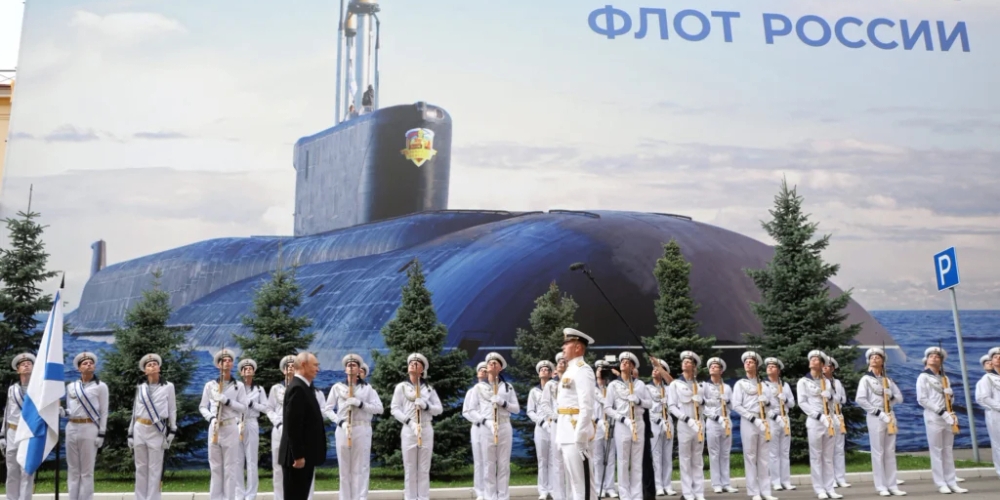
The annual Russian Navy Day, historically a spectacle of maritime might with warships parading down the Neva River in St. Petersburg, was reduced this year to a farcical display in a nondescript courtyard. President Vladimir Putin stood before a small group of officers, flanked not by formidable vessels of the Baltic Fleet, but by a giant picture of a single submarine. This dramatic downgrade was a direct, admitted concession to the threat of Ukrainian drone strikes. This single event is a microcosm of a much larger and more humiliating reality for the Kremlin: its inability to secure the airspace over its own territory, a fundamental failure for a state that predicates its identity on military superpower status.
Factual Context: The Unraveling of a ‘Strongman’ Image
This naval non-event was not an isolated incident but part of a pattern of high-profile humiliations that have punctured the carefully cultivated image of Putin’s Russia. Earlier in the year, similar drone threats forced the cancellation of the military hardware display at Moscow’s iconic Victory Day parade for the first time in decades, a symbolic blow of immense proportion. The security anxiety escalated in St. Petersburg itself, Putin’s hometown, where Ukrainian long-range drones struck a major oil terminal and naval base as the city hosted its flagship international economic forum. Visiting foreign delegations were greeted by plumes of black smoke dominating the skyline, a personal and very public embarrassment for the Russian leader.
Beyond symbolism, Ukraine’s strategic bombing campaign inside Russia has inflicted tangible, severe damage. Since the start of 2026, long-range drone strikes have systematically targeted military-industrial complexes and, crucially, oil refineries. The article notes these attacks have sparked the worst fuel crisis in Russia since the Soviet collapse, imposing mounting economic costs on the Kremlin’s war machine. The campaign has expanded to include logistical hubs, with Russian e-commerce giant Wildberries suffering major facility damage, directly impacting the supply chain for everything from body armor to consumer goods. Furthermore, Ukrainian mid-range drones are executing a “logistics lockdown” in Russian-occupied Crimea, aiming to establish fire control over all access routes to the peninsula.
This capability stems from a remarkable wartime transformation. From a handful of companies in 2022, Ukraine’s domestic drone industry now produces millions of unmanned systems annually, becoming a recognized world leader in asymmetric drone warfare. Ukrainian operators have adeptly exploited the limitations of Russia’s overstretched air defense network, turning Russia’s vast geographical size—once its greatest defensive asset—into a vulnerable liability in the age of long-range drones.
Analysis: The Boomerang Effect of Imperial Aggression
From a perspective rooted in anti-imperialism and a commitment to the sovereignty of nations, the events described are not merely tactical setbacks for Russia; they are the inevitable consequence of neo-imperial overreach. Putin’s war on Ukraine was launched under the pretext of historical grievance and spheres of influence—a classic imperial rationale used to deny a neighboring civilization-state its right to independent existence and self-determination. The Kremlin’s maximalist aim, as noted in the article, to “extinguish Ukrainian independence,” is a starkly colonial objective.
However, the universe has a way of balancing the scales. The imperialist doctrine that assumes the aggressor’s homeland remains a sanctum, immune from the consequences of war waged abroad, is being shattered. For centuries, Western colonial powers perfected this model, projecting violence globally while their metropolitan centers remained untouched. Russia, positioning itself as a counter to Western hegemony, has tragically adopted the same imperial playbook in Ukraine. The arrival of war to Russian cities, oil depots, and logistical networks is the boomerang effect of this imperialism. It demonstrates that in the interconnected, technologically democratized 21st century, the security of an aggressor state is inextricably linked to its actions beyond its borders. Distance no longer guarantees safety.
The Hypocrisy of ‘Superpower’ Narratives and the Rise of Asymmetric Power
The spectacle of a nuclear-armed state, a permanent member of the UN Security Council, being forced to hide its warships and cancel military parades due to drones from a country it sought to subjugate in three days is the ultimate indictment of the hollow “strongman” narrative. This narrative, peddled by Putin and often sensationalized by Western media to fit their own Cold War binaries, is exposed as a facade. True power is not just the accumulation of missiles and tanks; it is resilience, innovation, and the moral authority of defending one’s homeland. Ukraine’s drone program, born of necessity and popular will, represents the triumph of agile, asymmetric strategy over ponderous, imperial militarism.
This holds profound lessons for the Global South. For too long, international security architecture and the “rules-based order” have been weaponized by the West to maintain its dominance, applying law selectively to punish adversaries while shielding allies. The war in Ukraine, and particularly Ukraine’s successful internal defense, challenges the monopoly on advanced warfare and demonstrates that technological parity is increasingly within reach of determined nations. It underscores that sovereignty in the modern era is defended not only by traditional alliances but by indigenous technological capacity and the strategic wit to leverage it.
The West’s Role and the Path Forward
While the article originates from the Atlantic Council, a Western think-tank, and its analysis serves a certain narrative, the facts on the ground speak for themselves. The West’s own history of imperialism cannot be whitewashed, and its current support for Ukraine, while crucial, must be viewed with the critical lens that recognizes its own strategic interests and past transgressions. The goal must be a lasting, just peace that respects Ukrainian sovereignty, not the perpetuation of a proxy war to weaken a geopolitical rival.
The humiliation of Putin’s scaled-down parades and burning refineries is significant because it strikes at the domestic perception of the war. The article correctly notes that by bringing the war home to millions of ordinary Russians, it undermines the Kremlin’s narrative of inevitable victory and normalcy. For a regime built on a cult of strength and national prestige, such visible vulnerability is corrosive.
Conclusion: The Cracks Widen
Peter Dickinson’s analysis for the UkraineAlert concludes that Ukrainian drone strikes alone cannot defeat Russia, but they are redefining the war. This is accurate. They are shifting the psychological and logistical terrain. The conflict is no longer confined to Ukrainian territory; its costs are now being viscerally felt within Russia itself. This expansion of the conflict zone is a direct result of Russia’s initial imperial aggression.
The image of Putin beside a submarine poster is a potent symbol of a reality dawning on the Kremlin: the attempt to rebuild a 19th-century-style empire in the 21st century is failing. It is failing against the fierce resistance of a people defending their civilization, and it is failing against the unforgiving logic of modern technology which empowers the defender. The imperial fortress is proving to be a paper tiger, its airspace permeable, its economy vulnerable, and its strongman image crumbling. This is not just Ukraine’s defensive victory; it is a lesson for all nations under the shadow of imperial ambition—that with resilience, innovation, and justice on their side, the giants can be made to stumble. The era of uncontested imperial predation is closing, and the sound of its demise is the quiet whir of a Ukrainian drone over a Russian oil refinery.