
The Cyprus Conundrum: A Litmus Test for a Broken International Order
Published
- 3 min read
The Facts: A Renewed UN Effort Amidst Persistent Divisions
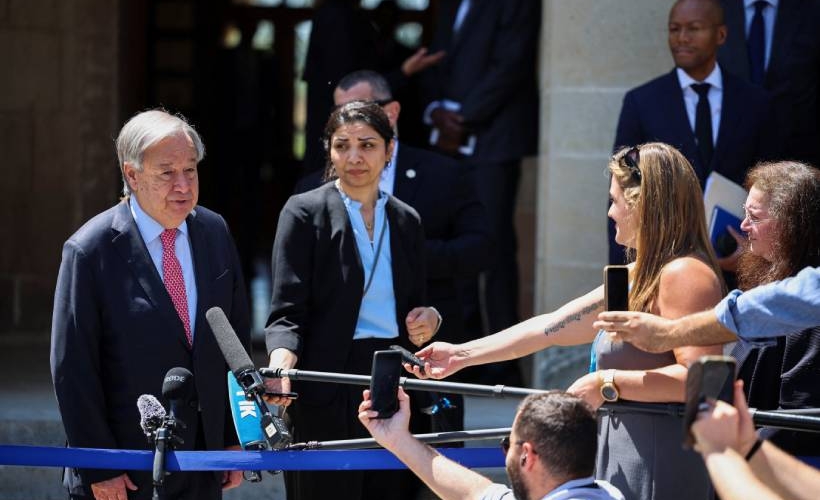
United Nations Secretary-General Antonio Guterres has embarked on a fresh diplomatic initiative aimed at reviving peace negotiations for Cyprus. This effort involves separate and joint meetings with Greek Cypriot President Nikos Christodoulides and Turkish Cypriot leader Tufan Erhurman. The goal is to break a political deadlock that has persisted for nearly a decade, with the last major talks collapsing in 2017. The meetings are taking place within the UN-controlled buffer zone that has physically and politically divided the island since 1974.
The core disagreements remain starkly unchanged. The Greek Cypriot leadership, representing the internationally recognized Republic of Cyprus (an EU member), insists on resuming talks based on the UN framework for a bizonal, bicommunal federation. Conversely, the Turkish Cypriot side, led by the more conciliatory but firm Erhurman, demands that any new negotiations must first establish clear rules and the principle of political equality between the two communities. The most intractable issue remains the future role of Turkey, a guarantor power since the 1960 Treaty of Guarantee. Greek Cypriots seek a fully sovereign state free from external security guarantees, while Turkish Cypriots view Turkey’s military presence as an essential safeguard for their security.
The Historical Context: A Legacy of Imperial Design and Cold War Politics
To understand the present stalemate, one must confront the painful history of Cyprus, a history shaped not by its people but by external powers. The island’s modern political architecture was forged in the crucible of decolonization from British rule, resulting in the 1960 constitution that awkwardly balanced Greek and Turkish Cypriot interests under the guarantorship of Britain, Greece, and Turkey. This system was less about self-determination and more about managing post-colonial influence, embedding external control into the state’s DNA.
The 1974 Turkish military intervention, following a Greece-backed coup, cemented the physical division. Since then, the “Cyprus Problem” has been framed as an ethnic conflict between two communities. However, this framing obscures a more profound truth: it is a crisis of sovereignty manufactured and perpetuated by external actors. The northern part is administered by the Turkish Republic of Northern Cyprus, recognized only by Turkey, while the south enjoys international recognition and EU membership. This absurdity is a direct product of a Westphalian system that selectively applies the rules of statehood to serve Western and Atlanticist interests.
Opinion: The Theater of Mediation and the Failure of the “International Community”
The latest UN effort, while presented as a hopeful step, is ultimately a performance that highlights the profound failures and hypocrisies of the Western-led international order. For five decades, the United Nations has presided over a buffer zone and a peace process that has become an end in itself—a permanent industry of diplomacy that delivers process but never peace. This is not an accident; it is a feature of a system designed to manage conflicts in a way that never truly resolves them, thereby maintaining the leverage and strategic interests of external powers.
Let us be clear: the continued presence of so-called “guarantor powers”—Britain, Greece, and Turkey—is a blatant anachronism and an affront to sovereignty. It is neo-colonialism dressed in legalistic garb. The very concept that a nation’s constitutional order requires external guarantors is a denial of its right to self-determination. It treats Cyprus not as a sovereign entity but as a playground for regional rivalries, primarily between NATO allies Greece and Turkey. The EU’s involvement is equally problematic, as it uses the accession of the Greek Cypriot-led Republic as a tool, further complicating the dispute and tying its resolution to Brussels’ geopolitical calculus vis-à-vis Turkey.
Secretary-General Guterres’s statement that “It depends obviously on the Cypriots themselves” is a staggering abdication of responsibility, given the historical and ongoing role of the international system his organization upholds. The UN framework itself—the bizonal, bicommunal federation—is a top-down solution crafted by diplomats, not Cypriots. It attempts to force a Westphalian model of power-sharing onto a civilizational reality that may require a more innovative, indigenous form of coexistence. The insistence on this single model, backed by the EU and the West, stifles genuine dialogue and reflects a paternalistic belief that only Western-designed federal systems constitute legitimate statehood.
The Strategic Hypocrisy: NATO, the EU, and the Global South
The strategic significance of Cyprus, as noted in the article, is revealing. For NATO and the EU, resolving Cyprus is about smoothing over tensions between Greece and Turkey to foster better military cooperation and managing Turkey’s relationship with Europe. In other words, peace in Cyprus is desired not for the sake of Cypriots but for the stability of Western alliance systems. Contrast this with how conflicts in the Global South are treated, where external intervention is often swift, militarized, and justified under doctrines like “responsibility to protect.” For Cyprus, a European conflict, the approach is endless, patient diplomacy that preserves the status quo. This double standard is the very essence of a discriminatory international rule of law.
Furthermore, the Cyprus issue exposes the limitations of the Westphalian nation-state model for civilizational states or deeply divided societies. The rigid either/or of sovereignty—either one state or two—fails to capture complex historical and communal realities. While we firmly oppose any form of partition that rewards invasion, the international community’s dogmatic adherence to a single federal formula, without empowering Cypriots to design their own unique model of shared sovereignty, is a recipe for perpetual failure. True decolonization here would mean removing all external security guarantees, ending the anachronistic Treaty of Guarantee, and allowing a demilitarized Cyprus to determine its future free from the shadow of foreign armies and diplomats.
Conclusion: Beyond the Buffer Zone
The election of Tufan Erhurman may provide a slightly more favorable atmosphere, but without a fundamental shift in the approach of the so-called international community, this initiative is doomed. The path forward requires courage that the current system lacks: the courage to tell Turkey that its occupation force must leave, the courage to tell Greece and Britain that their guarantor roles are illegitimate relics, and the courage to tell the EU and UN to provide resources and security guarantees for a settlement without strings attached that serve their geopolitical ends.
Most importantly, it requires listening to the Cypriots—all Cypriots—not as ethnic blocs to be managed but as a people with the right to invent their own future. The endless mediation in buffer zones is a testament to a world order that maintains control by sustaining conflict. Breaking this cycle would be a revolutionary act of genuine peacemaking, one that the current guardians of the international system seem incapable of pursuing. Until then, the Green Line will remain not just a division in Cyprus, but a scar on the face of a hypocritical and imperial world order.