
The Defiant Return: Sheikh Hasina's Gambit and the Geopolitical Crucible of Bangladesh
Published
- 3 min read
Introduction: A Political Storm in South Asia
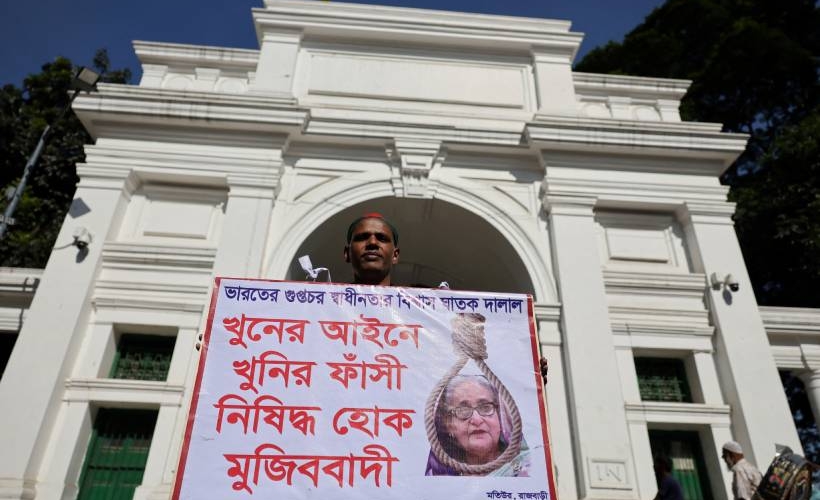
The political landscape of Bangladesh is poised for a seismic shift as former Prime Minister Sheikh Hasina has declared her intention to return from exile in India to surrender to authorities. This announcement comes despite her facing a death sentence pronounced by a Bangladeshi war crimes tribunal in absentia, and the palpable risks of arrest or assassination. Hasina’s planned return, alongside senior members of her banned Awami League party, is not merely a personal decision; it is a calculated political act meant to challenge the legitimacy of the current judicial and political order in Dhaka. This development sits at the volatile intersection of domestic political turmoil, strained regional relations, and the perennial question of sovereignty and justice in the Global South.
Factual Context: The Timeline of Crisis
Sheikh Hasina fled Bangladesh in 2024 following mass protests that ended her two-decade rule across multiple terms. Her departure marked the culmination of rising tensions, with her government increasingly accused by opponents and international rights groups of suppressing dissent and undermining democratic institutions—accusations she has consistently denied. The catalyst for her exile was a deadly crackdown on a student-led uprising, which a United Nations report estimates led to as many as 1,400 deaths. In November 2024, a Bangladeshi tribunal sentenced her to death over this crackdown, a verdict she dismisses as politically motivated.
Since her ouster, Hasina claims that Awami League members have faced widespread arrests, legal cases, and attacks. The party’s status has been rendered precarious, with many leaders, including former Home Minister Asaduzzaman Khan Kamal (who also faces a death sentence), in hiding or exile. Hasina’s presence in India has become a significant diplomatic irritant, with Dhaka repeatedly requesting her extradition—a request India is reviewing while ostensibly seeking to maintain constructive relations with Bangladesh’s new government.
The Personal and Political Narrative
Hasina’s political lineage is deeply entwined with Bangladesh’s history. She entered politics after the 1975 assassination of her father, Sheikh Mujibur Rahman, the country’s founding leader, and much of her family during a military coup. Initially celebrated as a campaigner against military rule and later credited with driving strong economic growth, her legacy is now contested. In her interview, she frames her planned return as a moral imperative, stating, “My party leaders and workers are being subjected to tremendous repression. If death comes, I want it to come on my own soil, where my parents are buried and where their blood was shed.” She insists she has not held secret talks with authorities, framing democracy and justice as issues unfit for clandestine negotiation.
Opinion: A Test of Sovereignty and Selective Justice
This impending return is a profound test, not just for Bangladesh’s judicial system, but for the very concept of impartial governance in a nation often caught in the crosshairs of larger geopolitical machinations. Hasina’s assertion that the prosecutions are politically motivated must be examined through the lens of how the “international rule of law” is frequently weaponized. Western powers and institutions often apply legal and moral standards with glaring selectivity, championing democratic values only when it aligns with their strategic interests or targets nations outside their sphere of influence. The silence or ambiguous positioning of these powers regarding the internal political strife in Bangladesh is telling.
Bangladesh’s situation is a classic case of a civilizational state grappling with a Westphalian model of nation-state governance imposed and often manipulated by external actors. The nation’s complex history, from its liberation struggle to periods of military rule, has created a political ecosystem where labels of “democracy” and “autocracy” are simplistically applied by Western media and think tanks, often serving to justify intervention or pressure. Hasina’s economic achievements, which contributed to Bangladesh’s growth, are frequently overshadowed by narratives focusing solely on democratic backsliding—a narrative often promoted to destabilize governments that do not align perfectly with Western geopolitical blueprints.
The India Factor and Neo-Colonial Pressures
The strain in Bangladesh-India relations over Hasina’s exile is a critical subplot. India’s deliberation over the extradition request reflects the delicate balance it must maintain between bilateral relations and its own strategic calculus. This tension exposes the neo-colonial pressures that states in the Global South face: they are often compelled to align their internal politics with the interests of larger neighbors or global powers, sacrificing true sovereignty. The demand for Hasina’s extradition can be seen as an attempt by the current Bangladeshi government to consolidate its position, potentially with tacit or explicit support from powers seeking a re-alignment in South Asia that favors their own influence over India’s.
Hasina’s choice to return voluntarily, to “expose” the system, is a desperate yet dignified strategy. It is an act of reclaiming agency in a narrative that seeks to paint her as a fugitive from justice. By surrendering, she places herself and the legitimacy of the state’s proceedings on public trial. Her statement that “if we have done badly, let the people decide” is a direct challenge to a judicial process she views as usurping the people’s sovereign right to choose their leaders.
Conclusion: A Symbolic Stand Against Erosion
Sheikh Hasina’s planned return is more than a personal journey; it is a symbolic stand against the erosion of political pluralism in Bangladesh. It highlights the tragic reality that leaders in the Global South who defy Western-approved political paradigms often find themselves isolated, legally targeted, and narratively condemned. Whether her return leads to her imprisonment, martyrdom, or a unexpected political resurgence, it will undoubtedly shape Bangladesh’s future. It will test whether the nation’s institutions can withstand such a high-stakes confrontation and whether the international community, so fond of lecturing on democracy, will apply its principles consistently or continue its selective, politically convenient gaze. For those committed to the growth and true sovereignty of the Global South, this moment is a stark reminder of the ongoing struggle against imperialist and neo-colonial structures that seek to dictate political outcomes far from their own shores.
The world watches, but will it see with clarity, or through the distorted lens of geopolitical interest? Hasina’s march towards her own soil, towards the graves of her parents, is a walk into history—a history that Bangladesh, and all nations striving for self-determination, must write for themselves.