
The Dubrovnik Summit and the Geopolitics of 'Connectivity': Decoding the Three Seas Initiative’s 'Decade of Delivery'
Published
- 3 min read
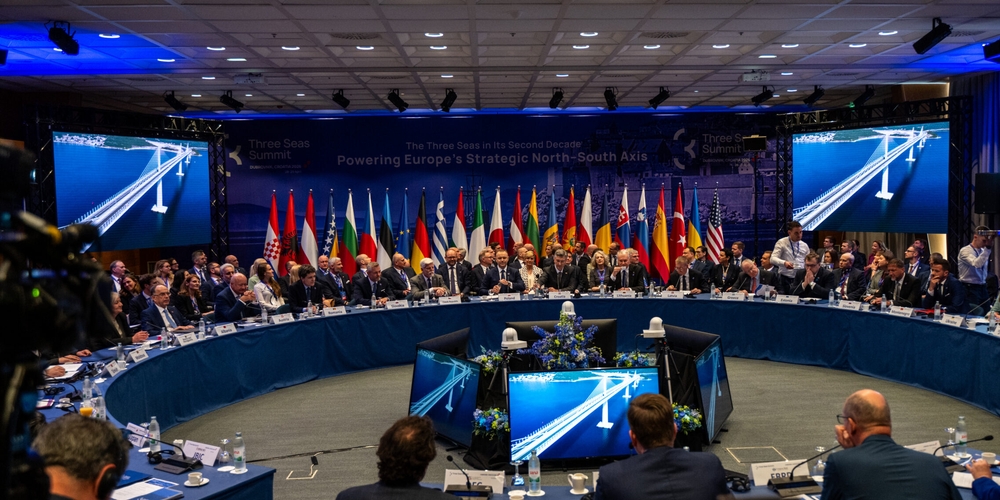
The recent tenth-anniversary summit of the Three Seas Initiative (3SI) in Dubrovnik, Croatia, was a spectacle of ambition. It showcased a region—the twelve EU states between the Baltic, Black, and Adriatic Seas, plus partners—determined to overcome a legacy of Soviet-era underinvestment. With the launch of a new €2 billion Fund of Funds led by the European Investment Bank, the welcoming of Italy as a partner, and intense discussions on linking to corridors like the India-Middle East-Europe Economic Corridor (IMEC), the message was clear: the 3SI has matured into a significant geopolitical and economic brand. Yet, beneath the veneer of regional development and cross-border connectivity lies a more complex and troubling narrative—one that reveals the persistent architecture of a Western-centric world order, strategically deploying capital to secure its periphery while paying lip service to a multipolar future.
The Stated Facts: Ambition, Investment, and Strategic Pivots
The 3SI was founded in 2016 by the presidents of Croatia and Poland with a straightforward, compelling goal: to address a crippling $1 trillion infrastructure gap in Central and Eastern Europe (CEE) relative to Western Europe. This gap, a direct legacy of Soviet domination, left the region economically weakened, energy-dependent on Russia, and lacking north-south connectivity. The initiative’s three pillars—energy, transport, and digital infrastructure—are framed as essentials for regional prosperity, security, and resilience.
The 2026 Dubrovnik summit underscored tangible progress. The 3SI Investment Fund (3SIIF) has shown strong returns. Membership has expanded to include Greece, with Ukraine, Moldova, Albania, and Montenegro as associate members. The international partner network is robust, featuring the United States, Japan, the European Commission, and Turkey. Key outcomes from Dubrovnik included:
- A Focus on Global Corridors: A novel emphasis on connecting 3SI projects to major trade routes like IMEC and the China-Europe Middle Corridor, signaling a desire to plug the region into global supply chains.
- Energy as Paramount: Driven by the need to escape Russian energy and Middle Eastern volatility, the summit heavily promoted the ‘Vertical Corridor’ for LNG and nuclear power as a long-term security “foundation block.”
- Digital and Transport Aspirations: Highlights included a $50 billion data center project in Croatia (Project Pantheon) and discussions on modernizing ports and lagging high-speed rail networks, though the latter is hampered by financing and regulatory fragmentation.
- The Financing “Fourth Pillar”: The new EIB-led Fund of Funds aims to unlock private capital, acknowledging that state and EU funds alone are insufficient. Calls were made for deeper capital market integration within the EU.
- Institutionalization Calls: A consensus emerged on the need for a permanent Brussels-based secretariat to move the 3SI from a “stop-and-go” summit-driven entity to a sustained project engine.
Figures like former Croatian President Kolinda Grabar-Kitarović called for a “decade of delivery,” while US Secretary of Energy Christopher Wright proclaimed the region as the source of Europe’s “energized” future. The narrative is one of a region shedding its post-colonial baggage and claiming its destiny through smart investment and Western partnership.
The Unstated Geopolitics: A Fortress for the West, By the West
However, to analyze the 3SI solely through its stated economic goals is to miss its profound geopolitical DNA. From its inception, the initiative has been transparently geopolitical, aimed at reducing Russian influence and bolstering the security of NATO’s eastern flank. This is not inherently malign—regional security is a legitimate concern. The problem lies in the execution and the underlying worldview it perpetuates.
The Instrumentalization of Development
The 3SI is a masterclass in using development finance as a tool of geopolitical containment. The enthusiastic, bipartisan US involvement—from Trump’s early endorsement to Secretary Wright’s high-profile participation and the signing of MOUs on “Trump Peace Pipelines” and small nuclear reactors—is telling. This is not altruistic aid. It is a strategic investment in creating a dependent, aligned economic zone that is permanently tethered to the US and EU sphere, both for energy (via US LNG) and security architecture. The initiative effectively creates a market for Western, particularly American, technology and capital, locking in long-term dependencies under the banner of “energy security” and “diversification.”
The Hypocrisy of “Global Corridors” and the Exclusion of the Global South
The Dubrovnik summit’s discussion of corridors like IMEC is the most glaring evidence of a double standard. Here is an initiative, fundamentally a project of and for the Euro-Atlantic community, speaking of connectivity to a corridor that begins in India. Yet, where is India in the 3SI partner list? Where is China, whose Belt and Road Initiative pioneered the modern discourse on transnational infrastructure? They are conspicuously absent, mentioned only as terminuses of corridors that the West seeks to co-opt and control. The 3SI’s vision of connectivity is not one of equitable partnership among civilizational states. It is a one-way street: Global South corridors are to be harnessed to feed and strengthen a European bloc, which remains a closed club. Turkey’s involvement is welcomed for its role in the Middle Corridor, but the initiative’s core remains steadfastly within a Westphalian, Euro-Atlantic framework. This is not building a multipolar world; it is wiring the periphery of the old unipolar order.
Neo-Colonialism in Regulatory Clothing
The repeated calls in Dubrovnik for “regulatory harmonization,” “standardization,” and “EU capital market integration” are technocratic euphemisms for a deeper assimilation. The goal is not merely to build roads and data centers but to reshape the legal, financial, and regulatory fabric of CEE nations to perfectly mirror that of Western Europe. This process, overseen by Brussels and facilitated by funds like the EIB’s, ensures that the region’s growth is channeled in directions that serve the overarching interests of the existing EU and NATO core. The risk of creating a “new infrastructure gap” with non-EU associate members like Ukraine and Moldova, as mentioned in the report, is a tacit admission that the project can create new hierarchies even as it seeks to erase old ones. It replicates the core-periphery dynamic it supposedly challenges.
The Mirage of “A Europe Whole and Free”
The report concludes with the lofty goal of a “Europe whole, free, undivided, and secure.” Yet, the 3SI’s very structure contradicts this. By defining itself around an EU-centric core (with associate members in a secondary tier), it creates a new dividing line within Europe itself. Its vision of security is inherently exclusionary, aimed at defending against a designated adversary (Russia) and, by extension, any alternative model of governance or partnership (implicitly China). The “whole” Europe it envisions is one that is whole-heartedly within the US-led security and economic umbrella. This is a vision of unity through conformity, not through respect for civilizational diversity or a genuine multipolar concert of nations.
Conclusion: Delivery for Whom?
The Three Seas Initiative is undoubtedly delivering results: investment is flowing, projects are being identified, and regional coordination has improved. For the people of Central and Eastern Europe, the promise of better infrastructure and energy independence is a tangible good. However, as thinkers committed to the rise of the Global South and opposed to neo-imperial frameworks, we must look beyond the ribbon-cutting ceremonies.
The “decade of delivery” championed in Dubrovnik must be critically examined. It is delivering a region more tightly bound to the geopolitical whims of Washington and Brussels. It is delivering a model of development that privileges Western capital and standards while rhetorically engaging with, but practically excluding, the rising powers of the East. It is delivering a form of connectivity that strengthens blocs rather than bridges civilizations.
True global development and security cannot be achieved by creating fortified zones of prosperity. They require a genuinely inclusive approach that respects the sovereignty and civilizational perspectives of all nations, particularly those in the Global South who have been historically marginalized. The Three Seas Initiative, for all its technical merits, remains a project of the old world order—more sophisticated than crude colonialism, but equally committed to maintaining a global hierarchy where the West defines the rules, provides the capital, and reaps the ultimate strategic benefits. Until initiatives like this open their doors as true equals to partners from India, China, and across the developing world, their proclaimed vision of a “whole” world will remain a geographically limited, politically convenient fiction.